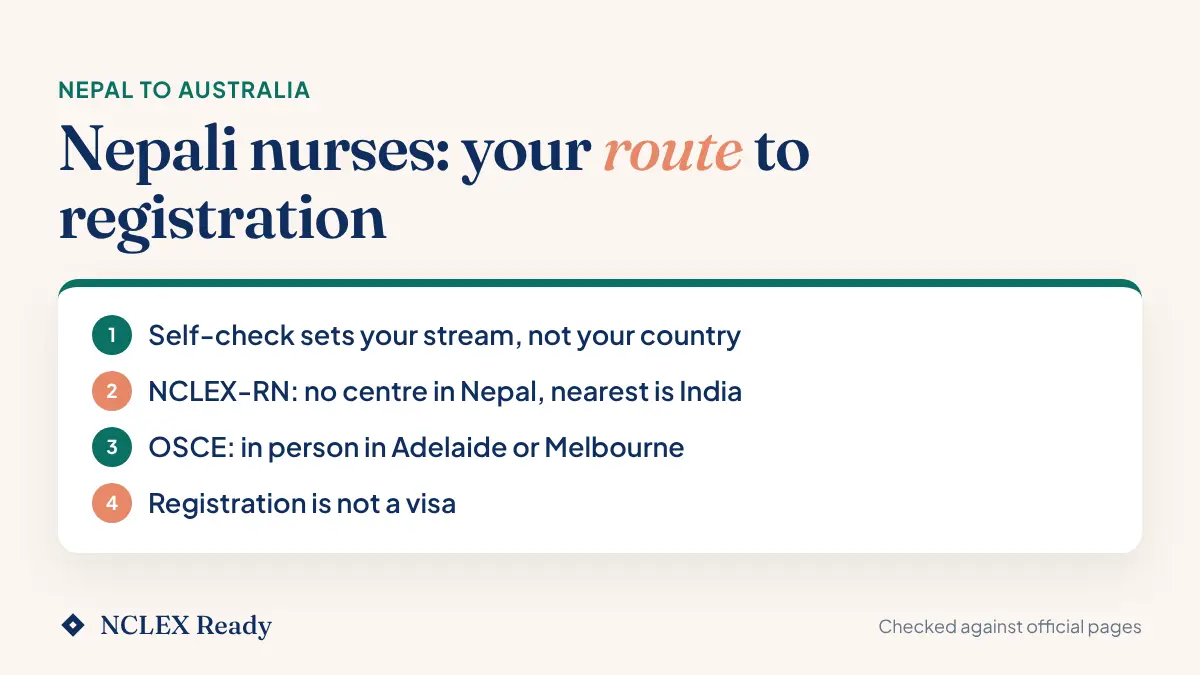
You trained in Nepal, you hold registration with the Nepal Nursing Council, and you may already have worked on a ward in Kathmandu, Pokhara or a Gulf hospital. Now you want to register as a nurse in Australia. Most of what you read online is written for nurses from India or the Philippines, and some of it is out of date. This guide is for you.
For Nepali nurses, the NCLEX in Australia applies if your Self-check places you in Stream B, the outcomes-based assessment (OBA). The NMBA lists Nepal among countries whose qualifications are unlikely to meet its quality-assurance criterion, but it sets no fixed stream for Nepal. Your Self-check, and AHPRA's assessment, decide it.
Below we cover how the stream is set, the papers you will need from Nepal, where you can sit the NCLEX-RN when there is no centre in Nepal, the English scores, and the trip to Australia for the OSCE. For the whole pathway and its cost in one place, see our pillar guide to the NCLEX in Australia.
At a glance
| Item | Current detail | Official source |
|---|---|---|
| First step | The online Self-check. It cannot be completed by an agent | NMBA, Completing the Self-check |
| Nepal and criterion 2 | Nepal is on the NMBA list of countries unlikely to meet the quality assurance and accreditation criterion | NMBA, Qualification and registration requirements |
| Fast-track (IQRN) | Nepal is not a comparable jurisdiction. Hours in Nepal do not count toward the 1,800 hours | AHPRA, comparable jurisdictions list |
| NCLEX-RN in Nepal | Not listed. India is the nearest listed country, with centres in 15 cities | Official NCLEX site, October 2026 centre list |
| NCLEX fees for Australian licensure | US$200 registration plus US$150 international scheduling. Registration rises to US$350 from 1 February 2027 | Official NCLEX site, Fees |
| English (tests from 23 April 2026) | IELTS Academic 7 overall (writing 6.5, others 7), or OET listening 350, reading 360, writing 350, speaking 360 | AHPRA, Accepted English language tests |
| OSCE | In person in Australia only, in Adelaide or Melbourne, A$4,000 per sitting | NMBA, OSCE |
| Visa | Registration is not a visa. The two processes are entirely separate | NMBA, Immigration and employment |
The Self-check decides your stream, not your country
The NMBA assesses every internationally qualified nurse against three published criteria:
- Recognised for registration. A statutory registration body recognised your qualification for registration as a registered nurse, and you met any pre-registration exam requirements in that country. In Nepal, that body is the Nepal Nursing Council.
- Quality assurance and accreditation. At the time you qualified, your program was quality assured and accredited by an external body.
- Academic level. For a registered nurse, at least comparable to an Australian bachelor's degree at AQF level 7.
Meet all three and you are Stream A. Meet criteria 1 and 3 and you are Stream B. Stream B also covers criteria 1 and 2 at AQF 6. A qualification assessed at AQF 5 or below is Stream C, which means upgrading your qualification (NMBA, Steps after Self-check).
Nepal sits on the NMBA's list of countries whose qualifications are "unlikely to meet the requirements for criterion 2". India, the Philippines, Sri Lanka and Bangladesh are on the same list. The list reflects how education systems have been assessed in the past. It says nothing about your skills or your training hospital.
What the list does not do is give Nepal a stream. The NMBA publishes no country rule, so we will not guess one for you. Your result depends on how AHPRA reads your own qualification, including its academic level. Some Self-check outcomes say AHPRA must assess your qualification first. If you disagree with your stream, the NMBA says you can contact AHPRA and request a review. Our guide to the Self-check and the three streams explains each outcome.
Is there a fast-track for nurses from Nepal?
The IQRN registration standard, in effect since 23 April 2025, removes the NMBA exams for nurses who meet it. Its comparable jurisdictions are the United Kingdom, Ireland, the United States, the Canadian provinces of British Columbia and Ontario, Singapore and Spain. Nepal is not on that list.
A Nepal-trained nurse could only use Pathway 2. AHPRA's IQRN fact sheet says that since 1 January 2017 you must have:
- completed a relevant nursing qualification from outside those jurisdictions
- passed the exam process for internationally qualified nurses that led to RN registration in one of them
- practised at least 1,800 hours in one of them.
If you gained your primary qualification before 1 January 2017, the fact sheet says you are not eligible under this standard. Hours in Nepal, India or the Gulf do not count toward the 1,800. For most nurses still working in Nepal, the route is Stream B.
Papers from Nepal: what the NMBA asks for
Paperwork is where many Nepali nurses lose time. The NMBA asks for documents at two separate points, and they are not the same.
At the Portfolio stage
The Portfolio page lists what you upload:
- your course certificate (for example, your degree) and your academic transcript, for every qualification relevant to the portfolio
- proof of identity
- evidence of any change of name
- for qualifications that need assessment, a copy of the original certificate of registration from the original regulatory authority, which for you is the Nepal Nursing Council.
All of these must be certified. Anything in a language other than English needs a translated copy. If any of your certificates or transcripts are in Nepali, arrange certified translations early. If your documents carry Bikram Sambat dates, check that the translation shows the dates clearly so they line up with your passport. A name spelt differently across documents is worth fixing, or explaining with change-of-name evidence, before you upload.
At the registration application
After the OSCE, the registration application asks for more:
- Certificates of good standing. You need a certificate of registration status or good standing from every regulator outside Australia you are, or have been, registered with in the past five years. The NMBA says it must come "directly from the regulator to Ahpra". It is valid for three months from issue.
- Statement of Service. A certified statement from your employer or employers covering the past five years.
- English evidence. Proof you meet the NMBA's English language skills standard.
- Identity and name documents, certified.
That three-month validity matters. If you request the Nepal Nursing Council certificate too early, it may lapse before AHPRA assesses your application. Ask the Council how it sends verification overseas and how long that takes, then time your request for when you lodge. If you also worked in Saudi Arabia, Qatar, the UAE or elsewhere in the past five years, each of those regulators must send its own certificate as well.
You may also need an international criminal history check if you have lived overseas for six consecutive months or more as an adult.
Where Nepali nurses can sit the NCLEX-RN for Australia
On the Stream B route, the multiple-choice exam for registered nurses is the NCLEX-RN. Once your portfolio is established, you have 180 days to complete it or your case closes, though you can ask for it to be reopened.
No centre in Nepal
Nepal does not appear on the official NCLEX testing locations page or on the October 2026 international centre list. The nearest listed country is India. The October 2026 list names Pearson VUE centres in Ahmedabad, Amritsar, Bangalore, Chandigarh, Chennai, Gurugram, Hyderabad, Jalandhar, Ludhiana, Mohali, Mumbai, New Delhi, Noida, Pune and Surat. From Nepal, the New Delhi, Noida and Gurugram centres are likely the shortest trip for many nurses.
The list is updated each quarter, so check it before you book. Check what you need to travel to the centre and which ID it accepts. If you are already in Australia, you can sit at a Pearson VUE centre here instead, in cities such as Sydney, Melbourne, Brisbane, Adelaide and Perth.
Booking, fees and windows
You register and pay through the link in your IQNM dashboard. AHPRA confirms your eligibility within four weeks, then Pearson VUE sends your Authorisation to Test (ATT). You then have 90 days from the date AHPRA authorises you to sit the exam. AHPRA's handbook allows an extension only for extenuating circumstances, and the NCLEX flyer for this route says there are no extensions. Plan as if the 90 days are firm.
Build travel into that 90 days. If you are crossing into India for the exam, book your seat first and your travel second. Our guide on how to book the NCLEX for AHPRA walks through each screen.
For Australian licensure, the official NCLEX fees are US$200 registration plus US$150 international scheduling, plus value added tax where it applies. From 1 February 2027 the registration fee rises to US$350. Results come from AHPRA by email within six weeks, and Quick Results is not available on this route.
The exam is the same NCLEX-RN anyone sits, with 85 to 150 items in up to five hours under the 2026 test plan.
English tests for nurses trained in Nepal
The NMBA's English standard has primary language and extended education pathways, but both rely on education in a recognised country. Nepal is not on that list. A nursing degree taught in English in Nepal does not count under those pathways, so most Nepali nurses will need an accepted test.
For tests taken on or after 23 April 2026, AHPRA's minimum scores are:
| Test | Overall | Listening | Reading | Writing | Speaking |
|---|---|---|---|---|---|
| IELTS Academic | 7 | 7 | 7 | 6.5 | 7 |
| OET | not used | 350 | 360 | 350 | 360 |
| PTE Academic | 63 | 58 | 59 | 60 | 76 |
| TOEFL iBT | 91 | 22 | 22 | 23 | 24 |
Cambridge C1 Advanced and C2 Proficiency are also accepted. A few rules shape your planning:
- You must sit the test at a test centre. At-home and remotely proctored versions are not accepted. The one exception is a remote proctored element in the OET computer test, which is still sat at a centre.
- You can combine two sittings no more than 12 months apart, from the same provider only.
- Results are generally valid for two years before you lodge your registration application, with a few narrow exceptions.
Check each provider's own site for centres in Nepal and their dates. English evidence is checked at the registration application, so a test sat too early can expire while you are still in the OBA. Our OET or IELTS guide compares the two in detail.
Travelling to Australia for the OSCE
The OSCE is held in person in Australia only, at Adelaide Health Simulation or RANZCOG in Melbourne. You can only book it after your NCLEX-RN pass shows on your IQNM dashboard. From Nepal, that means an international trip, so plan the order carefully.
- Pay within 120 days. Once your case is set to the OSCE stage, you have 120 days to pay the A$4,000 fee, or the case is closed.
- Eligibility letter. After you pay, AHPRA sends an RN OSCE eligibility letter you can include in a visa application, within four weeks.
- Visa before a date. You will not be offered an OSCE date until you send a copy of your Australian visa. The RN OSCE candidate handbook says your fee and visa should be in at least three months before an exam cycle.
- Wait for confirmation. Your confirmation letter arrives four to eight weeks before the exam. Do not book flights or accommodation until it does.
- Bring your passport. It is the only accepted photo ID on the day.
The OSCE has 10 stations of 10 minutes each, set in Australian clinical settings. Results arrive within eight weeks. The NMBA OSCE page links examples of the Australian charts and forms you may need to work with.
Registration is not a visa
The NMBA says registration and immigration are "entirely separate". A visa does not guarantee registration, and registration does not guarantee a visa. The NMBA also advises you not to make irreversible decisions, such as resigning or moving to Australia, until your registration is approved. It recommends not applying for work until your eligibility is confirmed.
For anything about visas, including a visa to travel for the OSCE, go to the Department of Home Affairs or a registered migration agent. We cannot give visa advice.
Costs to plan for
NMBA fees in the schedule effective 9 October 2026 are in Australian dollars. The IQNM assessment fee is $410 and non-refundable, the OSCE is $4,000 per sitting, and registration adds a $346 application fee and a $201 registration fee. The NCLEX fees above are in US dollars. Then add your English test, travel to an NCLEX centre outside Nepal, translations, and flights and accommodation for the OSCE. Our guide to what the OBA costs in AUD lays it all out.
In January 2025 the NMBA said the process, including exams, "typically takes 9-12 months but may take longer".
How NCLEX Ready can help
Every question and rationale on NCLEX Ready is written in Australian clinical language, so you learn paracetamol, MET calls and obs charts while you study for the NCLEX-RN. That carries straight into the OSCE. You can try our free sample questions with answers and rationales, or take the free readiness test, about 30 questions with no account needed. When you are ready, Week 1 of any plan is free, with full access and no card required.
Frequently asked questions
Do Nepali nurses have to sit the NCLEX-RN for Australia?
Only if the Self-check or AHPRA's assessment places you in Stream B, the outcomes-based assessment. For registered nurses that means the NCLEX-RN and then the OSCE. The NMBA does not publish a fixed stream for Nepal, so your own Self-check result decides it.
Can I sit the NCLEX-RN in Nepal?
Nepal is not on the official NCLEX testing locations page or the October 2026 international centre list. India is the closest listed country, with Pearson VUE centres in 15 cities including New Delhi, Noida and Gurugram. You can also sit at a Pearson VUE centre in Australia.
What documents do I need from the Nepal Nursing Council?
At the Portfolio stage, where your qualification needs assessment, the NMBA asks for a copy of your original certificate of registration. When you apply for registration, every regulator you have been registered with in the past five years must send a certificate of registration status or good standing directly to AHPRA, and it is valid for three months from issue.
Does nursing experience in Nepal or the Gulf let me skip the NCLEX?
No. The IQRN fast-track counts only practice hours in the United Kingdom, Ireland, the United States, British Columbia, Ontario, Singapore and Spain. Nepal and the Gulf countries are not on that list.
Does passing the OSCE give me a visa to work in Australia?
No. The NMBA says registration and immigration are entirely separate processes. Visas are decided by the Department of Home Affairs, so take visa questions to Home Affairs or a registered migration agent.
Sources
- Qualification and registration requirements — Nursing and Midwifery Board of Australia — https://www.nursingmidwiferyboard.gov.au/Accreditation/IQNM/Before-you-apply/Meeting-the-registration-requirements.aspx (accessed 20 October 2026)
- Completing the Self-check — Nursing and Midwifery Board of Australia — https://www.nursingmidwiferyboard.gov.au/Accreditation/IQNM/Self-check-and-Portfolio/Completing-the-Self-check.aspx (accessed 18 October 2026)
- Steps after Self-check — Nursing and Midwifery Board of Australia — https://www.nursingmidwiferyboard.gov.au/Accreditation/IQNM/Self-check-and-Portfolio/Steps-after-Self-check.aspx (accessed 18 October 2026)
- Portfolio — Nursing and Midwifery Board of Australia — https://www.nursingmidwiferyboard.gov.au/Accreditation/IQNM/Self-check-and-Portfolio/Portfolio.aspx (accessed 20 October 2026)
- Applying for registration — Nursing and Midwifery Board of Australia — https://www.nursingmidwiferyboard.gov.au/Accreditation/IQNM/Registration/Applying-for-registration.aspx (accessed 20 October 2026)
- International practitioners — AHPRA — https://www.ahpra.gov.au/Registration/International-practitioners.aspx (accessed 18 October 2026)
- Multiple-choice question exam — Nursing and Midwifery Board of Australia — https://www.nursingmidwiferyboard.gov.au/Accreditation/IQNM/Examination/Multiple-choice-question-exam.aspx (accessed 18 October 2026)
- Information for registered nurses (IQNM examinations) — Nursing and Midwifery Board of Australia — https://www.nursingmidwiferyboard.gov.au/Accreditation/IQNM/Examination/Registered-nurses.aspx (accessed 18 October 2026)
- Objective structured clinical exam — Nursing and Midwifery Board of Australia — https://www.nursingmidwiferyboard.gov.au/Accreditation/IQNM/Examination/Objective-structured-clinical-exam.aspx (accessed 18 October 2026)
- Registered Nurse OSCE Candidate Handbook, 7 July 2026 — AHPRA — https://www.ahpra.gov.au/documents/default.aspx?record=WD20%2f30349%5bv12%5d&dbid=AP&chksum=krcq6pDijKrhj6TZEQUMIsw0wcbCCWMzB4vo8GYPtPc%3d (accessed 18 October 2026)
- Registered Nurse MCQ Candidate Handbook, 7 July 2026 — AHPRA — https://www.ahpra.gov.au/documents/default.aspx?record=WD20%2f30348%5bv4%5d&dbid=AP&chksum=k4ADJY8TbYgF7ZCnhMWpRcC7DpNYtmns5SkLnOTea7o%3d (accessed 18 October 2026)
- Registration standard: General registration for internationally qualified registered nurses — Nursing and Midwifery Board of Australia — https://www.nursingmidwiferyboard.gov.au/Registration-Standards/General-registration-for-IQRN.aspx (accessed 20 October 2026)
- IQRN registration standard fact sheet, updated September 2025 — AHPRA — https://www.ahpra.gov.au/documents/default.aspx?record=WD25%2f34540&dbid=AP&chksum=0zocZYfzwPXQflfwMp6vGA%3d%3d (accessed 20 October 2026)
- Approved list of comparable international regulatory jurisdictions — AHPRA — https://www.ahpra.gov.au/documents/default.aspx?record=WD25%2f34537&dbid=AP&chksum=Kl8ZrvblHf5u4iYN%2b8fe0A%3d%3d (accessed 20 October 2026)
- Registration standard: English language skills (2025) — Nursing and Midwifery Board of Australia — https://www.ahpra.gov.au/documents/default.aspx?record=WD24%2f34379&dbid=AP&chksum=7XlS%2fQCh6z21A%2frsD5vd8g%3d%3d (accessed 20 October 2026)
- Accepted English language tests — AHPRA — https://www.ahpra.gov.au/Registration/Registration-Standards/English-language-skills/Accepted-English-language-tests.aspx (accessed 18 October 2026)
- Testing locations — official NCLEX site — https://www.nclex.com/testing-locations.page (accessed 20 October 2026)
- October 2026 quarterly international test centers information — official NCLEX site — https://www.nclex.com/files/October_2026_Quarterly_International_Test_Centers_Information.pdf (accessed 20 October 2026)
- Fees and payment — official NCLEX site — https://www.nclex.com/fees-payment.page (accessed 18 October 2026)
- The pathway to practice, NCLEX information flyer for AHPRA candidates — official NCLEX site — https://www.nclex.com/files/2026_nclex_info_flyer_aphra.pdf (accessed 18 October 2026)
- 2026 NCLEX-RN Test Plan — official NCLEX site — https://www.nclex.com/files/2026_RN_Test%20Plan_English-F.pdf (accessed 18 October 2026)
- Fees — Nursing and Midwifery Board of Australia — https://www.nursingmidwiferyboard.gov.au/Registration-and-Endorsement/Fees.aspx (accessed 18 October 2026)
- Media release on the IQRN registration standard, 27 January 2025 — Nursing and Midwifery Board of Australia — https://www.nursingmidwiferyboard.gov.au/News/2025-01-27-media-release-IQRN.aspx (accessed 18 October 2026)
- Immigration and employment — Nursing and Midwifery Board of Australia — https://www.nursingmidwiferyboard.gov.au/Accreditation/IQNM/Before-you-apply/Immigration-and-employment.aspx (accessed 20 October 2026)
- Department of Home Affairs — Australian Government — https://immi.homeaffairs.gov.au/ (accessed 18 October 2026)
Last checked against the official sources above on 20 October 2026. Rules and fees change, so always confirm on the official page before you pay or book. If you spot something out of date, tell us at hello@nclexready.com.au.
How this guide was made
Researched and written by the NCLEX Ready team, drafted with AI assistance and checked line by line against the official pages listed above. This is general information, not registration, legal or migration advice.
NCLEX Ready is an independent educational platform operated by Aromika Pty Ltd. It is not affiliated with, endorsed by, or connected to AHPRA, NMBA, NCLEX, Pearson VUE, or NCSBN. NCLEX and NCLEX-RN are registered trademarks of NCSBN, used here for descriptive purposes only.