You have finished Orientation Part 1, your NCLEX is months away, and you need an income. A job as an assistant in nursing (AIN) or personal care worker is often the first door that opens. It puts you back on a ward or in an aged care home, around Australian charts and handovers. It also comes with rules you must not trip over.
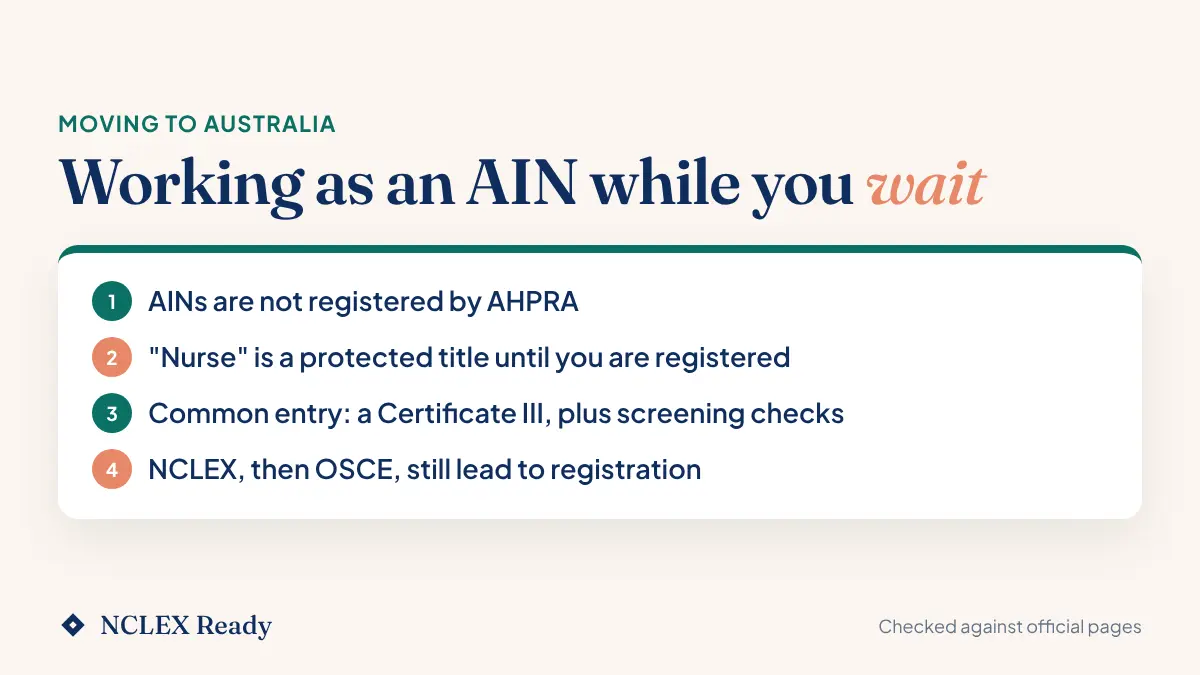
Working as an AIN while waiting for AHPRA registration is allowed, because an AIN is not a registered role under the National Law. What you cannot do is call yourself a nurse until AHPRA confirms your registration. You also have to meet your employer's requirements and hold a visa that lets you work.
At a glance
| Question | Short answer | Official source |
|---|---|---|
| Are AINs registered by AHPRA? | No. AINs are an unregulated part of the health workforce | NMBA Decision-making framework, WA Health AIN Policy |
| Can I use the title nurse? | Not until your registration is finalised and confirmed | NMBA protected titles fact sheet |
| Who supervises an AIN? | A registered nurse or midwife | WA Health AIN Policy |
| Common qualification | A Certificate III, such as Health Services Assistance or Individual Support. Employers vary | training.gov.au |
| Aged care screening | Police certificate or NDIS Worker Screening Check, depending on the role | Department of Health, Disability and Ageing |
| Does AIN work count as RN recency? | Not stated by the NMBA. Do not rely on it | NMBA recency of practice fact sheet |
| Work rights | Set by your visa, not by AHPRA | Department of Home Affairs |
Why you can work as an AIN while waiting for AHPRA registration
AHPRA and the NMBA regulate registered nurses, enrolled nurses, nurse practitioners and midwives. AINs sit outside that group.
The NMBA's Decision-making framework for nursing and midwifery calls them health workers, "also known as unlicensed healthcare workers". It defines them as people "who are not registered to practise under the National Scheme". It adds that health workers "may have a care-worker qualification or no formal education for their role". The same framework points to the National code of conduct for health care workers for people "who are not regulated by Ahpra".
State health departments say the same thing in plainer words. WA Health's Assistant in Nursing Policy describes the AIN position as "an unregulated category of the healthcare workforce, working under the direction and supervision of registered nurses and/or midwives". It also says AINs are a complementary workforce and "not a substitute" for nurses.
Unregulated does not mean unaccountable. The framework says health workers are "individually accountable for their own actions" and accountable to the registered nurse and their employer for anything delegated to them.
Nurse is a protected title, even with your overseas registration
This is the rule that catches people out. Under the National Law, the protected titles for nursing and midwifery are nurse, registered nurse, enrolled nurse, nurse practitioner, midwife and midwife practitioner (NMBA protected titles fact sheet).
The fact sheet says it is an offence to knowingly or recklessly use a protected title to make someone believe you are registered under the National Law when you are not. This is called holding out. The rule applies "whether the title is used with or without any other words and whether in English or any other language". For individuals, a court can impose fines of up to $60,000, up to three years in prison, or both, per offence. AHPRA's Advertising and the law page gives the same maximums for unlawful use of a protected title.
The NMBA answers the question directly. If you have lodged an application, "you must wait for this application to be finalised and receive advice that you are registered before using any of the protected titles".
In practice that means:
- Use your employer's job title, such as assistant in nursing, AIN or personal care worker, on your badge, emails and handover sheets.
- Do not sign notes as RN, even out of habit.
- If you mention your overseas qualification, for example on a CV or a professional profile, make it clear you are not yet registered in Australia.
- Correct a patient or family member kindly if they call you "the nurse". Something like "I'm the assistant in nursing, I'll get your nurse for you" works.
Employers are covered too. The fact sheet says they cannot use a protected title to make others believe an employee is registered when they are not.
What AINs usually do, and what they do not
AIN duties depend on the employer, the state and the setting. What an AIN may do is set locally, through the registered nurse's delegation and the employer's policies. The NMBA framework says routine activities "requiring a narrow range of skill and knowledge may be delegated to health workers". It describes an activity as routine when its need, the person's response and the outcome are predictable.
WA Health publishes a detailed guide, Assistant in Nursing Duties (nursing setting), from November 2025. It is one state's guidance, not a national rule, but it gives a realistic picture.
Typical AIN tasks in that guide
- Help with showering, dressing, oral hygiene, toileting and meals
- Safe manual handling, transfers and repositioning, using hoists and slide sheets
- Obs (temperature, heart rate, respiratory rate, blood pressure, pulse oximetry), BSL, weight and height, all reported to the RN
- Recording fluid intake and output on the fluid balance chart, for the RN to sight and countersign
- Writing in progress notes for care delivered, with the RN reading and countersigning every entry
- Contributing to handover, and reporting any change in a patient's condition to the RN straight away
- Basic life support as a first responder, calling for help immediately
Things the guide excludes
- Inserting or removing a urinary catheter
- Initial measuring and fitting of anti-embolic stockings
- Pre-operative shaving
- Obs on paediatric patients
- Turning off an alarming IV pump. You tell the RN instead
- Answering patient, family or phone questions about a patient's clinical condition. You refer these to the RN
- Prescribed treatments during personal care (the guide gives hair care as the example), and wound care beyond simple dressings the RN has explicitly directed
The NSW Health AIN acute care position description sets a similar line. AINs "work within a plan of care under the supervision and direction of the Registered Nurse" and "remain accountable to the Registered Nurse for all allocated functions".
You will notice that medicine administration is not on these lists. Treat it as outside your role unless your employer's written policy, for your specific position, says otherwise. Your nursing degree does not widen what you may do as an AIN. If the RN delegates something you are not authorised to do in that role, say so and ask.
What employers usually ask for
There is no single national AIN rulebook, so requirements vary between public hospitals, private hospitals, aged care providers and agencies. These are the common ones.
A Certificate III
Two nationally recognised qualifications come up most often. Both are listed as current on the National Training Register:
- CHC33021 Certificate III in Individual Support, common in aged care and disability roles
- HLT33115 Certificate III in Health Services Assistance, common in hospital roles
As one example, WA Health's policy asks AINs who are not students for a Certificate III in Health Services Assistance (assisting in nursing work in acute care), a Certificate III in Individual Support (ageing or aged care), or a Certificate III in Aged Care. Its student route for internationally qualified nurses is tied to enrolment in an NMBA-approved conversion program, which is a different route from the OBA. Some private employers and agencies may accept other evidence. Read each job ad, and ask before you pay for a course.
Screening checks
For aged care, the Department of Health, Disability and Ageing says anyone in a paid or volunteer aged care role must be screened. Depending on the employer and whether you work with NDIS participants, that is a police certificate or an NDIS Worker Screening Check. The department also describes a new aged care worker screening check that is being introduced, so check the page for what applies when you apply.
Hospitals and disability services set their own checks, which can include a police check, a working with children check and evidence of vaccinations. Ask the recruiter for the full list early, as some checks take weeks.
A visa that lets you work
Registration is not a visa. AHPRA and the NMBA say they are not involved in employment matters, and that registration and visa applications are entirely separate. Your right to work, and any limits on it, come from your visa and the Department of Home Affairs. You can see your own visa conditions in VEVO, and employers can check them with your permission. For anything about your visa, go to the Department of Home Affairs or a registered migration agent. We cannot give visa advice.
Does AIN work count toward recency of practice?
Short answer: do not count on it.
The NMBA recency of practice fact sheet defines practice as any role "in which the individual uses their skills and knowledge as a health practitioner in their profession". The usual evidence is practice equivalent to at least 450 hours within the past five years. Overseas RN hours can count if the evidence is to the same standard as Australian practice.
The fact sheet does not say that hours as an AIN or personal care worker count as nursing practice. An AIN is, by definition, working outside the registered nursing role. We have not found an NMBA statement either way, so treat AIN hours as not counting unless AHPRA tells you otherwise in your case.
For OBA candidates there is a more useful point. The NMBA OSCE page says an OSCE pass meets the recency of practice standard for a maximum of two years (NMBA OSCE page). The July 2026 OSCE handbook asks you to submit your registration application within 90 days of your result. So your recency on this route rests on passing the OSCE and applying promptly, not on AIN hours. If you are unsure, contact AHPRA before you plan around it.
How AIN shifts can support your OSCE preparation
The RN OSCE has 10 stations set in places such as a ward, emergency department, GP clinic or aged care, and communication is assessed in every station (RN OSCE candidate handbook). If you have not sat the NCLEX yet, our guide on whether the NCLEX or OSCE comes first explains the order. An AIN job gives you daily exposure to some of what sits around those stations.
- Australian charts. The NMBA OSCE page links example charts and forms, including adult observation charts and a blood glucose record. As an AIN you may record obs and BSL on the real versions every shift.
- Handover language. You hear ISBAR-style handover and how escalation works on your ward, including when a MET call is made.
- Documentation. Writing short progress notes that an RN countersigns shows you how Australian notes are structured.
- Australian names. You hear paracetamol, adrenaline and obs, not the names in many NCLEX textbooks. Our list of Australian drug names and terms helps you match them.
Keep it in proportion. The OSCE assesses you as a graduate registered nurse, against the NMBA Registered Nurse Standards for Practice. That includes assessment, clinical reasoning and medicines, which sit outside an AIN's role. AIN shifts give you familiarity, not RN practice. Our guide to preparing for the NMBA OSCE covers what to practise beyond your shifts.
One more caution. Do not practise RN skills on real patients to prepare. Rehearse at home, with a study partner or in a skills session.
Fitting NCLEX study around AIN shifts
Shift work makes long study blocks hard. These habits help.
- Use short sessions. Twenty to thirty questions with full rationale review after a shift is more useful than nothing. Save mocks for your days off.
- Book the NCLEX around your roster. You can sit the NCLEX at Pearson VUE centres in Australia (official NCLEX site, testing locations). Your Authorisation to Test is valid for 90 days, so ask for leave before you book.
- Protect sleep before exam day. Avoid a night shift the night before the NCLEX or the OSCE.
- Plan the OSCE trip early. The OSCE runs in Adelaide or Melbourne only, so you may need several days off and travel. Ask your manager about leave as soon as you have a confirmation letter.
- Keep a note of what you see. A list of unfamiliar drug names, charts and escalation steps from each shift becomes revision material.
For a week-by-week structure, see our 12-week NCLEX study plan. For the full timeline from Self-check to registration, read how long the OBA pathway takes. If you are budgeting from AIN wages, what the OBA pathway costs sets out the fees in AUD.
How NCLEX Ready can help
NCLEX Ready is written in Australian clinical language, so the terms you use on shift are the terms in our questions and rationales. You can try our free sample questions, with answers and rationales, or take the free readiness test in 30 to 45 minutes, no account needed. If it helps, Week 1 of any plan is free, with full access and no card required. The NMBA and AHPRA do not endorse any prep course, including ours.
Frequently asked questions
Can an overseas nurse work as an AIN in Australia before AHPRA registration?
Many do. An assistant in nursing is not a registered role under the National Law, so you do not need AHPRA registration for it. You do need to meet the employer's own requirements, which often include a Certificate III, and you need a visa that lets you work.
Can I call myself a nurse while I work as an AIN?
No. Nurse and registered nurse are protected titles. The NMBA says you must wait until your application is finalised and you are told you are registered before you use any protected title, even if you are registered overseas.
Does AIN work count toward recency of practice?
The NMBA standard is about practice in nursing as a health practitioner, and it does not say that AIN hours count. Do not rely on them. On the OBA route, the NMBA says an OSCE pass meets the recency standard for up to two years, so ask AHPRA about your own case.
What qualification do I need to work as an AIN?
It depends on the employer and the state. WA Health, for example, asks non-student AINs for a Certificate III in Health Services Assistance (assisting in nursing work in acute care) or a Certificate III in Individual Support (ageing or aged care). Always check the job ad.
Do I need a police check to work in aged care?
Yes. The Department of Health, Disability and Ageing says anyone in a paid or volunteer aged care role needs screening, which is a police certificate or an NDIS Worker Screening Check depending on the role. The rules are changing, so check the current page.
Will working as an AIN help me pass the OSCE?
It can help with familiarity. You see Australian obs charts, handover and documentation every shift. The OSCE tests you at graduate registered nurse level, though, which is a wider scope than an AIN works in, so shifts are not a substitute for OSCE preparation.
Sources
- Frameworks (Decision-making framework for nursing and midwifery, 2020) — Nursing and Midwifery Board of Australia — https://www.nursingmidwiferyboard.gov.au/Codes-Guidelines-Statements/Frameworks.aspx (accessed 20 October 2026)
- Fact sheet: The use of health practitioner protected titles — Nursing and Midwifery Board of Australia — https://www.nursingmidwiferyboard.gov.au/Codes-Guidelines-Statements/FAQ/The-use-of-health-practitioner-protected-titles (accessed 20 October 2026)
- Fact sheet: Recency of practice — Nursing and Midwifery Board of Australia — https://www.nursingmidwiferyboard.gov.au/Codes-Guidelines-Statements/FAQ/recency-of-practice (accessed 20 October 2026)
- Immigration and employment — Nursing and Midwifery Board of Australia — https://www.nursingmidwiferyboard.gov.au/Accreditation/IQNM/Before-you-apply/Immigration-and-employment.aspx (accessed 20 October 2026)
- Objective structured clinical exam — Nursing and Midwifery Board of Australia — https://www.nursingmidwiferyboard.gov.au/Accreditation/IQNM/Examination/Objective-structured-clinical-exam.aspx (accessed 20 October 2026)
- Registered Nurse OSCE Candidate Handbook (7 July 2026) — AHPRA — https://www.ahpra.gov.au/documents/default.aspx?record=WD20%2f30349%5bv12%5d&dbid=AP&chksum=krcq6pDijKrhj6TZEQUMIsw0wcbCCWMzB4vo8GYPtPc%3d (accessed 20 October 2026)
- Registered Nurse MCQ Candidate Handbook (7 July 2026) — AHPRA — https://www.ahpra.gov.au/documents/default.aspx?record=WD20%2f30348%5bv4%5d&dbid=AP&chksum=k4ADJY8TbYgF7ZCnhMWpRcC7DpNYtmns5SkLnOTea7o%3d (accessed 20 October 2026)
- Assistant in Nursing Policy MP 0080/18 and Assistant in Nursing Duties (nursing setting) — WA Department of Health — https://www.health.wa.gov.au/About-us/Policy-frameworks/Clinical-Governance-Safety-and-Quality/Mandatory-requirements/Assistant-in-Nursing-Policy (accessed 20 October 2026)
- Assistant in Nursing (AIN) Acute Care position description — NSW Health — https://www.health.nsw.gov.au/workforce/Documents/AIN-acute-care-position-description.pdf (accessed 20 October 2026)
- CHC33021 Certificate III in Individual Support — training.gov.au — https://training.gov.au/Training/Details/CHC33021 (accessed 20 October 2026)
- HLT33115 Certificate III in Health Services Assistance — training.gov.au — https://training.gov.au/Training/Details/HLT33115 (accessed 20 October 2026)
- Screening requirements for the aged care workforce — Department of Health, Disability and Ageing — https://www.health.gov.au/topics/aged-care-workforce/screening-requirements (accessed 20 October 2026)
- Check visa details and conditions (VEVO) — Department of Home Affairs — https://immi.homeaffairs.gov.au/visas/already-have-a-visa/check-visa-details-and-conditions/check-conditions-online (accessed 20 October 2026)
- Department of Home Affairs — Australian Government — https://immi.homeaffairs.gov.au/ (accessed 20 October 2026)
- Testing locations — official NCLEX site — https://www.nclex.com/testing-locations.page (accessed 20 October 2026)
- Advertising and the law (penalties) — AHPRA — https://www.ahpra.gov.au/Resources/Advertising-hub/Advertising-guidelines-and-other-guidance/Advertising-and-the-law.aspx (accessed 20 October 2026)
Last checked against the official sources above on 20 October 2026. Rules and fees change, so always confirm on the official page before you pay or book. If you spot something out of date, tell us at hello@nclexready.com.au.
How this guide was made
Researched and written by the NCLEX Ready team, drafted with AI assistance and checked line by line against the official pages listed above. This is general information, not registration, legal, employment or migration advice.
NCLEX Ready is an independent educational platform operated by Aromika Pty Ltd. It is not affiliated with, endorsed by, or connected to AHPRA, NMBA, NCLEX, Pearson VUE, or NCSBN. NCLEX and NCLEX-RN are registered trademarks of NCSBN, used here for descriptive purposes only.