You have your portfolio in, a roster that changes every fortnight and a test plan that runs to dozens of pages. The hard part is rarely motivation. It is knowing what to study this week, and fitting it around early shifts, late shifts and the odd night.
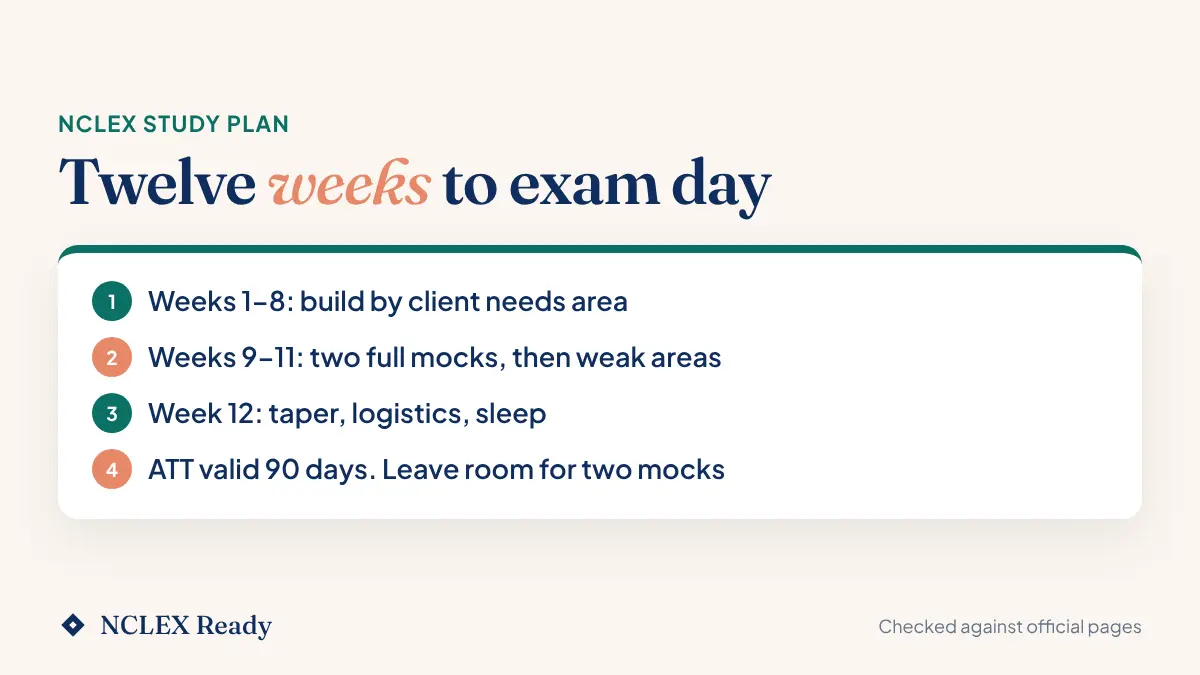
A good NCLEX study plan for the OBA pathway follows the 2026 NCLEX-RN test plan. It starts with a baseline, works through the eight client needs areas by weight, practises Next Gen clinical judgement every week and moves to full timed mocks near the end. Twelve weeks suits many nurses working shifts.
What follows is the plan we would suggest, week by week, plus how to run shift days and days off, how to review, when to book, and how to stretch or shrink it. It is a suggestion, not a formula. Adjust it to your baseline and your roster.
At a glance
| Item | Current detail | Official source |
|---|---|---|
| Exam you are studying for | NCLEX-RN, the NMBA multiple-choice exam for registered nurses on Stream B | NMBA MCQ exam page |
| Test plan | 2026 NCLEX-RN Test Plan, effective 1 April 2026 to 31 March 2029 | Official NCLEX site: test plans |
| Content areas | Eight client needs areas, each with a percentage range | 2026 RN Test Plan (PDF) |
| Exam length | 85 to 150 items in five hours, breaks included | 2026 RN Test Plan (PDF) |
| Clinical judgement | Three case studies of six items, plus about 10 per cent stand-alone clinical judgement items | 2026 RN Test Plan (PDF) |
| Time to complete the MCQ stage | 180 days once your portfolio is established, or your IQNM case closes | NMBA MCQ exam page |
| Authorisation to Test | Valid for 90 days from when AHPRA authorises you | NMBA Registered nurses exam page |
What the plan is built on
The test plan organises content into four client needs categories. Two of them are split into subcategories, which gives eight areas in total. Each has a set share of the exam (2026 RN Test Plan).
| Client needs area | Share of items |
|---|---|
| Management of Care | 15–21% |
| Safety and Infection Prevention and Control | 10–16% |
| Health Promotion and Maintenance | 6–12% |
| Psychosocial Integrity | 6–12% |
| Basic Care and Comfort | 6–12% |
| Pharmacological and Parenteral Therapies | 13–19% |
| Reduction of Risk Potential | 9–15% |
| Physiological Adaptation | 11–17% |
Management of Care and Safety sit under Safe and Effective Care Environment. The last four sit under Physiological Integrity. The test plan says individual exams may differ by up to 3 per cent in each area, because exam length varies. For a plain-English walk through each area, see our guide to the NCLEX-RN test plan and client needs categories.
Clinical judgement runs across all of them. Every exam includes three case studies of six items, and each case study works through the six steps of the clinical judgement model. In Australian spelling these are recognise cues, analyse cues, prioritise hypotheses, generate solutions, take action and evaluate outcomes. About 10 per cent more are stand-alone clinical judgement items (2026 RN Test Plan).
That is why the plan below gives most weeks a content area and a clinical judgement step. You build knowledge and the way the exam asks you to use it, side by side.
Week 0: start with a baseline
Before week 1, find out where you are. A baseline stops you spending three weeks on an area you already know while a weaker one waits.
Our free readiness test is about 30 questions and takes 30 to 45 minutes, with no account needed. Any honest baseline works, as long as it shows results by area rather than one overall score.
While you are setting up, work through the official NCLEX Candidate Tutorial. The test plan points candidates to it for examples of item types (2026 RN Test Plan). Knowing how a bow-tie or a matrix item behaves on screen saves time later. Our guide to Next Gen NCLEX question types covers each format.
Then write down your roster for the next month. Mark which days are shift days, which are days off and which follow a night. You will plan around those, not around a perfect week.
The 12-week NCLEX study plan, week by week
The order follows the test plan weights, with the largest areas early so they get the most revision time later. If your baseline shows a weak area, move it forward.
| Week | Main focus | Test plan share | Clinical judgement focus | End-of-week check |
|---|---|---|---|---|
| 1 | Exam structure, tutorial, study habits, light mixed practice | All areas | Read the six steps, try one case study | Roster mapped, baseline reviewed |
| 2 | Management of Care: prioritising by acuity, delegation, handover | 15–21% | Recognise cues | 50 to 75 mixed items in this area |
| 3 | Safety and Infection Prevention and Control | 10–16% | Analyse cues | Area quiz, rationales reviewed |
| 4 | Pharmacological and Parenteral Therapies, part 1: drug classes, safe administration | 13–19% | Prioritise hypotheses | Flashcards for drug names you keep missing |
| 5 | Pharmacological and Parenteral Therapies, part 2: IV therapy, blood products, calculations | 13–19% | Generate solutions | Timed set of calculation items |
| 6 | Physiological Adaptation: acute illness, deterioration, emergencies | 11–17% | Take action | Two case studies, timed |
| 7 | Reduction of Risk Potential: diagnostics, complications, abnormal results | 9–15% | Evaluate outcomes | First half-length timed practice |
| 8 | Health Promotion and Maintenance, and Psychosocial Integrity | 6–12% each | Full case studies, mixed steps | Area quizzes for both |
| 9 | Basic Care and Comfort, then full-length mock 1 on a day off | 6–12% | Case studies inside the mock | Mock 1 results by area |
| 10 | Your two or three weakest areas from mock 1 | Varies | Steps where you lost most marks | Re-test of weak areas |
| 11 | Full-length mock 2, then targeted review | All areas | Mixed | Mock 2 results compared with mock 1 |
| 12 | Light mixed review, rest, exam-day logistics | All areas | One or two case studies a day | Passport, travel time, sleep plan |
Notes on the content weeks (1 to 8)
Each content week has the same shape. Read or revise the area early in the week. Then answer practice items in that area, then mixed items, so you do not only practise with the topic already in your head.
Management of Care gets its own week because it carries the largest share. The test plan lists delegating and supervising care provided by others, and prioritising care by acuity, among its activities. Our guide to prioritisation and delegation questions is a good companion for week 2.
Pharmacology gets two weeks because it is the second-largest area and the one where names trip people up. Study in the drug names you use on shift, such as paracetamol and adrenaline, and learn the other name the exam may use beside each one, such as acetaminophen and epinephrine. Our guide to Australian drug names for the NCLEX lists the pairs.
Notes on the mock weeks (9 to 11)
A full-length mock should feel like exam day. That means up to 150 items in five hours, breaks inside the clock, and no skipping or going back (2026 RN Test Plan, official NCLEX site FAQ). Sit it on a day off, after a proper sleep, never after a night shift.
Pacing matters. If time runs out before you have answered the minimum number of items, the result is a fail (official NCLEX site). Use your first mock to learn your pace as much as your score. Our guide to how many questions are on the NCLEX explains the length and pass rules.
No practice test can tell you exactly how you will go on the real adaptive exam. Use mocks to find weak areas and rehearse the conditions, not to predict a result.
Week 12: taper
We suggest your last full mock comes about a week before the exam. The final days are for light mixed review, a couple of case studies a day, sleep and logistics. A passport is required for all international NCLEX appointments (NCLEX information flyer for AHPRA candidates). Check your ATT dates, your test centre address and how long it takes to get there.
How to study for the NCLEX while working shifts
Many nurses on the OBA pathway are studying around paid work, whether as an AIN in Australia or as an RN overseas. The plan only works if it survives a bad week on the roster.
Shift days
On a shift day, aim small. A routine many shift workers find workable looks like this:
- Before work, 15 to 20 minutes. Flashcards for drug names or lab values you have flagged.
- On a break, 10 minutes. Five to ten practice items, if your workplace allows it.
- After work, 20 to 30 minutes. Review the rationales for those items. Skip this after a hard shift. Rest counts.
After a night shift, do nothing heavier than flashcards. Tired study tends to mean rereading the same rationale three times.
Days off
Days off carry most of the load. A block of two to four hours, split into 45 to 50 minute sessions with breaks, suits most people. Use these days for new content, case studies and, from week 7, timed practice. Keep at least one day a week fully off study.
A sample week
| Day | Roster | Study |
|---|---|---|
| Mon | Early shift | 20 min flashcards before, 20 min rationales after |
| Tue | Early shift | Same as Monday |
| Wed | Day off | 3 hours: new content, 40 items, one case study |
| Thu | Late shift | 45 min in the morning: mixed items |
| Fri | Late shift | 30 min in the morning: weak-area review |
| Sat | Day off | 2 to 3 hours: mixed items and rationale review |
| Sun | Day off | Rest |
This is an example, not a target. If a week goes badly, carry the unfinished work forward rather than trying to double up.
Reviewing rationales and spacing your revision
Most of the learning happens after you answer. For every item, read why the right answer is right and why each wrong option is wrong. On a select-all-that-apply item, look hardest at the options you nearly chose.
Keep a short error log. For each missed item, note the area, the clinical judgement step and one line on why you missed it. Common reasons are a knowledge gap, misreading the question, or knowing the content but choosing the second-best priority. After a few weeks, patterns show up, and those patterns tell you what week 10 should be.
Spaced revision means coming back to an area after a gap rather than finishing it once. A simple way to build it in:
- Each content week: spend about a fifth of your item time on earlier areas.
- Every fourth week: do one mixed set drawn from everything so far.
- Flashcards: review missed cards more often and known cards less often.
You can see how we write our explanations on the free sample questions page.
When to book your exam
Booking is where your plan meets the official clocks. Three of them matter here.
- The MCQ stage. Once your portfolio is established, the NMBA gives 180 days to complete the MCQ exam, or your IQNM case is closed (NMBA MCQ exam page). The AHPRA handbook words this as registering for the exam within 180 days, so check both and plan to sit well inside the window (AHPRA RN MCQ handbook).
- Eligibility. AHPRA confirms your eligibility within four weeks of you registering with Pearson VUE (NMBA Registered nurses exam page).
- The ATT. Your Authorisation to Test is valid for 90 days from when AHPRA authorises you. The official NCLEX flyer for this route says there are no extensions, and NCLEX fees are not refunded for any reason (NCLEX information flyer).
Put together, that suggests an order. Start studying before you register, so the ATT does not set the pace. Register once your baseline and the first few weeks look on track. Then choose a date inside the ATT window that leaves room for at least two full mocks before it.
If you need to move your appointment, the flyer sets the cut-offs. A Tuesday to Friday appointment must be changed 24 hours ahead. A Saturday, Sunday or Monday appointment must be changed by the Friday before. For the full process, see how to book the NCLEX for AHPRA.
If you are overseas: you can sit the NCLEX at Pearson VUE centres outside Australia, including in India and the Philippines (official NCLEX site, testing locations). Remember the OSCE comes next and is in person in Australia, so leave room in your planning.
If you are already in Australia: study around your roster, and pick an exam date with a day off before it. Registration is not a visa. For work rights or visa questions, go to the Department of Home Affairs.
Adapting the plan to 8 or 16 weeks
An 8-week version
Eight weeks can work if your baseline is strong and your roster gives you longer days off.
- Weeks 1 to 2: baseline review, Management of Care, Safety.
- Weeks 3 to 4: Pharmacology, Physiological Adaptation.
- Week 5: Reduction of Risk Potential, Health Promotion, Psychosocial, Basic Care.
- Week 6: full mock 1, then weak areas.
- Week 7: full mock 2, then targeted review.
- Week 8: taper.
Keep two full mocks and the taper week. Cut the volume of easy-area practice instead.
A 16-week version
Sixteen weeks suits a baseline with several weak areas, a heavy roster or a long break from clinical study. Keep the 12-week order and add four weeks:
- After week 1: a foundations week on whatever your baseline showed as weakest.
- After week 5: a consolidation week of mixed items across everything so far.
- After week 8: a case-study week, two to three full case studies a day off.
- After week 10: a third full-length mock.
Longer is not always better. Check the 180-day MCQ window before you stretch the plan.
How NCLEX Ready can help
NCLEX Ready builds a study plan from your readiness test results, with 7,716 practice questions, 118 case studies, flashcards and mock exams, all in Australian clinical language. Start with the free readiness test, no account needed, then try everything free in Week 1 of your plan, no card required. For what to look for in any prep, see our NCLEX prep in Australia checklist. The NMBA and AHPRA do not endorse any prep course, including ours.
Frequently asked questions
How many hours a day should I study for the NCLEX while working shifts?
There is no official number. We suggest under an hour on shift days, split into short pieces such as flashcards before work and rationale review after, and a block of two to four hours on days off. Consistency across the week matters more than one long session.
How is the NCLEX-RN content split across topics?
The 2026 NCLEX-RN test plan sets a percentage range for eight client needs areas. Management of Care is the largest at 15 to 21 per cent, followed by Pharmacological and Parenteral Therapies at 13 to 19 per cent and Physiological Adaptation at 11 to 17 per cent.
When should I book my NCLEX date on the AHPRA pathway?
Your Authorisation to Test is valid for 90 days from when AHPRA authorises you, and NCLEX fees are not refunded. We suggest registering once your study is under way, then picking a date inside the ATT window that leaves time for at least two full mocks.
Can I do this NCLEX study plan in 8 weeks instead of 12?
Yes, if your baseline is strong and your roster allows longer study days. Pair the content weeks, keep at least two full-length mocks and keep the final taper week. If your baseline shows several weak areas, a 16-week version is usually more realistic.
Should I sit a full mock exam in the last few days before the NCLEX?
We suggest not. Sit your last full-length mock about a week out, then use the final days for light review, sleep and exam-day logistics such as your passport and travel time.
Sources
- 2026 NCLEX-RN Test Plan (PDF) — official NCLEX site — https://www.nclex.com/files/2026_RN_Test%20Plan_English-F.pdf (accessed 20 October 2026)
- Test plans — official NCLEX site — https://www.nclex.com/test-plans.page (accessed 20 October 2026)
- FAQs — official NCLEX site — https://www.nclex.com/faqs.page (accessed 20 October 2026)
- Computerized adaptive testing — official NCLEX site — https://www.nclex.com/computerized-adaptive-testing.page (accessed 20 October 2026)
- NCLEX information flyer for AHPRA candidates — official NCLEX site — https://www.nclex.com/files/2026_nclex_info_flyer_aphra.pdf (accessed 20 October 2026)
- Testing locations — official NCLEX site — https://www.nclex.com/testing-locations.page (accessed 20 October 2026)
- Multiple-choice question exam — Nursing and Midwifery Board of Australia — https://www.nursingmidwiferyboard.gov.au/Accreditation/IQNM/Examination/Multiple-choice-question-exam.aspx (accessed 20 October 2026)
- Registered nurses (Examination) — Nursing and Midwifery Board of Australia — https://www.nursingmidwiferyboard.gov.au/Accreditation/IQNM/Examination/Registered-nurses.aspx (accessed 20 October 2026)
- Registered Nurse MCQ Candidate Handbook (7 July 2026) — AHPRA — https://www.ahpra.gov.au/documents/default.aspx?record=WD20%2f30348%5bv4%5d&dbid=AP&chksum=k4ADJY8TbYgF7ZCnhMWpRcC7DpNYtmns5SkLnOTea7o%3d (accessed 20 October 2026)
- Department of Home Affairs — Australian Government — https://immi.homeaffairs.gov.au/ (accessed 20 October 2026)
Last checked against the official sources above on 20 October 2026. Rules and fees change, so always confirm on the official page before you pay or book. If you spot something out of date, tell us at hello@nclexready.com.au.
How this guide was made
Researched and written by the NCLEX Ready team, drafted with AI assistance and checked line by line against the official pages listed above. This is general information, not registration, legal or migration advice.
NCLEX Ready is an independent educational platform operated by Aromika Pty Ltd. It is not affiliated with, endorsed by, or connected to AHPRA, NMBA, NCLEX, Pearson VUE, or NCSBN. NCLEX and NCLEX-RN are registered trademarks of NCSBN, used here for descriptive purposes only.