Many nurses on the OBA pathway trained on single-best-answer questions. Then they open a practice case study and meet a bow-tie, a grid of tick boxes and a nurse's note they are asked to highlight. The Next Gen NCLEX formats look strange at first. Each one is a different way of asking the same thing: what would a safe beginning RN notice, decide and do?
The Next Gen NCLEX question types are extended multiple response, drag-and-drop, drop-down cloze, highlight, matrix or grid, bow-tie and trend items, alongside classic multiple choice and calculation. Items with more than one key earn partial credit through plus/minus, zero/one or rationale scoring, so a near miss still counts.
At a glance
| Item | Current detail | Official source |
|---|---|---|
| Next Gen NCLEX launch | 1 April 2023, to better measure clinical judgement | Official NCLEX site, NGN |
| Current test plan | 2026 NCLEX-RN Test Plan, in effect 1 April 2026 to 31 March 2029 | 2026 Candidate Bulletin |
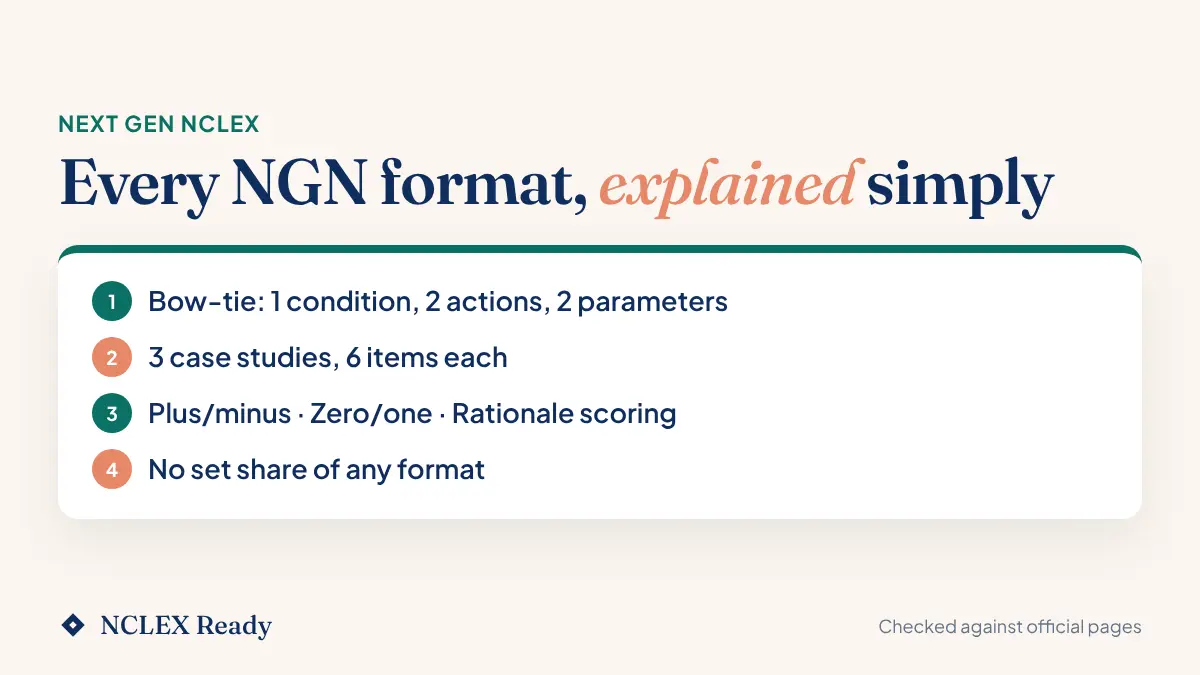
| Case studies | Three per exam, six items each, one client with unfolding information | 2026 NCLEX-RN test plan |
| Stand-alone clinical judgement items | About 10% of items, selected depending on exam length | 2026 NCLEX-RN test plan |
| Mix of formats | No predetermined percentage of any format | Official NCLEX FAQs |
| Scoring methods | Plus/minus, zero/one and rationale, for items with more than one key | Official NCLEX FAQs |
| Practice from the source | Free sample pack (three RN case studies) and a candidate tutorial | Official NCLEX site, Prepare |
How case studies and stand-alone items fit together
Every item on the NCLEX-RN is either part of a case study or stands on its own.
A case study is a set of six items about the same client. The client information unfolds as you move through it, and the six items line up with the six steps of the clinical judgement model. In Australian spelling these are recognise cues, analyse cues, prioritise hypotheses, generate solutions, take action and evaluate outcomes (2026 NCLEX-RN test plan). Under the 2026 plan you get three case studies, which is 18 items. For what each step is really asking, see our guide to clinical judgement on the NCLEX, step by step.
Stand-alone items present client information with one item. The test plan says about 10% of items are stand-alone clinical judgement items. The exam's owner, NCSBN, describes bow-tie and trend items as stand-alone types that measure more than one clinical judgement step within a single item (NGN News, Fall 2021).
A few things apply to every format:
- Exhibits. Some items show a client chart with tabs, such as nurses' notes, obs or lab results. You click each tab to read it (2026 Candidate Bulletin).
- Multimedia. Any item type may include charts, tables and graphics (2026 NCLEX-RN test plan).
- Bold key words. Words such as first, priority, immediately, next, increased, decreased, support and refute appear in bold (official NCLEX FAQs).
- Reference ranges. Any item with a numeric lab value shows the normal range beside it.
- No going back. Once you confirm an answer and press Next, you cannot return to it. Every item must be answered before you can move on.
The FAQs also say there is no set share of each format. Bow-tie, matrix and the rest turn up based on your ability and item difficulty. For how that affects exam length, read how many questions are on the NCLEX.
How each item type is scored
Partial credit applies to items with more than one key. The official NCLEX FAQs describe three methods:
- Plus/minus. Used when you may select an unspecified number of options. You gain a point for each correct option and lose a point for each incorrect one. The most you can score is the number of correct options. The least is zero.
- Zero/one. Used when you are told to choose a specific number of responses. Each correct response earns a point and wrong ones earn nothing. On multipoint items, the points add up.
- Rationale. Used when two pieces of information are closely linked, such as a cause and its effect. Both parts of the pair must be right to earn the point.
The FAQs explain the three methods but do not publish a type-by-type list. In the sections below, we match each type to the method whose official description fits it. Treat that as a guide to how to think, not a published rule.
One more point from the FAQs. A select-all-that-apply item carries the words "select all that apply" in bold, and one or more options will be correct. That could be one option or all of them.
The Next Gen NCLEX question types, one by one
The exam's owner groups the newer formats by how you respond. These are added to all the formats the NCLEX already used (NGN News, Winter 2022). The examples below are our own, short versions written in Australian ward language. Real items are longer and come with full client data.
Classic multiple choice
What it looks like. A stem and four options. You choose one.
Scoring. One key, so it is right or wrong.
Example. Mrs Tran is 74 and day one after a hip replacement. She is newly confused, her respiratory rate is 30 and her SpO2 is 88% on 2 L via nasal prongs. Her obs meet the MET call criteria on the ward's observation chart. What do you do first? The best answer is to call the MET team and stay with her, not to recheck obs in 30 minutes or give paracetamol and document.
Extended multiple response
This group has three versions (NGN News, Winter 2022).
- Select all that apply. A list of options, and you choose every one that fits. Fits plus/minus scoring.
- Select N. The stem tells you how many to pick, such as "select the 2 findings". Fits zero/one scoring.
- Multiple response grouping. A table split into groups, such as body systems, and you select all that apply in each group.
Example (select all that apply). Mr Singh, who has type 2 diabetes and uses insulin, says he feels shaky before lunch. Which findings fit hypoglycaemia? The options are sweating, tremor, a BSL of 3.1 mmol/L, warm dry skin, new confusion and passing large amounts of urine. The keys are sweating, tremor, the BSL and confusion. If you picked all four keys plus warm dry skin, plus/minus scoring would give you three points, not four.
Our guide to answering select-all-that-apply questions goes deeper on this format.
Drag-and-drop
What it looks like. You drag word or phrase tokens into blanks in a sentence, a table or a set of boxes. NCSBN material lists cloze and rationale versions (NGN News, Winter 2022) and also uses the name extended drag and drop (NCSBN NGN presentation, 2021).
Scoring. A cloze with a fixed number of blanks fits zero/one. A rationale version, where one token explains another, fits rationale scoring.
Example (rationale). "The client is at highest risk of ____ as shown by ____." Tokens include falls, pressure injury, new confusion and a Braden score of 22. For a newly confused older client with a low-risk Braden score, falls and new confusion go together. The pair only earns the point if both tokens are right.
Drop-down (cloze)
What it looks like. A sentence, a nurse's note or a table with drop-down menus in place of key words. You pick one option from each menu.
Scoring. Each menu has one key, so a plain drop-down cloze fits zero/one. A drop-down rationale, built as cause and effect, fits rationale scoring.
Example. "The nurse should first [withhold the metoprolol / give the metoprolol as charted / double the next dose] because the client's [heart rate is 46 / temperature is 37.2 °C / BSL is 6.8 mmol/L]." The keys are to withhold the metoprolol and the heart rate of 46. Then follow your facility's procedure to inform the medical officer.
Highlight
What it looks like. A nurse's note or a table of findings. You click words or phrases to highlight them, as many as you think apply. NCSBN material lists in-text and in-table versions (NGN News, Winter 2022). Some prep material calls it enhanced hot spot.
Scoring. You choose an unspecified number, so on our reading it fits plus/minus. If so, highlighting everything costs you points.
Example. "Day 2 after bowel resection. Alert and oriented. Pain 3/10 on PCA. Temp 38.9 °C. HR 118. BP 94/58. Abdomen firm and distended. Wound dry and intact. Voiding." Highlight the findings that need follow-up. The keys are the temperature, heart rate, blood pressure and the firm, distended abdomen. The pain score, dry wound and voiding are expected findings here.
Matrix or grid
What it looks like. A table with rows of findings or actions and columns of choices. There are two versions (NGN News, Winter 2022).
- Matrix multiple choice. One answer per row. Fits zero/one, one point per row.
- Matrix multiple response. More than one box can be ticked in a row or column. Fits plus/minus.
Example (multiple choice). A client arrives 40 minutes after the sudden onset of right-sided weakness. For each action, choose indicated or contraindicated. Keep nil by mouth until a swallow screen is done: indicated. Give oral aspirin before the CT scan: contraindicated, because a bleed has not been ruled out. Check the BSL: indicated.
Example (multiple response). The columns are hypoglycaemia and hyperglycaemia. For each action, tick every column it applies to. Recheck the BSL after treatment: tick both. Give fast-acting carbohydrate: hypoglycaemia only. Check blood ketones in a person with type 1 diabetes: hyperglycaemia only.
Bow-tie
What it looks like. A diagram shaped like a bow-tie. You drag one condition into the centre, two actions to take on one side and two parameters to monitor on the other (NGN News, Fall 2021). Each part has its own list of choices.
Scoring. You fill a fixed number of spaces, so on our reading it fits zero/one, one point per correct space.
Example. Mr Lee, 81, comes in from residential aged care. Temp 38.6 °C, HR 112, BP 92/54, RR 24, new confusion and cloudy, offensive urine. The condition most likely is sepsis. The two actions are to escalate under your hospital's deterioration procedure and to give IV fluids as prescribed. The two parameters to monitor are blood pressure and urine output. Distractors might include worsening dementia, encouraging oral fluids only and a daily weight.
Trend
What it looks like. Client data over time, such as a fluid balance chart or obs across several hours. You answer using what the trend shows. A trend item can use any of the newer response types except bow-tie (NGN News, Winter 2022).
Scoring. It follows the response type the trend uses. A select-all trend fits plus/minus, a matrix trend fits whichever method suits that matrix.
Example. A 70 kg man is six hours out of theatre. His hourly urine output reads 60, 45, 28 and 20 mL, and his heart rate climbs from 88 to 116. Select all findings that need escalation. The falling urine output, now under 0.5 mL/kg/h, and the rising heart rate both need it.
Calculation
The classic calculation item is still used. The FAQs say the item tells you whether to answer as a whole number or to one or two decimal places. If decimals are asked for, you must type the decimal point. Round only at the end of the calculation. An on-screen calculator is provided (2026 Candidate Bulletin).
Summary: Next Gen NCLEX question types and scoring
The scoring column is our reading of the three official definitions. The official NCLEX site does not publish a scoring method for each item type.
| Type | What you do | Our reading of the scoring |
|---|---|---|
| Multiple choice | Pick one option | Right or wrong |
| Select all that apply | Pick every option that fits | Plus/minus |
| Select N | Pick the stated number | Zero/one |
| Multiple response grouping | Select all that apply within each group | Plus/minus |
| Drag-and-drop cloze | Drag tokens into a fixed number of blanks | Zero/one |
| Drag-and-drop or drop-down rationale | Complete a cause-and-effect pair | Rationale |
| Drop-down cloze | Pick one option per menu | Zero/one |
| Highlight | Click the words or rows that apply | Plus/minus |
| Matrix multiple choice | One choice per row | Zero/one |
| Matrix multiple response | Tick all that apply per row or column | Plus/minus |
| Bow-tie | One condition, two actions, two parameters | Zero/one |
| Trend | Read data over time, then answer in another format | Follows that format |
| Calculation | Type a number | Right or wrong |
How to practise the formats
- Learn the screens before exam day. The official Prepare page has a free candidate tutorial and a sample pack with three RN case studies. Work through both so the mechanics feel ordinary.
- Read the instruction line first. "Select all that apply", "select 2" and "for each row" change both what you do and how you are scored.
- Do not over-select. On plus/minus items, every wrong choice costs a point. Choose what the client data supports, not what might be true.
- Practise the clinical judgement steps, not just the formats. A bow-tie and a highlight item can test the same thinking. The format is the container.
- Review partial credit honestly. If you scored three out of five on a select-all item, look at the two you missed and ask which cue you skipped.
- Practise in Australian clinical language. The exam uses generic drug names on most occasions (official NCLEX FAQs), and it helps to think in the terms you use on shift. Our list of Australian drug names and terms covers the common ones.
For what to look for in a course or question bank, see NCLEX prep in Australia.
How NCLEX Ready can help
We built NCLEX Ready in Australian clinical language, with 7,716 practice questions, Next Gen formats including bow-tie, highlight, matrix, drop-down and SATA, and 118 case studies. You can try worked examples of eight formats on our free sample questions page, with answers and rationales and no account needed. If you want the full bank, Week 1 of any plan is free, with full access and no card required.
Frequently asked questions
What are the Next Gen NCLEX question types?
The exam's owner lists extended multiple response (select all that apply, select N and multiple response grouping), matrix or grid, drag-and-drop, drop-down, highlight, bow-tie and trend items. These sit alongside the classic formats such as multiple choice and calculation items.
How are Next Gen NCLEX questions scored?
Items with more than one key get partial credit using one of three methods. Plus/minus adds a point for each correct choice and takes one off for each wrong one, with a floor of zero. Zero/one gives a point per correct choice with no penalty. Rationale scoring only gives the point when both parts of a linked pair are correct.
How many case studies are on the NCLEX-RN?
Under the 2026 NCLEX-RN test plan, every exam has three clinical judgement case studies. Each one has six items about the same client, with information that unfolds as you go.
Is there a set number of bow-tie or matrix questions on the NCLEX?
No. The official NCLEX FAQs say there is no predetermined percentage of item formats. The computer picks items based on your ability and item difficulty, not on format.
Do I lose marks for wrong answers on select all that apply?
On items where you can select an unspecified number of options, yes. Plus/minus scoring takes a point off for each incorrect option you choose, but your score for that item never goes below zero.
Sources
- Frequently Asked Questions — official NCLEX site — https://www.nclex.com/faqs.page (accessed 20 October 2026)
- Next Generation NCLEX — official NCLEX site — https://www.nclex.com/next-generation-nclex.page (accessed 20 October 2026)
- Prepare for Success — official NCLEX site — https://www.nclex.com/prepare.page (accessed 20 October 2026)
- 2026 NCLEX-RN Test Plan — official NCLEX site — https://www.nclex.com/files/2026_RN_Test%20Plan_English-F.pdf (accessed 20 October 2026)
- 2026 NCLEX Examination Candidate Bulletin — official NCLEX site — https://www.nclex.com/files/2026_NCLEX_Candidate_Bulletin_English.pdf (accessed 20 October 2026)
- Next Generation NCLEX News, Winter 2022: Test Design — NCSBN — https://www.ncsbn.org/public-files/NGN_Winter22_English_Final.pdf (accessed 20 October 2026)
- Next Generation NCLEX News, Fall 2021: Stand-alone items — NCSBN — https://www.ncsbn.org/public-files/NGN_Fall21_English_Final.pdf (accessed 20 October 2026)
- Next Generation NCLEX update (2021 presentation) — NCSBN — https://ncsbn.org/public-files/presentations/2021_MYM_pdickison_NGN.pdf (accessed 20 October 2026)
Last checked against the official sources above on 20 October 2026. Rules and fees change, so always confirm on the official page before you pay or book. If you spot something out of date, tell us at hello@nclexready.com.au.
How this guide was made
Researched and written by the NCLEX Ready team, drafted with AI assistance and checked line by line against the official pages listed above. This is general information, not registration, legal or migration advice.
NCLEX Ready is an independent educational platform operated by Aromika Pty Ltd. It is not affiliated with, endorsed by, or connected to AHPRA, NMBA, NCLEX, Pearson VUE, or NCSBN. NCLEX and NCLEX-RN are registered trademarks of NCSBN, used here for descriptive purposes only.