You know your pharmacology. Then a label or a handover uses a name you did not study, and you pause for a second you would rather not spend. Many internationally qualified nurses learn from US-written NCLEX material, so Australian drug names for nurses can feel like a second vocabulary on the first shift.
Australian drug names for nurses differ from US names in a handful of places that matter. Australia uses paracetamol, not acetaminophen, and the TGA keeps adrenaline and noradrenaline as the approved names. Other old Australian names, such as frusemide, have given way to the name used internationally, and medicines released for supply from 1 May 2026 must show only the new name.
Below are the verified name pairs, the 2026 label change, and the Australian clinical terms you will meet on the ward and in the OSCE.
At a glance
| Item | Current detail | Official source |
|---|---|---|
| The NCLEX-RN in Australia | The NMBA's MCQ exam for internationally qualified registered nurses is the NCLEX-RN | NMBA MCQ exam page |
| Drug names in NCLEX items | Generic medication names on most occasions | Official NCLEX FAQ |
| Paracetamol | Australian name. Known as acetaminophen in some countries | TGA Section 19A record |
| Adrenaline and noradrenaline | Remain the approved Australian names. Labels show adrenaline (epinephrine) | TGA adrenaline labels |
| Most dual-labelled ingredient names | Medicines released for supply from 1 May 2026 must show the sole new name | TGA dual-labelling transition |
| Responding to deterioration | National term is a rapid response system. A medical emergency team (MET) is one example | ACSQHC National Consensus Statement |
| Blood glucose on charts | Recorded as BGL in mmol/L | Queensland Health insulin chart |
Why you need both names
The NCLEX-RN is not a separate Australian exam. The NMBA states that "the MCQ exam for RNs is the National Council Licensure Examination for Registered Nurses (NCLEX-RN)", and you must pass it before the OSCE. Our guide to the AHPRA OBA pathway step by step shows where it sits.
The exam itself is written for North American practice. The official NCLEX FAQ says "the same NCLEX-RN exam is used for Canadian and U.S. entry to nursing practice". The 2026 test plan is built on a practice analysis of newly licensed RNs in the US and Canada.
On drug names, the same FAQ says the exam "will reflect, on most occasions, the use of generic medication names only". So a pain relief question may well name acetaminophen rather than paracetamol. Neither name is wrong. They are two labels for one medicine, and you need to recognise both.
That works in both directions. For the exam you read the North American name. For your AIN shifts, the NMBA OSCE and your first RN rotation, you read and say the Australian one.
Australian drug names for nurses: the pairs to know
The Therapeutic Goods Administration (TGA) decides the ingredient names on Australian labels. In 2016 it updated some names "to align with names used internationally", and it publishes a list of affected ingredients. Not every name changed, which is why two groups exist.
Names Australia kept
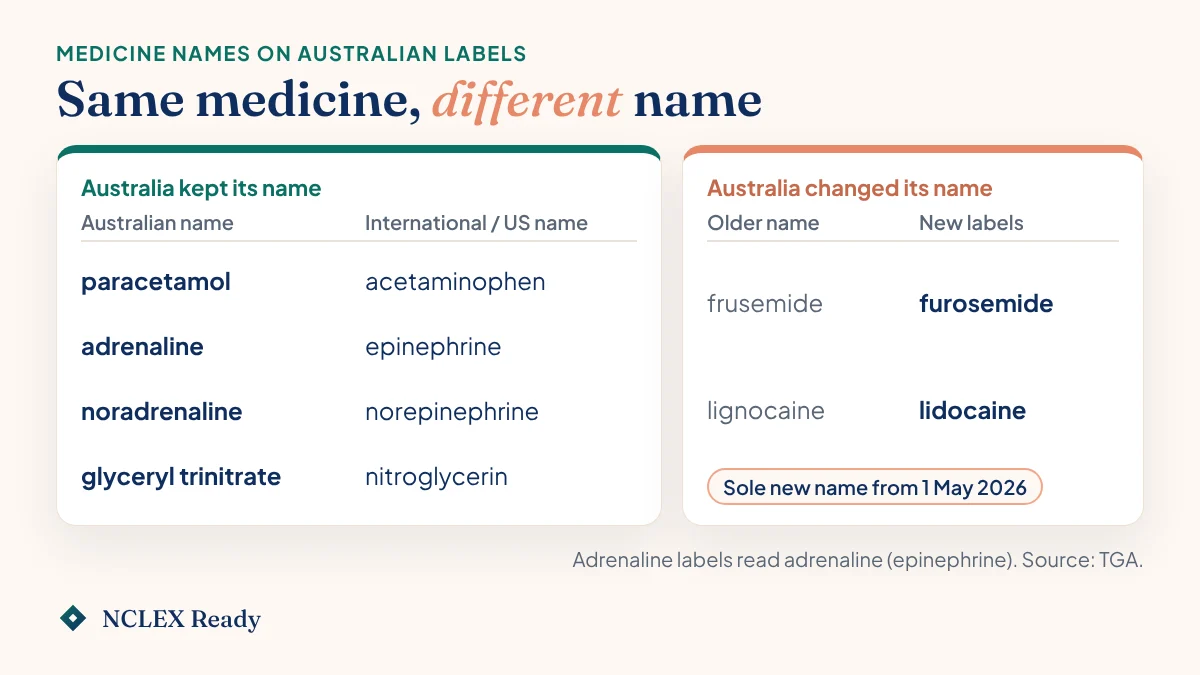
These are the Australian names, each paired with the other name we confirmed on an official TGA page. The TGA calls epinephrine and norepinephrine the international names.
| Australian name | International / US name |
|---|---|
| paracetamol | acetaminophen |
| adrenaline | epinephrine |
| noradrenaline | norepinephrine |
| glyceryl trinitrate | nitroglycerin |
Paracetamol is the name the TGA uses on its own pages. A TGA record for imported Tylenol tablets notes that "paracetamol is known by actetominophen in some countries" (the misspelling is the TGA's own).
Adrenaline and noradrenaline are a deliberate exception. The TGA says they "remain as the approved names in Australia" and that "there is no intent to move to using epinephrine and norepinephrine". Instead, labels read "adrenaline (epinephrine)", so you will see both names on the same ampoule.
Glyceryl trinitrate is the name on Australian products such as Nitrostat sublingual tablets. When imported stock was approved, the TGA record was titled "Nitrostat 0.6mg nitroglycerin sublingual tablets". It listed the Australian product in short supply as Anginine glyceryl trinitrate.
Salbutamol and pethidine are also unchanged Australian names on the TGA register. US-written material may use other names for these. We could not confirm those names on an Australian government page, so check a current drug reference before you rely on them.
Names Australia changed
For these, the older Australian name gave way to the international name. If you trained before the change, or a senior colleague did, you will hear the old one.
| Older Australian name | Current Australian label name |
|---|---|
| frusemide | furosemide |
| lignocaine | lidocaine |
| thyroxine sodium | levothyroxine sodium |
| chlorpheniramine maleate | chlorphenamine maleate |
| amoxycillin | amoxicillin |
| cephalexin | cefalexin |
| oestradiol | estradiol |
Some of these are only spelling changes, such as amoxycillin to amoxicillin. Others, such as frusemide to furosemide and lignocaine to lidocaine, went through a period of dual labelling, with both names printed together.
What changed in 2026
The TGA set the timeline in stages:
- For the dual-labelled names, labels had to show the old and new names together for medicines released for supply from May 2020.
- For most dual-labelled names, dual labelling ended on 30 April 2023 and a transition began on 1 May 2023.
- The transition ended on 30 April 2026. Medicines released for supply from 1 May 2026 "must show the sole name".
Names that were never dual labelled, such as amoxicillin, cefalexin and estradiol, had an earlier deadline. The TGA's four-year transition for updated names on labels ended on 30 April 2020.
A short list has longer. Dosulepin (dothiepin), tetracaine (amethocaine), hydroxycarbamide (hydroxyurea) and trihexyphenidyl (benzhexol) must show sole names on medicines released from 1 May 2028. A few, such as alimemazine (trimeprazine), stay dual-labelled with no planned switch.
Old stock and old habits
The TGA notes that new labels appear "gradually as new stock is distributed". So in late 2026 you may still find a box that says "furosemide (frusemide)". Colleagues may also keep saying frusemide out of habit. Know both and check the label against the chart every time.
Australian clinical terms you will meet on the ward
Drug names are only half the gap. The systems around a deteriorating patient, the charts and even the room names differ too. Some of these also vary between states, which study material rarely mentions.
Rapid response systems, MET calls and Between the Flags
Nationally, the Australian Commission on Safety and Quality in Health Care describes a "rapid response system". Its consensus statement says "examples of rapid response providers include medical emergency teams (METs) or nurse-led rapid response teams". Where the team is a MET, staff commonly call this a MET call. That is everyday ward usage rather than a national term.
The wording changes by state:
- New South Wales uses Between the Flags, developed by the Clinical Excellence Commission. Under NSW Health policy, a Yellow Zone observation may need a Clinical Review (or other local) call, and a Red Zone observation requires a Rapid Response call.
- South Australia uses its own Rapid Detection and Response (RDR) observation charts.
- Nationally, NSQHS Standard 8 (Recognising and Responding to Acute Deterioration) sets 13 actions. It speaks of escalating care rather than naming one team.
So "MET call" and "rapid response call" can both be correct, depending on where you work. Learn the escalation chart and the call name used in your facility.
Observation charts and obs
Official charts are called observation charts. The OSCE page lists examples you may need to complete, including adult and paediatric observation charts, neurological and neurovascular observation charts, and an intravenous fluid order chart. In everyday ward talk, colleagues often shorten observations to obs. That is common usage, not an official chart term.
BGL, BSL and mmol/L
The official Australian charts we checked use BGL (blood glucose level). Queensland Health, NSW Health and the Commission's national insulin chart guide all use it, and Queensland's chart heads the column "BGL (mmol/L)". You may also hear BSL (blood sugar level) at handover as an informal term. The OSCE examples include a blood glucose record chart.
If your study material reports glucose in a different unit, check which unit an item uses before you judge whether a result is high or low.
Theatre
In Australia the operating room is the operating theatre, usually just theatre. NSW Health, for example, has advertised roles as "Registered Nurse - Operating Theatres". The Home Affairs occupation list uses "Registered Nurse (Perioperative)".
ISBAR handover
The RN OSCE handbook expects you to know ISBAR (Introduction, Situation, Background, Assessment and Recommendation). It says communication is assessed in every station.
How to study both sets of names
A short routine helps Australian drug names for nurses stick alongside the names you studied, without slowing you down.
- Learn the medicine once. Study the class, action, key risks and nursing checks. These do not change with the name.
- Attach both names. Write the Australian name and the other name together on one card, for example "paracetamol / acetaminophen".
- Mark the 2026 changes. Flag pairs like frusemide and furosemide so you know which name new labels show.
- Read a real chart. Look at the OSCE example charts on the NMBA page and say each term aloud, from BGL to your facility's escalation zones.
- Practise the call. Rehearse an ISBAR escalation using your facility's call name, MET call or Rapid Response call.
For a wider plan, our guide to NCLEX prep in Australia covers study timing.
If you are overseas
You may meet Australian names first in the OSCE. Download the example charts from the NMBA OSCE page early and practise filling them in. Treat the TGA's current names as the names you will see on new Australian labels.
If you are already in Australia
Your AIN or EN shifts are a daily lesson in Australian names. Note any medicine you see under an unfamiliar name and add it to your cards. Ask how your ward escalates, because local practice decides the call name.
How NCLEX Ready can help
We write our practice questions, rationales and flashcards in Australian clinical language, so the names you study match the ones you will see on shift. If you want to see where you stand, try the free readiness test, about 30 questions, 30 to 45 minutes, no account needed.
Frequently asked questions
Is acetaminophen the same as paracetamol?
Yes. Paracetamol is the Australian name and the TGA notes that paracetamol is known as acetaminophen in some countries. On an Australian ward, chart and label you will see paracetamol.
Do Australian nurses say adrenaline or epinephrine?
Adrenaline. The TGA says adrenaline and noradrenaline remain the approved names in Australia, with no intent to move to epinephrine and norepinephrine. Labels show adrenaline (epinephrine) so both names appear together.
Is it frusemide or furosemide in Australia now?
Furosemide. Australian medicines released for supply from 1 May 2026 must show the sole name furosemide. Older stock and long habits mean you may still see or hear frusemide for a while.
Does the NCLEX use Australian drug names?
The NCLEX-RN is the same exam used for US and Canadian entry to practice, and the official NCLEX FAQ says items use generic medication names on most occasions. Expect names used in North American practice, so learn both names for each medicine.
Is it a MET call or a rapid response call?
It depends on the state and the hospital. The national term is a rapid response system, and a medical emergency team (MET) is one example. NSW uses a Rapid Response call under Between the Flags. Learn the system your facility uses.
Sources
- Multiple-choice question exam — Nursing and Midwifery Board of Australia — https://www.nursingmidwiferyboard.gov.au/Accreditation/IQNM/Examination/Multiple-choice-question-exam.aspx (accessed 18 October 2026)
- Objective structured clinical exam — Nursing and Midwifery Board of Australia — https://www.nursingmidwiferyboard.gov.au/Accreditation/IQNM/Examination/Objective-structured-clinical-exam.aspx (accessed 18 October 2026)
- RN OSCE candidate handbook — AHPRA — https://www.ahpra.gov.au/documents/default.aspx?record=WD20%2f30349%5bv12%5d&dbid=AP&chksum=krcq6pDijKrhj6TZEQUMIsw0wcbCCWMzB4vo8GYPtPc%3d (accessed 18 October 2026)
- Frequently asked questions — the official NCLEX site — https://www.nclex.com/faqs.page (accessed 18 October 2026)
- 2026 NCLEX-RN Test Plan — the official NCLEX site — https://www.nclex.com/files/2026_RN_Test%20Plan_English-F.pdf (accessed 18 October 2026)
- Updating medicine ingredient names: the overview — Therapeutic Goods Administration — https://www.tga.gov.au/products/medicines/labelling-and-advertising/medicines-and-biologicals-labelling-and-packaging/labelling-requirements-international-harmonisation-ingredient-names-project/updating-medicine-ingredient-names-overview (accessed 18 October 2026)
- Updating medicine ingredient names: list of affected ingredients — Therapeutic Goods Administration — https://www.tga.gov.au/products/medicines/labelling-and-advertising/medicines-and-biologicals-labelling-and-packaging/labelling-requirements-international-harmonisation-ingredient-names-project/updating-medicine-ingredient-names-list-affected-ingredients (accessed 18 October 2026)
- Dual labelled medicine ingredient names transition to sole names — Therapeutic Goods Administration — https://www.tga.gov.au/products/medicines/labelling-and-advertising/medicines-and-biologicals-labelling-and-packaging/labelling-requirements-information-sponsors/dual-labelled-medicine-ingredient-names-transition-sole-names (accessed 18 October 2026)
- Changes to adrenaline and noradrenaline labels — Therapeutic Goods Administration — https://www.tga.gov.au/products/medicines/labelling-and-advertising/medicines-and-biologicals-labelling-and-packaging/changes-adrenaline-and-noradrenaline-labels (accessed 18 October 2026)
- Buy and use paracetamol safely — Therapeutic Goods Administration — https://www.tga.gov.au/news/blog/buy-and-use-paracetamol-safely (accessed 18 October 2026)
- Section 19A approval (lapsed): Tylenol paracetamol 500 mg tablets — Therapeutic Goods Administration — https://www.tga.gov.au/resources/section-19a-approvals/approval-lapsed-tylenol-paracetamol-500mg-tablet-100-tablets (accessed 18 October 2026)
- ARTG 438870: Nitrostat glyceryl trinitrate 300 microgram sublingual tablet — Therapeutic Goods Administration — https://www.tga.gov.au/resources/artg/438870 (accessed 18 October 2026)
- Section 19A approval (lapsed): Nitrostat 0.6 mg nitroglycerin sublingual tablets — Therapeutic Goods Administration — https://www.tga.gov.au/resources/section-19a-approvals/approval-lapsed-nitrostat-06mg-nitroglycerin-sublingual-tablets (accessed 18 October 2026)
- ARTG 317221: Ventolin inhaler salbutamol 100 microgram — Therapeutic Goods Administration — https://www.tga.gov.au/resources/artg/317221 (accessed 18 October 2026)
- ARTG 340377: Pethidine Juno pethidine hydrochloride injection — Therapeutic Goods Administration — https://www.tga.gov.au/resources/artg/340377 (accessed 18 October 2026)
- National Consensus Statement: essential elements for recognising and responding to acute physiological deterioration, third edition — Australian Commission on Safety and Quality in Health Care — https://www.safetyandquality.gov.au/sites/default/files/2026-09/National-Consensus-Statement-Essential-elements-for-recognising-and-responding-to-acute-physiological-deterioration-third-edition.pdf (accessed 18 October 2026)
- Recognising and Responding to Acute Deterioration Standard — Australian Commission on Safety and Quality in Health Care — https://www.safetyandquality.gov.au/national-standards/nsqhs-standards/recognising-and-responding-acute-deterioration-standard (accessed 18 October 2026)
- User guide to the national subcutaneous insulin chart — Australian Commission on Safety and Quality in Health Care — https://www.safetyandquality.gov.au/sites/default/files/resources/attachments/User-guide-to-the-national-subcutaneous-insulin-chart-Acute-facilities-October-2017.pdf (accessed 18 October 2026)
- PD2025_014 Recognition and management of patients who are deteriorating — NSW Health — https://www1.health.nsw.gov.au/pds/ActivePDSDocuments/PD2025_014.pdf (accessed 18 October 2026)
- Standard observation charts — Clinical Excellence Commission (NSW) — https://cec.health.nsw.gov.au/safety-essentials/deterioration/observation-charts (accessed 18 October 2026)
- Rapid Detection and Response (RDR) observation charts — SA Health — https://www.sahealth.sa.gov.au/wps/wcm/connect/public+content/sa+health+internet/clinical+resources/clinical+programs+and+practice+guidelines/safety+and+wellbeing/clinical+deterioration/rapid+detection+and+response+rdr+observation+charts (accessed 18 October 2026)
- Subcutaneous insulin chart, maternity (BGL) — Queensland Health — https://www.health.qld.gov.au/__data/assets/pdf_file/0027/924561/sw883-sc-maternity-insulin-bgl.pdf (accessed 18 October 2026)
- NSW adult subcutaneous insulin prescribing chart — NSW Health — https://aci.health.nsw.gov.au/__data/assets/pdf_file/0004/196636/NSW-Health-NSW-Adult-subcutaneous-insulin-prescribing-chart.pdf (accessed 18 October 2026)
- Registered Nurse - Operating Theatres — NSW Health Careers — https://jobs.health.nsw.gov.au/jobs/registered-nurse-operating-theatres-304952 (accessed 18 October 2026)
- Skilled occupation list — Department of Home Affairs — https://immi.homeaffairs.gov.au/visas/working-in-australia/skill-occupation-list (accessed 18 October 2026)
Last checked against the official sources above on 18 October 2026. Rules and fees change, so always confirm on the official page before you pay or book. If you spot something out of date, tell us at hello@nclexready.com.au.
How this guide was made
Researched and written by the NCLEX Ready team, drafted with AI assistance and checked line by line against the official pages listed above. This is general information, not registration, legal or migration advice.
NCLEX Ready is an independent educational platform operated by Aromika Pty Ltd. It is not affiliated with, endorsed by, or connected to AHPRA, NMBA, NCLEX, Pearson VUE, or NCSBN. NCLEX and NCLEX-RN are registered trademarks of NCSBN, used here for descriptive purposes only.