The NMBA OSCE is the one part of the outcomes-based assessment you cannot sit from home. If you are overseas, it means an Australian visa, a long flight and one session of ten stations in Adelaide or Melbourne, after months of study and paperwork.
Station content is confidential, so it is also the step people know least about. What the NMBA and AHPRA do publish is detailed, and most of it sits in a 43-page candidate handbook.
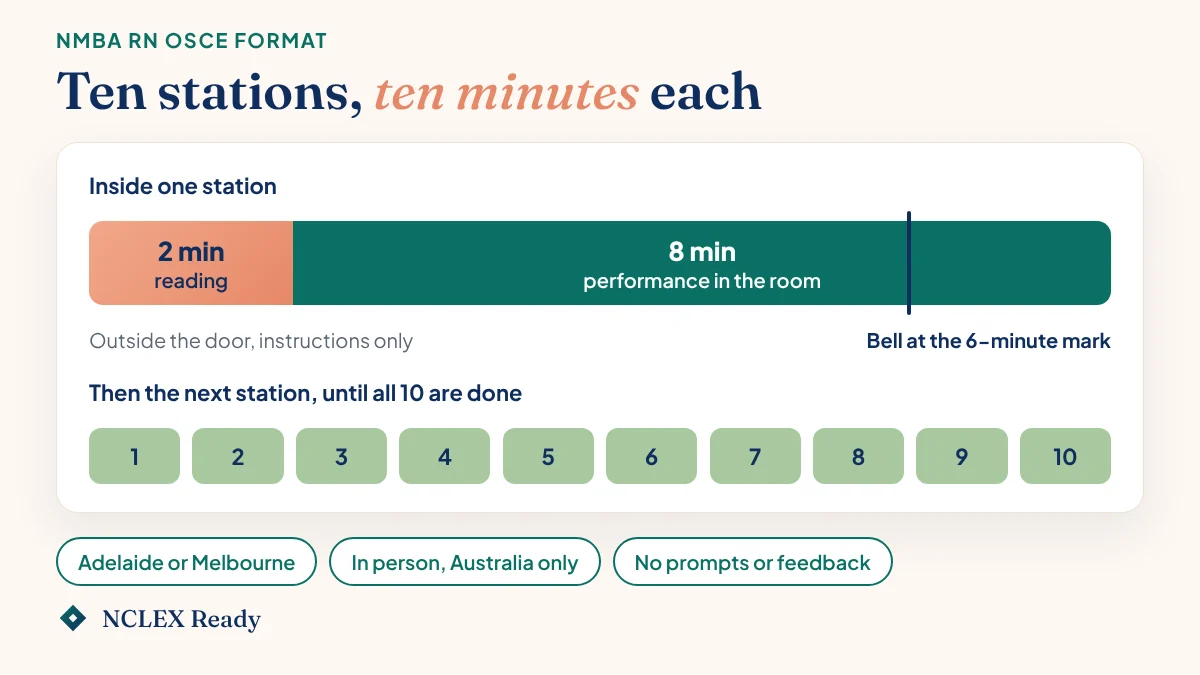
The NMBA OSCE is the in-person clinical exam that Stream B registered nurses sit after passing the NCLEX-RN. The RN OSCE candidate handbook (7 July 2026) sets 10 stations of 10 minutes each, two minutes reading and eight minutes performing, at Adelaide Health Simulation or RANZCOG Melbourne.
Below: the format, booking and visa steps, what to bring, results, re-sits and how to prepare.
At a glance
| Item | Current detail | Official source |
|---|---|---|
| Who sits it | Stream B registered nurses who have passed the NCLEX-RN | NMBA MCQ exam page |
| Venues | Adelaide Health Simulation (Adelaide, SA) or RANZCOG (Melbourne, Vic) | NMBA Registered nurses page |
| Delivery | In person, in Australia only | NMBA OSCE page |
| Format | 10 stations, 10 minutes each: 2 minutes reading, 8 minutes performance | RN OSCE handbook |
| Standard | At least the level of a graduate RN from an NMBA-approved Australian program, tested against the Registered Nurse Standards for Practice | RN OSCE handbook |
| How often | RN OSCEs run in each calendar month at one of the two venues | NMBA Registered nurses page |
| Fee | $4,000 AUD per sitting (fee schedule effective 9 October 2026) | NMBA fees |
| Time to pay | 120 days from when your case is set to the OSCE stage | NMBA OSCE page |
| Results | By email within eight weeks, with a per-station breakdown and no recheck | NMBA OSCE page |
| Re-sit wait | At least 45 calendar days from the result | NMBA re-sits policy |
Who sits the NMBA OSCE, and when
The OSCE is the last exam on Stream B of the outcomes-based assessment. The NMBA's Steps after Self-check page sets the order: IQNM assessment fee, Orientation Part 1, Portfolio, the MCQ exam (the NCLEX-RN), then the OSCE. One exception: if you passed the NCLEX-RN within 10 years of establishing your Portfolio, you upload that result at the Portfolio stage instead of sitting it again. Our step-by-step guide to the AHPRA OBA pathway covers the earlier stages.
The NMBA's MCQ exam page says candidates "must pass the MCQ exam before they can proceed" to the OSCE, and for registered nurses that MCQ is the NCLEX-RN. If you are weighing the order, see NCLEX or OSCE first.
Once your NCLEX pass is confirmed, your IQNM dashboard invites you to pay the OSCE fee.
OSCE venues: Adelaide Health Simulation and RANZCOG Melbourne
The RN OSCE runs at two locations, according to the handbook:
- Adelaide Health Simulation (AHS), within Adelaide University in South Australia. Exams may be held in either the Adelaide Health and Medical Sciences Building or the Helen Mayo South Building.
- The Royal Australian and New Zealand College of Obstetricians and Gynaecologists (RANZCOG), in the Melbourne CBD, Victoria.
Your confirmation email names the venue and address. You may look up where it is, but you must not enter or contact the exam centre before exam day. The handbook treats that as misconduct, and you would lose your allocated exam. Send any questions to the IQNM Exams Team instead.
How the day runs: 10 stations, 2 minutes plus 8
The handbook describes a regulatory OSCE, run the same way for every candidate.
- Arrive no more than 30 minutes before the registration period in your confirmation letter.
- Register. Show your passport, present devices for inspection and store your bag.
- Reading time (2 minutes). Sit outside the station and read the candidate instructions. You stay seated for the full two minutes, even if you finish early.
- Performance time (8 minutes). You enter the room. A bell sounds at the six-minute mark. At eight minutes you hand over your notes and leave, finished or not.
- Repeat until all 10 stations are done. There are no scheduled breaks during the exam, and time missed for a bathroom break cannot be made up.
- Quarantine. Morning-session candidates wait under supervision until the day's final session has registered.
Clinical documentation goes in the blue patient record folder inside the room. Notes on your notepaper are not marked. Write dates in the Australian day/month/year format, for example 1/10/2026.
What the examiner does, and how much to talk
People often ask how much to say out loud. The handbook sets no rule about narrating every step, but it is clear on the basics.
- An RN OSCE examiner sits in every station to "observe and mark". Unless your instructions say otherwise, they give no prompts, coaching or feedback.
- You must "demonstrate/perform the skills, not just talk about what they would do". Talking through a hand hygiene step is not the same as doing it.
- Speak to the simulated patient or manikin as you would to a real person meeting you for the first time. Explaining care and gaining consent are assessed.
- If you ask a manikin a question, the examiner answers for it, and you keep addressing the manikin.
- If the instructions ask you to present findings to the examiner, you address the examiner. The handbook expects familiarity with ISBAR for handover.
So speak where a real patient or colleague would need to hear you, and act where a real nurse would act.
What the NMBA OSCE assesses
Each station tests one clinical skill and how you manage the whole patient. The handbook lists skills that "may include, but are not limited to":
- physiological observations and vital signs
- calculating drug dosages and medication administration
- subcutaneous and intramuscular injection
- Aseptic Non-Touch Technique (ANTT) and wound care
- in-hospital resuscitation
- safe disposal of sharps, hand hygiene and infection control
- patient identification, communication and consent
- intravenous therapy administration and management
- risk management in the clinical environment
Communication is assessed in every station, and your written documentation is marked in the stations that ask for it. Stations span three domains: nursing assessment and care planning, care delivery, and evaluation of care. Settings include a hospital ward or emergency department, a GP clinic, aged care and the community. You are not expected to know state policies, but you are expected to show Australian national standards.
The Australian charts to practise with
The NMBA OSCE page links example charts for RNs. The list is not exhaustive, and variations may appear:
- adult and paediatric observation charts
- neurological and neurovascular observation charts
- blood glucose record chart (the official chart name, although you will often hear the reading called a BSL on the ward)
- adult falls risk and pressure care risk assessment charts
- mental health risk assessment chart
- intravenous fluid order chart
Print them and practise plotting a full set of obs, then decide what you would act on. Familiar paperwork saves seconds in an eight-minute station. Australian drug names matter too, so see our guide to Australian drug names and terms.
Booking and payment windows
The handbook and the OSCE page set out this sequence.
- Your case moves to the OSCE stage after the NCLEX pass shows on your dashboard.
- Pay the fee within 120 days. Otherwise your case is closed, although you can ask for it to be reopened.
- Offshore candidates receive an eligibility letter within four weeks of payment, which can support a visa application.
- Send AHPRA your visa once it is issued, if you are overseas. You will not be offered a date until you do.
- Confirm your availability through the online form when a cycle is scheduled. Places go first to the earliest fee payment (or earliest visa submitted, if offshore), then to the earliest form reply.
- Receive your confirmation letter, usually four to eight weeks before the exam and never earlier than eight weeks. If you confirm a late spare place inside the eight weeks, it comes within three business days. Do not book travel or accommodation until it arrives.
- Submit the agreements and consents form (terms and conditions, plus consent to video and audio recording).
To be emailed about a cycle, you need the fee paid (and your visa in, if offshore) at least three months before it.
A wording difference to know about. The OSCE page says you have 180 days after paying to schedule your exam. The newer handbook says 180 days to sit and complete an OSCE. Plan on sitting within about six months of paying, and ask the IQNM Exams Team if your dates are tight. If the case closes, the page says the fee is refunded.
If you are overseas
AHPRA cannot give visa advice. The NMBA points you to the Department of Home Affairs, and a registered migration agent can advise on your situation. A visa refusal, with evidence, is one of the grounds for an OSCE fee refund listed in the handbook.
If you are already in Australia
You skip the eligibility letter and visa steps. Your place in the queue depends on when you paid the fee and how quickly you answer the availability email.
Withdrawing and illness
If you cannot attend, email the IQNM Exams Team at least five full business days before your exam (weekends and public holidays do not count). With enough notice you move to a later cycle without a new fee. Without it, you fail automatically and forfeit the fee. If events beyond your control stopped you attending, you can apply for special consideration.
What to bring and wear
- Bring a current passport. It is the only photo ID accepted, and it must match the name on your Portfolio.
- Leave equipment at home. Everything is supplied, including pens and stethoscopes.
- Dress for clinical practice. Bare below the elbows, enclosed shoes, short nails with no polish or false nails, long hair tied back, and no jewellery except studs or sleepers. No jeans or tracksuits.
- Plan care for children. Family cannot pass the registration point, and the RANZCOG reception is not open to the public.
Results, and what a pass or fail means
Results arrive by email within eight weeks. The letter shows your overall result and, for each station, the pass mark, your mark, the outcome and the standard you reached, from Above standard to Well below standard. AHPRA asks you not to chase results inside the eight weeks. No recheck or further feedback is available.
After a pass
You then apply for registration through your dashboard. Two official sources frame the timing differently.
- The OSCE page says a pass is valid for five years but meets the recency of practice standard for only two years.
- The newer handbook says you have 90 days from your result to submit a complete application.
The safe reading is to have your documents ready before the result arrives and apply promptly. For the whole journey, see how long the OBA pathway takes.
After a fail
You can re-sit, and the NMBA publishes no limit on attempts. Under the re-sits policy, which the NMBA Examination page lists as applying from 1 July 2025, you wait at least 45 calendar days from the result and sit the entire exam again. The handbook adds that you must wait at least one exam cycle and pay a new OSCE fee. Your station breakdown is the only feedback, so use it to target your practice.
Preparing around the NMBA standards for practice
The NMBA's own advice is to use the handbook and the Registered Nurse Standards for Practice. Station marking criteria are mapped to those seven standards, which makes them the most reliable study frame you have.
- Thinks critically and analyses nursing practice. Use the full two minutes of reading. Work out what the station really asks before you walk in.
- Engages in therapeutic and professional relationships. Introduce yourself, check identity, explain and gain consent. Do this with manikins too.
- Maintains the capability for practice. Work within RN scope. Ask for a second check where Australian practice expects one.
- Comprehensively conducts assessments. Practise focused assessments and full sets of obs on the official charts until plotting is automatic.
- Develops a plan for nursing practice. Say what you will do next and why, as you would to a patient or colleague.
- Provides safe, appropriate and responsive quality nursing practice. Rehearse hand hygiene, ANTT, injection technique, medication checks and IV management with your hands, not just in your head.
- Evaluates outcomes to inform nursing practice. Reassess after you act. Document in the folder and hand over using ISBAR.
The handbook's reading list also names the National Safety and Quality Health Service Standards, the Australian Resuscitation Council, Hand Hygiene Australia, the ISBAR toolkit and the Australian Medicines Handbook.
Three cautions. The NMBA and AHPRA do not endorse any external OSCE preparation program. Station content is confidential, and accessing copied or recalled scenarios breaches the candidate rules. And the NMBA consulted on revised RN standards in early 2026, with feedback due by 13 March 2026. Its past consultations page says it is reviewing the feedback and expects the new standards to take effect later this year, with advance copies published first. Check the standards page before you sit.
How NCLEX Ready can help
We do not run OSCE coaching. We help with the step before it, the NCLEX-RN, which you must pass before an OSCE date is possible. Our practice questions, case studies and flashcards are written in Australian clinical language. If you want a starting point, the free readiness test is about 30 questions, takes 30 to 45 minutes and needs no account.
Frequently asked questions
Where is the NMBA OSCE held?
The RN OSCE is held at two venues, Adelaide Health Simulation in Adelaide, South Australia, and RANZCOG in the Melbourne CBD. It is in person and in Australia only, and your confirmation letter tells you which venue and building to attend.
How many stations are in the RN OSCE?
There are 10 stations. Each one lasts 10 minutes, made up of two minutes reading time and eight minutes performance time, and the exam runs strictly to time with no prompting or feedback.
Can I sit the OSCE before I pass the NCLEX?
No. The NMBA says candidates must pass the MCQ exam, which is the NCLEX-RN for registered nurses, before they can proceed to the OSCE. The OSCE fee is only offered through your IQNM dashboard once the NCLEX pass is confirmed.
How long do OSCE results take?
Results are emailed within eight weeks of the exam date. The letter shows your overall pass or fail plus each station's pass mark, your mark and the standard you achieved. No recheck or further feedback is available.
What happens if I fail the OSCE?
You pay a new OSCE fee and sit all 10 stations again. The NMBA re-sits policy says you must wait at least 45 calendar days from the result, and the candidate handbook says to wait at least one exam cycle before rescheduling.
Sources
- Objective Structured Clinical Exam (OSCE) — Nursing and Midwifery Board of Australia — https://www.nursingmidwiferyboard.gov.au/Accreditation/IQNM/Examination/Objective-structured-clinical-exam.aspx (accessed 18 October 2026)
- Registered nurses (IQNM examination) — Nursing and Midwifery Board of Australia — https://www.nursingmidwiferyboard.gov.au/Accreditation/IQNM/Examination/Registered-nurses.aspx (accessed 18 October 2026)
- Multiple-choice question exam — Nursing and Midwifery Board of Australia — https://www.nursingmidwiferyboard.gov.au/Accreditation/IQNM/Examination/Multiple-choice-question-exam.aspx (accessed 18 October 2026)
- Registered Nurse OSCE Candidate Handbook, 7 July 2026 — AHPRA and NMBA — https://www.ahpra.gov.au/documents/default.aspx?record=WD20%2f30349%5bv12%5d&dbid=AP&chksum=krcq6pDijKrhj6TZEQUMIsw0wcbCCWMzB4vo8GYPtPc%3d (accessed 18 October 2026)
- Policy: Examination re-sits — Nursing and Midwifery Board of Australia — https://www.ahpra.gov.au/documents/default.aspx?record=WD25%2f34888&dbid=AP&chksum=9u0zB%2bK%2b9%2fmX1RNpfBmopw%3d%3d (accessed 18 October 2026)
- Fees — Nursing and Midwifery Board of Australia — https://www.nursingmidwiferyboard.gov.au/Registration-and-Endorsement/Fees.aspx (accessed 18 October 2026)
- Registered nurse standards for practice — Nursing and Midwifery Board of Australia — https://www.nursingmidwiferyboard.gov.au/Codes-Guidelines-Statements/Professional-standards/registered-nurse-standards-for-practice.aspx (accessed 18 October 2026)
- Public consultation open: EN and RN standards for practice — Nursing and Midwifery Board of Australia — https://www.nursingmidwiferyboard.gov.au/News/2026-01-16-consultation-open-EN-RN-standards-for-practice.aspx (accessed 18 October 2026)
- Recency of practice — Nursing and Midwifery Board of Australia — https://www.nursingmidwiferyboard.gov.au/Registration-Standards/Recency-of-practice.aspx (accessed 18 October 2026)
- Immigration and citizenship — Department of Home Affairs — https://immi.homeaffairs.gov.au/ (accessed 18 October 2026)
- Steps after Self-check (assessment stages) — Nursing and Midwifery Board of Australia — https://www.nursingmidwiferyboard.gov.au/Accreditation/IQNM/Self-check-and-Portfolio/Steps-after-Self-check.aspx (accessed 18 October 2026)
- Examination — Nursing and Midwifery Board of Australia — https://www.nursingmidwiferyboard.gov.au/Accreditation/IQNM/Examination.aspx (accessed 18 October 2026)
- Past consultations — Nursing and Midwifery Board of Australia — https://www.nursingmidwiferyboard.gov.au/News/Past-Consultations.aspx (accessed 18 October 2026)
Last checked against the official sources above on 18 October 2026. Rules and fees change, so always confirm on the official page before you pay or book. If you spot something out of date, tell us at hello@nclexready.com.au.
How this guide was made
Researched and written by the NCLEX Ready team, drafted with AI assistance and checked line by line against the official pages listed above. This is general information, not registration, legal or migration advice.
NCLEX Ready is an independent educational platform operated by Aromika Pty Ltd. It is not affiliated with, endorsed by, or connected to AHPRA, NMBA, NCLEX, Pearson VUE, or NCSBN. NCLEX and NCLEX-RN are registered trademarks of NCSBN, used here for descriptive purposes only.