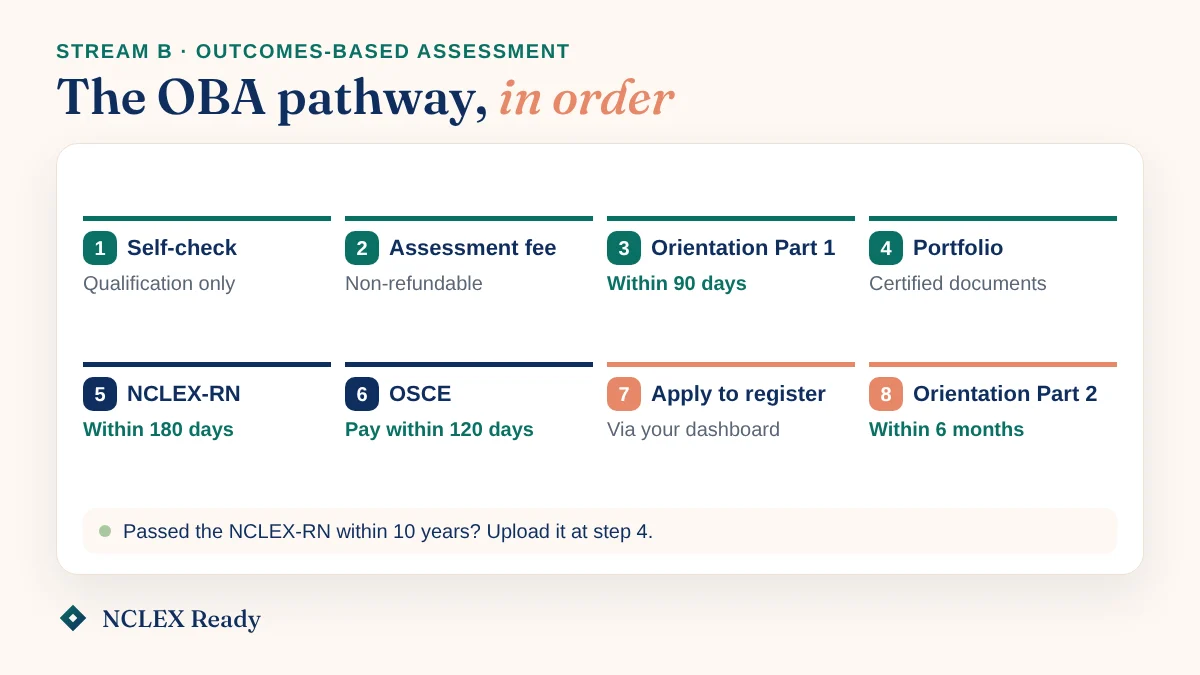
Your Self-check result says Stream B, and the next screen asks you to pay $410. Before you do, it helps to see the whole AHPRA OBA pathway at once — four assessment stages, two of them exams, and several clocks that can close your case if they run out.
The AHPRA OBA pathway is the NMBA's Stream B route, the outcomes-based assessment for internationally qualified nurses. After the Self-check you pay the IQNM assessment fee, complete Orientation Part 1, submit a Portfolio, then pass the NCLEX-RN and the OSCE, in that order, before you can apply for registration.
Below is every step in order, with its cost, its deadline and a link wherever we go deeper.
At a glance
| Item | Current detail | Official source |
|---|---|---|
| Order of stages | IQNM assessment fee, Orientation Part 1, Portfolio, NCLEX-RN, OSCE, then the registration application | NMBA — Steps after Self-check |
| IQNM assessment fee | $410, non-refundable, on the schedule effective 9 October 2026 | NMBA — Fees |
| NCLEX-RN fees | US$200 registration plus a US$150 international scheduling fee for Australian licensure. The official site says the registration fee will be US$350 from 1 February 2027 | Official NCLEX site — Fees |
| OSCE fee | $4,000 for each sitting | NMBA — Fees |
| OSCE venues | Adelaide Health Simulation (Adelaide) and RANZCOG (Melbourne CBD), in person in Australia only | NMBA — Registered nurses |
| Registration fees | $346 application fee plus $201 registration fee ($193 with a NSW principal place of practice) | NMBA — Fees |
| Prior NCLEX-RN pass | Counts if passed within 10 years of establishing your portfolio | NMBA — MCQ exam |
| NMBA time estimate | The process "typically takes 9-12 months but may take longer" | NMBA — media release, 27 January 2025 |
Before you start: what the Self-check decides
The Self-check assesses your qualification only. It does not weigh your years of experience, and it cannot be completed by an agent on your behalf. The outcome is Stream A, B or C, or a note that AHPRA must assess your qualification first.
Streams are set against three qualification criteria. Your qualification must lead to registration where you trained, meet quality assurance and accreditation standards, and sit at least at Australian bachelor level (AQF 7) for a registered nurse. Meet all three and you are Stream A. Meet criteria 1 and 3, or criteria 1 and 2 at a level comparable to AQF 6, and you are Stream B, which means the OBA. Stream C means the only way forward is to upgrade your qualification.
India and the Philippines are both on the NMBA's list of countries whose qualifications are unlikely to meet criterion 2. The NMBA says the list is based on previous assessments, so it signals a likely outcome rather than a ruling on your own qualification, and you can ask AHPRA to review a stream you disagree with. Our guide to the Self-check and the three streams walks through each outcome in detail.
Check whether you can skip the exams entirely
Since 23 April 2025, the registration standard for internationally qualified registered nurses lets some nurses register without NMBA exams. You need at least 1,800 hours as an RN since 1 January 2017 in an approved jurisdiction: the United Kingdom, Ireland, the United States, British Columbia or Ontario, Singapore or Spain.
If you trained in India, the Philippines or another country not on that list, you can only use Pathway 2. The IQRN fact sheet says your primary qualification must date from 1 January 2017 or later, and you must have passed that jurisdiction's exam process and registered there. If you qualified before 2017, this route is closed even with overseas registration and hours. The fact sheet adds that eligibility is only confirmed after a full AHPRA assessment of your documents.
The AHPRA OBA pathway, step by step
The diagram at the top of this guide shows the eight steps in order:
- Self-check
- IQNM assessment fee
- Orientation Part 1
- Portfolio
- NCLEX-RN
- OSCE
- Registration application
- Orientation Part 2, after you are registered
The NMBA lists the stages in a fixed order. The one exception is an NCLEX-RN pass, which the RN OSCE candidate handbook says may come before or after the Portfolio.
Step 1. Complete the Self-check
You complete the Self-check online yourself. The fee schedule lists no fee for it. If your result is Stream B, the next step is the assessment fee.
Step 2. Pay the IQNM assessment fee
The IQNM assessment fee covers assessment and orientation. It is $410 and it is non-refundable. The NMBA is also clear that finishing the stages does not by itself mean you will be registered, because eligibility is decided only when you apply.
Step 3. Complete Orientation Part 1
Orientation Part 1 is an online module that takes about an hour. You have 90 days from creating your account to finish it.
Step 4. Submit your Portfolio
The Portfolio is where AHPRA receives your documents. Expect to provide your qualification certificate, academic transcript, proof of identity and any change of name evidence. Every document must be certified, and anything not in English needs a translated copy.
If you have already passed the NCLEX-RN within 10 years, upload that evidence here. If your Self-check said your qualification needed assessment, this is also where AHPRA assesses it and confirms Stream A, B or C.
Step 5. Pass the NCLEX-RN
For registered nurses, the MCQ exam is the NCLEX-RN. Once your portfolio is finalised, the process runs like this:
- Follow the link on your IQNM dashboard to Pearson VUE, then register and pay. Your registration is valid for 365 days.
- The IQNM Exams Team confirms your eligibility within 4 weeks.
- Pearson VUE emails your Authorization to Test (ATT). The RN MCQ candidate handbook says it is valid for 90 days from the date AHPRA authorises you.
- Book and sit the exam at a Pearson VUE NCLEX centre.
- AHPRA emails your result within six weeks. Quick Results is not available on the AHPRA route.
Your Pearson VUE profile must match your AHPRA profile exactly. AHPRA's handbook says the ATT can be extended in extenuating circumstances, while the official NCLEX site's AHPRA flyer says there are no extensions. Treat the 90 days as firm.
The exam itself follows the 2026 NCLEX-RN test plan: between 85 and 150 items within five hours, including breaks. If you do not pass, you register and pay again, and the NMBA re-sit policy requires at least 45 calendar days from your result. The policy mentions that limits on re-sits each calendar year may apply but does not state a number.
Our guide to NCLEX prep in Australia covers study planning. It is the same NCLEX-RN that candidates in the United States and Canada sit, so a list of Australian drug names and clinical terms can save you second-guessing.
Step 6. Pass the OSCE
You must pass the NCLEX-RN before the OSCE, and the MCQ handbook says the next step after a pass is to pay the OSCE fee in your IQNM dashboard. Once your case is set to the OSCE stage, you have 120 days to pay the $4,000 fee.
After paying, you have about six months to get through the exam. The OSCE web page says 180 days to schedule your date, while the RN OSCE candidate handbook says 180 days to sit and complete it. Plan for the stricter reading.
The handbook describes 10 stations of 10 minutes each, made up of two minutes reading and eight minutes performing the skill. RN OSCEs run every calendar month at one of the two venues. Results arrive by email within eight weeks, and no recheck is available.
If you fail, you pay the fee again and wait at least 45 calendar days from your result, and the handbook adds at least one exam cycle. Our guides on what to expect at the NMBA OSCE and why the NCLEX comes before the OSCE go further.
Step 7. Apply for registration
When you are eligible, the registration application appears in your IQNM dashboard. You pay the $346 application fee, which is non-refundable, and the $201 registration fee. Evidence includes:
- certified qualification documents and proof of identity
- a certified Statement of Service covering the past five years
- English language evidence
- a Certificate of Registration Status or Good Standing from each regulator for the past five years, sent directly, and valid for three months from issue
This is the point where your English, criminal history and other registration standards are checked. English test results must be no more than two years old when you lodge, with some exceptions, so time your test with the whole pathway in mind. Our guide to choosing OET or IELTS has the current scores.
The revised criminal history standard, in effect from 15 July 2026, asks you to declare your history in all countries. AHPRA aims to finish its assessment within four to six weeks of receiving all documents, or an estimated eight to ten weeks if a Board decision is needed.
Apply promptly after your OSCE result. The OSCE web page says a pass is valid for five years but covers the recency of practice standard for only two. The newer handbook says you have 90 days from your result to submit a complete application. If you are close to either limit, check with the IQNM Exams Team first.
Step 8. Complete Orientation Part 2
Orientation Part 2 takes about two to three hours and is a requirement of your registration. Finish it within 6 months of registering, or you may be unable to renew. Registration then renews by 31 May each year.
The clocks that can close your case
Most waits on the pathway are out of your hands. These six clocks are not, so diarise them.
| Clock | Starts when | If you miss it |
|---|---|---|
| 90 days | You create your account after the Self-check | The page does not say, so treat it as firm |
| 180 days | Your portfolio is established | Your IQNM case is closed, and you can ask for it to be reopened |
| 365 days | You register with Pearson VUE | Your NCLEX registration expires. The NCLEX AHPRA flyer says AHPRA must make you eligible within this time |
| 90 days | AHPRA authorises your ATT | You re-register and pay again |
| 120 days | Your case is set to the OSCE stage | Your case is closed, and you can ask for it to be reopened |
| 180 days | You pay the OSCE fee | Your case is closed and the OSCE fee is refunded |
The MCQ page and the OSCE page both say a closed case can be reopened by contacting the IQNM Exams Team. The MCQ page gives 180 days to complete the exam, while the RN MCQ candidate handbook gives 180 days from when your dashboard is set to the MCQ stage to register with Pearson VUE. Either way, the 180-day MCQ window is shorter than the 365-day NCLEX registration. We would plan around the stricter reading and check with the IQNM Exams Team if unsure.
What the OBA pathway costs in official fees
These are the fees on the NMBA schedule effective 9 October 2026 and on the official NCLEX site.
| Fee | Amount | Paid to |
|---|---|---|
| IQNM assessment (assessment and orientation) | $410 | AHPRA |
| NCLEX-RN registration | US$200, rising to US$350 from 1 February 2027 | Pearson VUE |
| NCLEX international scheduling | US$150, with no change announced for 2027 | Pearson VUE |
| OSCE | $4,000 per sitting | AHPRA |
| Application for general registration | $346 | AHPRA |
| Registration for general registration | $201 ($193 in NSW) | AHPRA |
By our own sum, the NMBA fees for one attempt at each stage come to $4,957, or $4,949 with a NSW principal place of practice. The NCLEX adds US$350 today, or US$500 once the new registration fee takes effect on 1 February 2027. You pay the registration fee when you register with Pearson VUE, so check the official fees page before you register. Sitting at a centre in Australia still attracts the international scheduling fee.
None of this includes your English test, translations, certification, travel to the OSCE, a visa or any re-sits. NCLEX fees are never refunded.
If you are overseas
You can sit the NCLEX-RN at Pearson VUE centres in India and the Philippines, among other countries. The OSCE is different, because it is held in person in Australia only.
Once you pay the OSCE fee, AHPRA sends a letter you can include in a visa application. You must give the IQNM Exams Team a copy of your visa approval before you are invited to an exam date. The handbook says not to book travel or accommodation until your confirmation letter arrives, four to eight weeks before the exam.
The NMBA advises against irreversible decisions, such as resigning or moving, until your registration is approved. If you cannot meet the local identity check from overseas, AHPRA can send a letter of in principle approval instead.
Registration is not a visa. The NMBA notes the two processes are entirely separate. For visa questions, go to the Department of Home Affairs or a registered migration agent. Nurses from specific countries can start with our guides for Filipino nurses and Indian nurses.
If you are already in Australia
The steps and clocks are exactly the same. The official NCLEX site lists Australia among its international test locations, so you can sit the exam here. You will not need a visa letter for the OSCE, but you still need a passport, the only photo ID the handbook accepts on exam day.
Being here does not change your stream, because the Self-check looks only at your nursing qualification.
Names you will see along the way
- OBA — the outcomes-based assessment, which is what Stream B means.
- IQNM — internationally qualified nurses and midwives, the NMBA's name for the whole assessment process.
- MCQ — the multiple-choice exam stage. For registered nurses it is the NCLEX-RN.
- ATT — the Authorization to Test that Pearson VUE emails before you can book.
- ANMAC — a separate body that assesses skills for migration. The NMBA explains that ANMAC takes work experience into consideration, while the NMBA "can only take into account an applicant's qualifications" when deciding whether they are substantially equivalent to an Australian qualification.
- AURN — an informal abbreviation you may see online for Australian RN registration. It is not a term the NMBA or AHPRA use on their IQNM pages.
How long the whole pathway takes
The NMBA's own estimate, from January 2025, is that the process "typically takes 9-12 months but may take longer" if exams must be re-sat. Our guide to how long the OBA pathway takes breaks it down stage by stage.
How NCLEX Ready can help
The NCLEX-RN is the step most nurses spend longest preparing for. If you want to see where you stand before you register with Pearson VUE, our free readiness test takes about 30 questions and 30 to 45 minutes, with no account needed. The NMBA and AHPRA do not endorse any external MCQ or OSCE preparation programs, ours included.
Frequently asked questions
What are the steps of the AHPRA OBA pathway?
After the Self-check places you in Stream B, you pay the IQNM assessment fee, complete Orientation Part 1, submit your Portfolio, pass the NCLEX-RN and then pass the OSCE in Australia. Only then can you apply for registration, and Orientation Part 2 follows within 6 months of registering.
Can I sit the OSCE before the NCLEX-RN?
No. The NMBA requires you to pass the NCLEX-RN before you can proceed to the OSCE, and you pay the OSCE fee in your IQNM dashboard once your pass is recorded.
Do I need to sit the NCLEX-RN again if I have already passed it?
Not if you passed the NCLEX-RN within 10 years of establishing your portfolio. You upload your candidate report at the Portfolio stage and that covers the MCQ step.
What happens if I miss an OBA deadline?
Some clocks close your IQNM case, including 180 days after your portfolio is established to complete the MCQ exam (the RN MCQ handbook says to register for it within that time) and 120 days to pay the OSCE fee. The NMBA says you can contact the IQNM Exams Team to ask for the case to be reopened.
How much does the OBA pathway cost in official fees?
Under the NMBA schedule effective 9 October 2026, the IQNM assessment fee is $410 and the OSCE is $4,000, and registration adds a $346 application fee and a $201 registration fee. The NCLEX-RN is paid separately in US dollars, currently US$200 plus a US$150 international scheduling fee.
Is AHPRA registration the same as a visa?
No. Registration with the NMBA and AHPRA and visas from the Department of Home Affairs are separate processes, and success in one does not secure the other. Ask Home Affairs or a registered migration agent about visas.
Sources
- Steps after Self-check — Nursing and Midwifery Board of Australia — https://www.nursingmidwiferyboard.gov.au/Accreditation/IQNM/Self-check-and-Portfolio/Steps-after-Self-check.aspx (accessed 18 October 2026)
- Completing the Self-check — Nursing and Midwifery Board of Australia — https://www.nursingmidwiferyboard.gov.au/Accreditation/IQNM/Self-check-and-Portfolio/Completing-the-Self-check.aspx (accessed 18 October 2026)
- Meeting the registration requirements — Nursing and Midwifery Board of Australia — https://www.nursingmidwiferyboard.gov.au/Accreditation/IQNM/Before-you-apply/Meeting-the-registration-requirements.aspx (accessed 18 October 2026)
- Before you apply — Nursing and Midwifery Board of Australia — https://www.nursingmidwiferyboard.gov.au/Accreditation/IQNM/Before-you-apply.aspx (accessed 18 October 2026)
- Immigration and employment — Nursing and Midwifery Board of Australia — https://www.nursingmidwiferyboard.gov.au/Accreditation/IQNM/Before-you-apply/Immigration-and-employment.aspx (accessed 18 October 2026)
- Orientation Part 1 and Part 2 — Nursing and Midwifery Board of Australia — https://www.nursingmidwiferyboard.gov.au/Accreditation/IQNM/Orientation-Part-1-and-Part-2.aspx (accessed 18 October 2026)
- Portfolio — Nursing and Midwifery Board of Australia — https://www.nursingmidwiferyboard.gov.au/Accreditation/IQNM/Self-check-and-Portfolio/Portfolio.aspx (accessed 18 October 2026)
- Multiple-choice question exam — Nursing and Midwifery Board of Australia — https://www.nursingmidwiferyboard.gov.au/Accreditation/IQNM/Examination/Multiple-choice-question-exam.aspx (accessed 18 October 2026)
- Registered nurses (examination) — Nursing and Midwifery Board of Australia — https://www.nursingmidwiferyboard.gov.au/Accreditation/IQNM/Examination/Registered-nurses.aspx (accessed 18 October 2026)
- Objective structured clinical exam — Nursing and Midwifery Board of Australia — https://www.nursingmidwiferyboard.gov.au/Accreditation/IQNM/Examination/Objective-structured-clinical-exam.aspx (accessed 18 October 2026)
- RN MCQ candidate handbook (7 July 2026) — AHPRA — https://www.ahpra.gov.au/documents/default.aspx?record=WD20%2f30348%5bv4%5d&dbid=AP&chksum=k4ADJY8TbYgF7ZCnhMWpRcC7DpNYtmns5SkLnOTea7o%3d (accessed 18 October 2026)
- RN OSCE candidate handbook (7 July 2026) — AHPRA — https://www.ahpra.gov.au/documents/default.aspx?record=WD20%2f30349%5bv12%5d&dbid=AP&chksum=krcq6pDijKrhj6TZEQUMIsw0wcbCCWMzB4vo8GYPtPc%3d (accessed 18 October 2026)
- Policy: Examination re-sits — AHPRA and NMBA — https://www.ahpra.gov.au/documents/default.aspx?record=WD25%2f34888&dbid=AP&chksum=9u0zB%2bK%2b9%2fmX1RNpfBmopw%3d%3d (accessed 18 October 2026)
- Applying for registration — Nursing and Midwifery Board of Australia — https://www.nursingmidwiferyboard.gov.au/Accreditation/IQNM/Registration/Applying-for-registration.aspx (accessed 18 October 2026)
- Registration application stages — Nursing and Midwifery Board of Australia — https://www.nursingmidwiferyboard.gov.au/Accreditation/IQNM/Registration/Registration-application-stages.aspx (accessed 18 October 2026)
- Application outcomes — Nursing and Midwifery Board of Australia — https://www.nursingmidwiferyboard.gov.au/Accreditation/IQNM/Registration/Application-outcomes.aspx (accessed 18 October 2026)
- Fees — Nursing and Midwifery Board of Australia — https://www.nursingmidwiferyboard.gov.au/Registration-and-Endorsement/Fees.aspx (accessed 18 October 2026)
- Accepted English language tests — AHPRA — https://www.ahpra.gov.au/Registration/Registration-Standards/English-language-skills/Accepted-English-language-tests.aspx (accessed 18 October 2026)
- Criminal history registration standard — Nursing and Midwifery Board of Australia — https://www.nursingmidwiferyboard.gov.au/Registration-Standards/Criminal-history.aspx (accessed 18 October 2026)
- Registration standard: General registration for internationally qualified registered nurses — Nursing and Midwifery Board of Australia — https://www.nursingmidwiferyboard.gov.au/Registration-Standards/General-registration-for-IQRN.aspx (accessed 18 October 2026)
- IQRN registration standard fact sheet (updated September 2025) — AHPRA — https://www.ahpra.gov.au/documents/default.aspx?record=WD25%2f34540&dbid=AP&chksum=0zocZYfzwPXQflfwMp6vGA%3d%3d (accessed 18 October 2026)
- Media release, 27 January 2025 — Nursing and Midwifery Board of Australia — https://www.nursingmidwiferyboard.gov.au/News/2025-01-27-media-release-IQRN.aspx (accessed 18 October 2026)
- Fees and payment — official NCLEX site — https://www.nclex.com/fees-payment.page (accessed 18 October 2026)
- Testing locations — official NCLEX site — https://www.nclex.com/testing-locations.page (accessed 18 October 2026)
- 2026 NCLEX-RN test plan — official NCLEX site — https://www.nclex.com/files/2026_RN_Test%20Plan_English-F.pdf (accessed 18 October 2026)
- NCLEX information for AHPRA candidates (flyer, updated 12/25) — official NCLEX site — https://www.nclex.com/files/2026_nclex_info_flyer_aphra.pdf (accessed 18 October 2026)
- Department of Home Affairs — Australian Government — https://immi.homeaffairs.gov.au/ (accessed 18 October 2026)
Last checked against the official sources above on 18 October 2026. Rules and fees change, so always confirm on the official page before you pay or book. If you spot something out of date, tell us at hello@nclexready.com.au.
How this guide was made
Researched and written by the NCLEX Ready team, drafted with AI assistance and checked line by line against the official pages listed above. This is general information, not registration, legal or migration advice.
NCLEX Ready is an independent educational platform operated by Aromika Pty Ltd. It is not affiliated with, endorsed by, or connected to AHPRA, NMBA, NCLEX, Pearson VUE, or NCSBN. NCLEX and NCLEX-RN are registered trademarks of NCSBN, used here for descriptive purposes only.