You finished your BSN in the Philippines, passed your licensure exam and have years of ward experience. Now every Facebook group and Reddit thread says something different about NCLEX in Australia for Filipino nurses, and some of it is years out of date.
Here is the direct answer. Most Philippine-trained registered nurses are assigned Stream B, which means the outcomes-based assessment: Orientation, a Portfolio, the NCLEX-RN and then an OSCE in Australia. The NMBA lists the Philippines among countries whose qualifications are unlikely to meet its quality-assurance criterion.
Below we cover why that happens, the steps in order, what a previous US NCLEX pass changes, where to sit each exam and the English scores that apply now. For the full pathway in more depth, see our AHPRA OBA pathway guide.
At a glance
| Item | Current detail | Official source |
|---|---|---|
| Usual stream for a Philippine BSN | Stream B (outcomes-based assessment), confirmed only after your own assessment | NMBA, meeting the registration requirements |
| Exam for registered nurses | The NCLEX-RN is the NMBA's multiple-choice exam | NMBA, MCQ exam |
| Previous NCLEX-RN pass | Counts if passed within 10 years of establishing your Portfolio | NMBA, MCQ exam |
| NCLEX test centres in the Philippines | Manila and Muntinlupa on the October 2026 list | Official NCLEX site, testing locations |
| OSCE location | In person in Australia only, Adelaide or Melbourne | NMBA, OSCE |
| English (tests from 23 April 2026) | IELTS Academic 7 overall, 7 in listening, reading and speaking, 6.5 in writing | AHPRA, accepted English tests |
| Fast-track standard | Possible for some nurses with a qualification completed on or after 1 January 2017 who registered in a listed jurisdiction and practised 1,800 hours there | NMBA, IQRN registration standard |
What "AURN" means
"AURN" or "AuRN" is the shorthand many Filipino nurses use for becoming a registered nurse in Australia, often paired with "USRN". It is a community term, not an official one.
The official language is general registration with the Nursing and Midwifery Board of Australia (NMBA), administered by the Australian Health Practitioner Regulation Agency (AHPRA). Nurses trained overseas go through the IQNM process (internationally qualified nurses and midwives). For Stream B, that process is the outcomes-based assessment, often called the OBA pathway.
Why Philippine nursing degrees usually land in Stream B
The online Self-check assigns your stream by assessing your qualification, not your clinical skills. Since April 2025 it also asks about registration history and practice, to check whether the IQRN standard applies. The NMBA checks three criteria:
- Your qualification led to registration in the country where you trained, including any pre-registration exam.
- The education system meets its quality-assurance and accreditation elements.
- The academic level is at least an Australian bachelor's degree (AQF level 7) for a registered nurse.
Meeting all three gives Stream A. Meeting criteria 1 and 3 gives Stream B. AHPRA's IQNM policy guide names the Philippines as an example of a country where passing the pre-registration exam is part of criterion 1. So a Philippine BSN with a passed licensure exam will usually meet criterion 1, and it meets criterion 3 if AHPRA assesses it as comparable to an Australian bachelor's degree.
Criterion 2 is where the stream is decided. The Philippines appears on the NMBA list of countries whose qualifications are "unlikely" to meet it, alongside India, Nepal and Sri Lanka. The NMBA says the list is based on previous assessments of qualifications from institutions in those countries and the information available about their quality-assurance and accreditation systems.
So Stream B is about how an education system has been assessed, not about you or your skills. The list describes a likely outcome rather than a fixed rule, and if you disagree with your stream you can ask AHPRA for a review. Our guide to the Self-check and the three streams explains the outcomes in more detail.
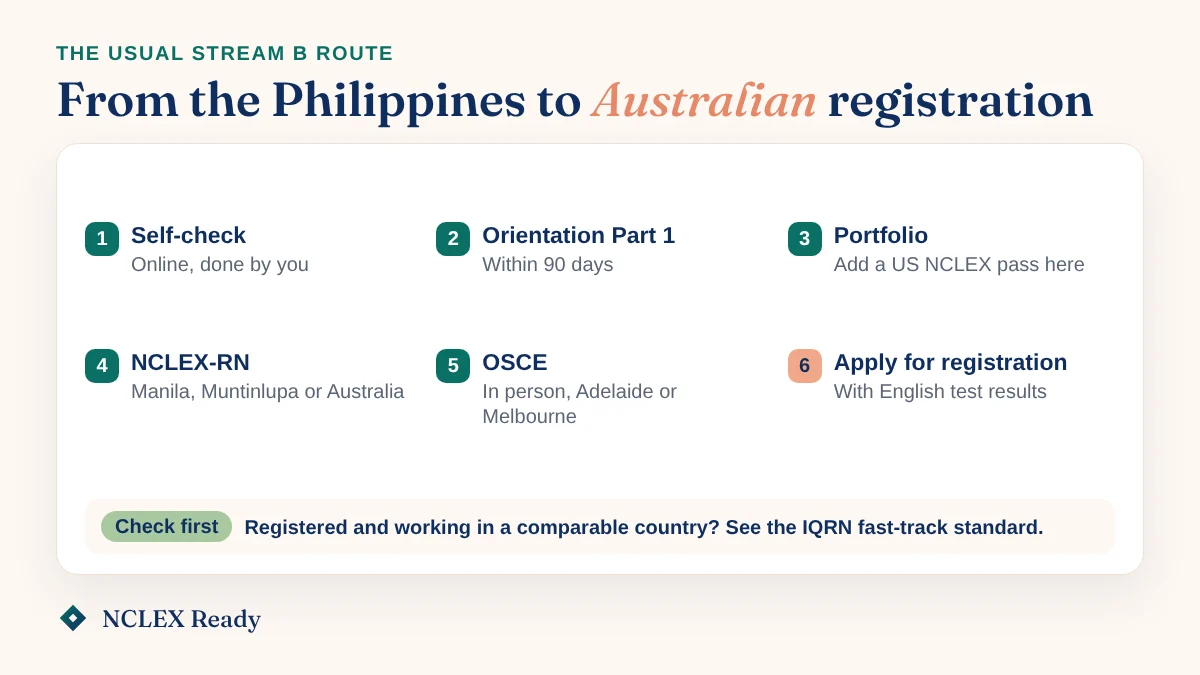
The NCLEX Australia route for Filipino nurses, step by step
This is the Stream B order from the NMBA's steps page.
- Self-check. Complete it online yourself. The NMBA says it cannot be done by an agent. It gives your stream, or tells you AHPRA must assess your qualification first.
- Assessment fee and Orientation Part 1. Pay the non-refundable IQNM assessment fee, then complete Orientation Part 1, an online module of about an hour. You have 90 days from creating your account to finish it.
- Portfolio. Upload your qualification certificate, transcript, identity documents and any change-of-name evidence. The Portfolio page says all documents must be certified, with translations for anything not in English.
- NCLEX-RN. Once your portfolio is established you have 180 days to complete the MCQ stage, or your case closes (it can be reopened). You register with Pearson VUE through your IQNM dashboard. AHPRA confirms eligibility within four weeks, and you then have 90 days from your Authorisation to Test to sit the exam. Results come from AHPRA within six weeks (NMBA, registered nurses). The RN MCQ candidate handbook says Quick Results is not available to candidates authorised by AHPRA.
- OSCE. After the NCLEX-RN pass shows on your dashboard, you pay the OSCE fee and sit the exam in Adelaide or Melbourne. More on that below.
- Apply for registration. Only eligible applicants are invited to apply. You provide certified documents, a five-year Statement of Service, English evidence and certificates of good standing (NMBA, applying for registration).
- Orientation Part 2. Complete it within six months of registering, or you may be unable to renew.
Passing every stage does not by itself secure registration, because eligibility is decided at the application. In January 2025 the NMBA said the existing process, including exams, typically takes 9 to 12 months but may take longer.
Where to sit the NCLEX
The official NCLEX site lists the Philippines among its international locations. Its October 2026 centre list names Manila (the listed address is in Makati City) and Muntinlupa City. Centre addresses change, so check the current list when you book.
If you are already in Australia, you can sit at a Pearson VUE centre here instead. Either way, if you test outside the US and its territories on the Australian route, you pay the international scheduling fee on top of the registration fee.
Already passed the NCLEX for a US state?
If you sat the NCLEX for New York, California or another US board, that pass can save you a step. It does not finish the pathway.
- The 10-year rule. A NCLEX-RN pass within 10 years of establishing your Portfolio removes the MCQ stage.
- How AHPRA receives it. Upload your NCLEX-RN candidate report at the Portfolio stage, or email it to the IQNM Exams Team. If you cannot get the report, a copy of your test booking is accepted (NMBA, registered nurses).
- What you still do. The Self-check, Orientation Part 1, the Portfolio and the OSCE in Australia.
A pass on its own is not the fast-track. If you also hold US registration and have worked there, read the next section.
There is a warning in the other direction. Transferring a score taken through AHPRA out to another regulator closes your IQNM case, unless you have already paid the OSCE fee. You can email the IQNM Exams Team later to ask for it to be reopened. The Texas Board of Nursing and the British Columbia College of Nurses and Midwives have told AHPRA they will not accept transfers from it.
Working in the UK, US, Singapore or Ireland now?
The IQRN registration standard, in effect since 23 April 2025, removes the NMBA exams for nurses who meet it. Its comparable jurisdictions are the United Kingdom, Ireland, the United States, British Columbia and Ontario in Canada, Singapore and Spain.
A Philippine-trained nurse would use Pathway 2. According to AHPRA's IQRN fact sheet, since 1 January 2017 you must have:
- completed a nursing qualification from outside those jurisdictions
- passed that jurisdiction's exam process for internationally qualified nurses, leading to RN registration there
- practised at least 1,800 hours in a comparable jurisdiction.
The fact sheet is explicit that a primary qualification obtained before 1 January 2017 is not eligible, even if everything else fits. In the UK, the CBT must be in adult nursing. You still complete the Self-check, and eligibility is confirmed only after a full AHPRA assessment of your documents. The NMBA estimated this route at 1 to 6 months.
English requirements for Filipino nurses
The Philippines is not on the list of recognised countries in the NMBA's English language skills registration standard. The pathways based on English as a primary language or on English-taught education rely on that list, so most Philippine-trained nurses meet the standard with an accepted test.
For tests taken on or after 23 April 2026, AHPRA's minimum scores include:
| Test | Minimum scores |
|---|---|
| IELTS Academic | 7 overall, 7 listening, 7 reading, 6.5 writing, 7 speaking |
| OET | Listening 350, reading 360, writing 350, speaking 360 |
| PTE Academic | 63 overall, listening 58, reading 59, writing 60, speaking 76 |
TOEFL iBT and Cambridge C1 or C2 are also accepted. Tests must be taken at a test centre, and at-home versions are not accepted. You can combine two sittings no more than 12 months apart, but only from the same provider. Results are generally valid for two years before you lodge your registration application, with limited exceptions, so time the test with that in mind. Our OET or IELTS guide compares the options.
The OSCE: travelling from the Philippines
The OSCE is in person in Australia only. It runs at Adelaide Health Simulation and at RANZCOG in Melbourne, and RN OSCEs are held every month at one of the two.
If you are overseas
According to the OSCE page and the RN OSCE candidate handbook (7 July 2026):
- You have 120 days to pay the OSCE fee once your case reaches the OSCE stage.
- AHPRA sends an eligibility letter for your visa application within four weeks of receiving the fee.
- You must provide a valid Australian visa before you are offered a place, and at least three months before an exam cycle to receive an availability email.
- Your confirmation letter arrives four to eight weeks before the exam. The handbook says not to book travel or accommodation until it arrives.
- If you cannot attend, give at least five full business days' notice so you move to a future cycle without paying the fee again.
Bring your passport, because it is the only accepted photo ID. Results arrive within eight weeks, and there is no recheck. Our guide to the NMBA OSCE covers the 10 stations.
If you are already in Australia
If you are preparing while working here, for example as an AIN, the OSCE fee window and scheduling rules still apply to you. A Pearson VUE centre in an Australian city may also make the NCLEX easier to fit around shifts.
Official fees
These are the NMBA fees in the schedule effective 9 October 2026, in Australian dollars.
| Item | Fee |
|---|---|
| IQNM assessment (assessment and orientation) | $410 |
| OSCE, per sitting | $4,000 |
| Application fee for general registration | $346 |
| Registration fee | $201 ($193 in NSW) |
The NCLEX fee is set separately: US$200 registration plus US$150 international scheduling for Australian licensure. From 1 February 2027, the registration fee rises to US$350 for anyone who registers on or after that date. English tests, flights and accommodation are extra.
Registration is not a visa
NMBA registration and an Australian visa are entirely separate processes. The NMBA advises against irreversible decisions, such as resigning or moving, until your registration is approved. For visa questions, go to the Department of Home Affairs or a registered migration agent. We cannot advise on visas.
How NCLEX Ready can help
The OSCE is set in Australian clinical settings and marked against the NMBA's standards, so it helps to practise in Australian clinical language from the start. NCLEX Ready has about 1,520 practice questions with rationales, Next Gen NCLEX formats and 62 case studies, written that way. To see where you stand, try the free readiness test. It is about 30 questions, takes 30 to 45 minutes and needs no account.
Frequently asked questions
Do Filipino nurses need to pass the NCLEX to work as a registered nurse in Australia?
Philippine-trained registered nurses are usually assigned Stream B, which means passing the NCLEX-RN and then the OSCE before applying for NMBA registration. The main exception is a nurse who meets the IQRN registration standard, which for a Philippine graduate needs a qualification completed on or after 1 January 2017, registration through the exam process in a listed comparable jurisdiction and at least 1,800 hours of practice there.
Can I use my US NCLEX pass for Australia?
Yes, if you passed the NCLEX-RN within 10 years of establishing your Portfolio. You upload your candidate report at the Portfolio stage or email it to the IQNM Exams Team, and you still complete Orientation Part 1, the Portfolio and the OSCE.
Where can I take the NCLEX for Australia in the Philippines?
The official NCLEX site lists the Philippines among its international testing locations, with Pearson VUE centres in Manila and Muntinlupa on its October 2026 list. You can also sit it at a Pearson VUE centre in Australia.
Is AURN an official registration type?
No. AURN is the shorthand many Filipino nurses use for becoming a registered nurse in Australia. The official terms are general registration with the Nursing and Midwifery Board of Australia, reached through the IQNM process and, for most Philippine graduates, the outcomes-based assessment.
Can Filipino nurses take the OSCE in Manila?
No. The NMBA OSCE is an in-person exam held in Australia only, at Adelaide Health Simulation or RANZCOG in Melbourne. If you are overseas, AHPRA sends an eligibility letter for your visa application after you pay the OSCE fee.
Sources
- Meeting the registration requirements — Nursing and Midwifery Board of Australia — https://www.nursingmidwiferyboard.gov.au/Accreditation/IQNM/Before-you-apply/Meeting-the-registration-requirements.aspx (accessed 18 October 2026)
- Steps after Self-check — Nursing and Midwifery Board of Australia — https://www.nursingmidwiferyboard.gov.au/Accreditation/IQNM/Self-check-and-Portfolio/Steps-after-Self-check.aspx (accessed 18 October 2026)
- Completing the Self-check — Nursing and Midwifery Board of Australia — https://www.nursingmidwiferyboard.gov.au/Accreditation/IQNM/Self-check-and-Portfolio/Completing-the-Self-check.aspx (accessed 18 October 2026)
- Orientation Part 1 and Part 2 — Nursing and Midwifery Board of Australia — https://www.nursingmidwiferyboard.gov.au/Accreditation/IQNM/Orientation-Part-1-and-Part-2.aspx (accessed 18 October 2026)
- Portfolio — Nursing and Midwifery Board of Australia — https://www.nursingmidwiferyboard.gov.au/Accreditation/IQNM/Self-check-and-Portfolio/Portfolio.aspx (accessed 18 October 2026)
- Multiple choice question exam — Nursing and Midwifery Board of Australia — https://www.nursingmidwiferyboard.gov.au/Accreditation/IQNM/Examination/Multiple-choice-question-exam.aspx (accessed 18 October 2026)
- Registered nurses (examination FAQs) — Nursing and Midwifery Board of Australia — https://www.nursingmidwiferyboard.gov.au/Accreditation/IQNM/Examination/Registered-nurses.aspx (accessed 18 October 2026)
- Objective structured clinical exam — Nursing and Midwifery Board of Australia — https://www.nursingmidwiferyboard.gov.au/Accreditation/IQNM/Examination/Objective-structured-clinical-exam.aspx (accessed 18 October 2026)
- Registered Nurse OSCE Candidate Handbook, 7 July 2026 — AHPRA — https://www.ahpra.gov.au/documents/default.aspx?record=WD20%2f30349%5bv12%5d&dbid=AP&chksum=krcq6pDijKrhj6TZEQUMIsw0wcbCCWMzB4vo8GYPtPc%3d (accessed 18 October 2026)
- Applying for registration — Nursing and Midwifery Board of Australia — https://www.nursingmidwiferyboard.gov.au/Accreditation/IQNM/Registration/Applying-for-registration.aspx (accessed 18 October 2026)
- IQNM policy reference guide, updated June 2026 — AHPRA — https://www.ahpra.gov.au/documents/default.aspx?record=WD25/34633&dbid=AP&chksum=g4oBmgp8xLMNaiONY/dG8g%3D%3D (accessed 18 October 2026)
- Registration standard: General registration for internationally qualified registered nurses — Nursing and Midwifery Board of Australia — https://www.nursingmidwiferyboard.gov.au/Registration-Standards/General-registration-for-IQRN.aspx (accessed 18 October 2026)
- Fact sheet: General registration for internationally qualified registered nurses, updated September 2025 — AHPRA — https://www.ahpra.gov.au/documents/default.aspx?record=WD25%2f34540&dbid=AP&chksum=0zocZYfzwPXQflfwMp6vGA%3d%3d (accessed 18 October 2026)
- Media release: new pathway for internationally qualified registered nurses, 27 January 2025 — Nursing and Midwifery Board of Australia — https://www.nursingmidwiferyboard.gov.au/News/2025-01-27-media-release-IQRN.aspx (accessed 18 October 2026)
- English language skills — Nursing and Midwifery Board of Australia — https://www.nursingmidwiferyboard.gov.au/Registration-Standards/English-language-skills.aspx (accessed 18 October 2026)
- Accepted English language tests — AHPRA — https://www.ahpra.gov.au/Registration/Registration-Standards/English-language-skills/Accepted-English-language-tests.aspx (accessed 18 October 2026)
- Fees — Nursing and Midwifery Board of Australia — https://www.nursingmidwiferyboard.gov.au/Registration-and-Endorsement/Fees.aspx (accessed 18 October 2026)
- Testing Locations — official NCLEX site — https://www.nclex.com/testing-locations.page (accessed 18 October 2026)
- Fees and Payment — official NCLEX site — https://www.nclex.com/fees-payment.page (accessed 18 October 2026)
- Registered Nurse NCLEX-RN MCQ Candidate Handbook, 7 July 2026 — AHPRA — https://www.ahpra.gov.au/documents/default.aspx?record=WD20%2f30348%5bv4%5d&dbid=AP&chksum=k4ADJY8TbYgF7ZCnhMWpRcC7DpNYtmns5SkLnOTea7o%3d (accessed 18 October 2026)
- October 2026 Quarterly International Test Centers Information — official NCLEX site — https://www.nclex.com/files/October_2026_Quarterly_International_Test_Centers_Information.pdf (accessed 18 October 2026)
- Before you apply — Nursing and Midwifery Board of Australia — https://www.nursingmidwiferyboard.gov.au/Accreditation/IQNM/Before-you-apply.aspx (accessed 18 October 2026)
- Department of Home Affairs, Immigration and citizenship — Australian Government — https://immi.homeaffairs.gov.au/ (accessed 18 October 2026)
Last checked against the official sources above on 18 October 2026. Rules and fees change, so always confirm on the official page before you pay or book. If you spot something out of date, tell us at hello@nclexready.com.au.
How this guide was made
Researched and written by the NCLEX Ready team, drafted with AI assistance and checked line by line against the official pages listed above. This is general information, not registration, legal or migration advice.
NCLEX Ready is an independent educational platform operated by Aromika Pty Ltd. It is not affiliated with, endorsed by, or connected to AHPRA, NMBA, NCLEX, Pearson VUE, or NCSBN. NCLEX and NCLEX-RN are registered trademarks of NCSBN, used here for descriptive purposes only.