You have a nursing degree, years of handovers behind you, and a test booking page open. Colleagues swear by OET, a cousin says IELTS, and the group chat says PTE. Choosing OET or IELTS for nursing in Australia got harder when the minimum scores changed in April 2026.
AHPRA accepts both, plus PTE Academic, TOEFL iBT and Cambridge C1 or C2. It says the minimums are benchmarked to equivalent levels, and "it is not easier to achieve the required scores on one test, compared with any of the others" (AHPRA accepted English tests). Choose on fit, format and what you can book.
Below are the current minimum scores, the rules about sittings and validity that catch people out, and a plain comparison of how OET and IELTS Academic actually test you.
At a glance
| Item | Current detail | Official source |
|---|---|---|
| Accepted tests | Five: IELTS Academic, OET, PTE Academic, TOEFL iBT, Cambridge C1 Advanced or C2 Proficiency | AHPRA accepted English tests |
| Standard in force | English language skills registration standard (2025), in effect from 18 March 2025 | NMBA English language skills |
| Current minimum scores | Apply to tests taken on or after 23 April 2026 | AHPRA accepted English tests |
| Older minimum scores | Apply to tests taken on or before 22 April 2026 | AHPRA accepted English tests |
| Sittings | One sitting, or two sittings no more than 12 months apart, same test provider only | AHPRA accepted English tests |
| Validity | Two years before you lodge your registration application, with limited exceptions | AHPRA accepted English tests |
| Home and online tests | Not accepted. OET on computer at a test centre is the only version with a remote element that is allowed | AHPRA accepted English tests |
| Retaking one skill | IELTS One Skill Retake only. It does not count as an extra sitting | AHPRA accepted English tests |
Current AHPRA minimum scores (tests on or after 23 April 2026)
The NMBA still lists the English language skills registration standard (2025), with a note that changes to test scores took effect on 23 April 2026 (NMBA English language skills). The new scores are set out in a transition arrangements policy, and which table applies depends on your test date (Transition arrangements policy). AHPRA says the change aligns with the Department of Home Affairs and with test providers' score concordance research, and "these changes do not change the level of English language proficiency required for registration."
| Test (accepted mode) | Overall | Listening | Reading | Writing | Speaking | Lowest score allowed in either sitting when combining two (L / R / W / S) |
|---|---|---|---|---|---|---|
| IELTS Academic (test centre only) | 7 | 7 | 7 | 6.5 | 7 | No component below 6.5, and overall 7 in each sitting |
| OET (paper or computer at a test centre, any profession) | Not set | 350 | 360 | 350 | 360 | 320 / 340 / 350 / 350 |
| PTE Academic (computer at a test centre) | 63 | 58 | 59 | 60 | 76 | 53 / 54 / 60 / 66, and overall 63 in each sitting |
| TOEFL iBT (computer at a test centre) | 91 | 22 | 22 | 23 | 24 | 19 / 19 / 23 / 22, and total 91 in each sitting |
| Cambridge C1 Advanced (test centre only) | 178 | 175 | 179 | 180 | 194 | 168 / 168 / 180 / 187 |
| Cambridge C2 Proficiency (test centre only) | 185 | 185 | 185 | 176 | 185 | No component below 176 |
Two things stand out for nurses. IELTS did not change at all. PTE changed a lot, with the overall minimum down from 66 to 63 but speaking up from 66 to 76 and writing up from 56 to 60.
For TOEFL, you must select "Taking TOEFL for Australia" when you register. ETS has reported TOEFL iBT on a new 1 to 6 scale since 21 January 2026, while AHPRA's table still uses the older scale of section scores out of 30 and a total out of 120. ETS says that for a two-year transition period score reports also show a comparable overall score on the 0 to 120 scale (ETS TOEFL scores). If you plan to sit TOEFL, confirm with AHPRA how it reads the new score report before you book.
Scores for tests on or before 22 April 2026
| Test | Overall | Listening | Reading | Writing | Speaking | Lowest score allowed in either sitting when combining |
|---|---|---|---|---|---|---|
| IELTS Academic | 7 | 7 | 7 | 6.5 | 7 | No component below 6.5, and overall 7 in each sitting |
| OET | Not set | B | B | C+ | B | No component below C+ |
| PTE Academic | 66 | 66 | 66 | 56 | 66 | No skill below 56, and overall 66 in each sitting |
| TOEFL iBT | 94 | 24 | 24 | 24 | 23 | 20 / 19 / 24 / 20, and total 94 in each sitting |
| Cambridge C1 or C2 | 185 | 185 | 185 | 176 | 185 | No component below 176 |
If your two sittings fall either side of the change
AHPRA's rule is simple. "Your first test must meet the old minimum scores in Table 1. Your second test must meet the new minimum scores in Table 2." Check each result against the table for its own test date.
Combining two sittings
You can rely on one sitting, or on two sittings whose dates are no more than 12 months apart. AHPRA's FAQ gives the example that a first sitting on 1 March means the second must be no later than 28 February the next year. The NMBA standard's own definition uses the same example but says 1 March of the following year. Until the two agree, play safe and sit the second test before the anniversary of the first (NMBA standard (2025)).
The rule that trips people up is this. Results from different test providers cannot be combined. A strong OET writing score cannot rescue a weak IELTS speaking score. You may sit more than twice, but the NMBA will only consider two sittings (NMBA fact sheet).
When you combine, each sitting must also clear the floor in the last column of the table above. For OET that means no sitting below 320 in listening, 340 in reading, 350 in writing or 350 in speaking.
The IELTS One Skill Retake
IELTS is the only accepted test with a retake option AHPRA accepts. The One Skill Retake lets you re-sit one section within 60 days of your original test, once per original test. Your original test must have been IELTS on computer, at a centre that offers the retake (IELTS One Skill Retake).
AHPRA does not count the retake as an extra sitting. If you rely on two sittings plus a retake, all three must fall within 12 months.
How long your result stays valid
English test results are valid for two years before the date you lodge your registration application. With two sittings, the two years run from the earlier sitting (NMBA standard (2025)).
An older result can still be accepted if, since the test, you have been continuously working in a recognised country as a registered health practitioner, or "in another relevant health, disability or aged-care related role where English was the main language of practice". The standard adds that registered practitioner work must have started within 12 months of the test date, and that another role must require you to read, write, listen to and speak English at work. Continuous enrolment in a Board-approved program that started within 12 months of the test date, passing subjects each semester, is the other exception. Either way, you must lodge within 12 months of finishing that work or study. "Continuously working" means at least 26 weeks full-time equivalent per year.
Once you are registered, you do not need to sit another test while you remain registered.
Home-based and online tests are not accepted
AHPRA does not accept at-home, "indicative" or remotely proctored versions of any test. That rules out OET@Home, IELTS online or indicator tests, and the TOEFL iBT Home Edition. The one exception is the OET computer-based test at a test centre, which has a single remote element AHPRA has assessed as acceptable. OET says that on its computer test you interact with the speaking interlocutor via Zoom (OET Speaking).
The IELTS Academic page notes you can take it "at a test centre or remotely online". For AHPRA, only the test centre counts.
Do you need an English test at all?
The NMBA standard has three pathways, and a test is only one of them (NMBA fact sheet).
- Primary language pathway. English is your primary language, with at least six years of primary and secondary education taught and assessed solely in English in a recognised country, "including at least two years between years 7 and 12". Your nursing qualification must also be taught and assessed solely in English in a recognised country.
- English language test pathway. One of the five accepted tests, as above.
- Extended education pathway. Intended as an exceptional pathway, needing at least five years full-time equivalent of continuous education taught and assessed solely in English in a recognised country, including your nursing degree. The last period of that education must have finished no more than five years before you apply.
The recognised countries are listed in the standard. They include Australia, Canada, Ireland, New Zealand, the United Kingdom and the United States. The Philippines, India, Nepal and Sri Lanka are not on the list, so a nursing degree taught in English there does not count under these pathways. South Africa stopped counting as a recognised country from 18 March 2026.
OET vs IELTS: how the two tests differ for nurses
Both tests check listening, reading, writing and speaking. What changes is the material and the tasks.
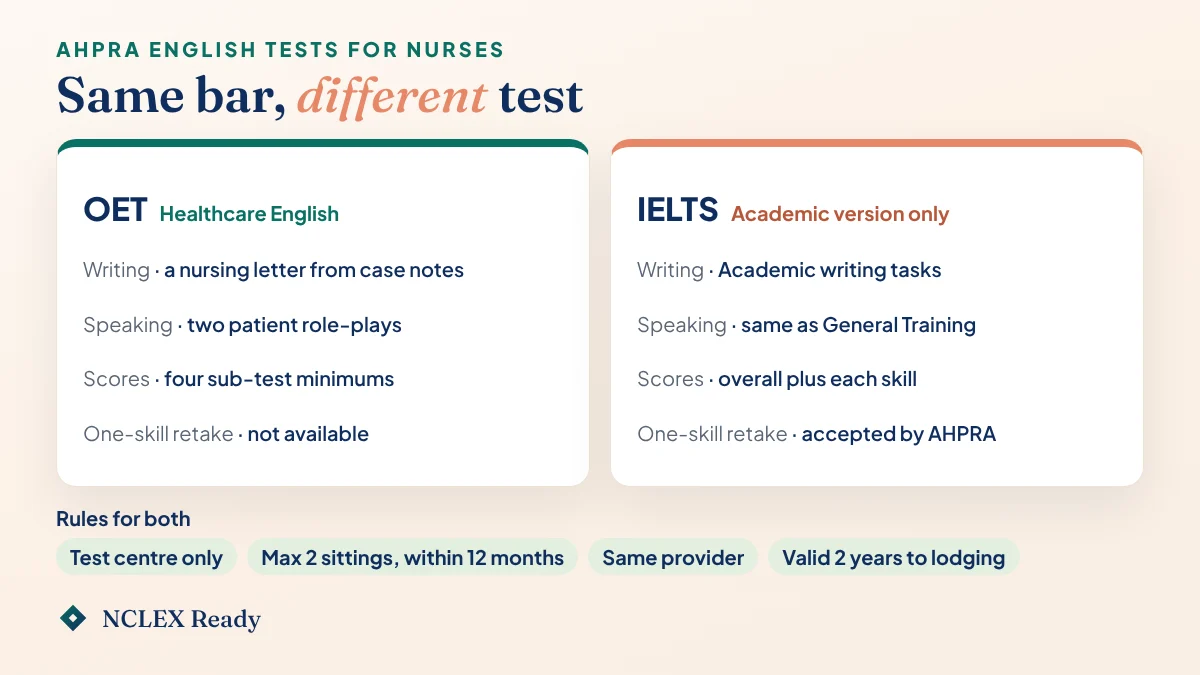
| Feature | OET | IELTS Academic |
|---|---|---|
| Built for | 12 healthcare professions, including nursing | Study at university level and professional registration |
| Listening and reading | Healthcare topics, common to all professions | Listening is the same as General Training, Reading is the Academic version |
| Writing | A nursing task, such as a referral, advice, or a letter of transfer or discharge, written from case notes | The Academic version, which differs from General Training |
| Speaking | Two nursing role-plays with an interlocutor | Same Speaking test as General Training |
| How scores are reported | 0 to 500 per sub-test, mapped to grades A to E | A score for each section plus an overall score |
| AHPRA overall score | None, four sub-test minimums only | Overall 7 |
| Retake one skill | Not available | One Skill Retake, accepted by AHPRA |
| Accepted delivery | Paper or computer at a test centre | Test centre only (IELTS is moving all tests to computer from mid-2026) |
OET in practice
OET's Writing and Speaking sub-tests are profession specific, so you sit nursing tasks (OET test). For writing, you get five minutes of reading time and 40 minutes to write a letter from case notes (OET Writing). For speaking, you do two role-plays, each usually coming to a natural end at about five minutes. OET says these may include "anxious or angry patients".
Each sub-test is scored from 0 to 500 in 10-point steps. OET's results page says grade B corresponds to a scale score of 350 (OET results and scoring). OET reports an overall score too, but AHPRA sets no overall OET minimum and looks only at the four sub-test scores. AHPRA accepts an OET from any profession that meets the standard.
IELTS Academic in practice
IELTS has two versions, and AHPRA accepts only Academic. IELTS's own page points nurses there, recommending Academic for anyone "seeking professional registration, e.g. doctors and nurses" (IELTS Academic). The test takes 2 hours and 45 minutes. Its Speaking and Listening are the same as General Training, while Reading and Writing differ.
IELTS has announced that from mid-2026 it will no longer offer a paper-based test, with timing varying by market (IELTS delivery update). In selected markets it is introducing a "Writing on Paper" option, where you handwrite only the Writing section of the computer test. The One Skill Retake needs an IELTS on computer original, and IELTS says a retake must be taken in the same delivery mode as the original test, including Writing on Paper.
What about PTE, TOEFL and Cambridge?
PTE Academic is a two-hour computer-based test at a test centre, scored by "AI scoring combined with human expertise", and it cannot be taken at home (PTE Academic). Its speaking minimum of 76 is the number to plan around. TOEFL iBT and the Cambridge tests are accepted on the same terms as the others. MET is not one of the five accepted tests.
OET or IELTS for nursing in Australia: how to choose
AHPRA's own advice is that "you should determine which test is the most suitable or convenient for you". Some honest questions help.
- Where is your English uneven? Look at your weakest skill, not your average. Every test sets a minimum in each skill, so one low skill decides the outcome.
- Which writing task feels natural? If you write discharge summaries and referrals at work, a letter from case notes may feel familiar. If you are comfortable writing about general academic topics, IELTS Academic may suit you.
- How do you speak best? OET's speaking is two patient-style role-plays. If you think in clinical conversations, that format may help you show your English.
- Would a retake help? If one skill tends to fall just short, the IELTS One Skill Retake is the only single-skill retake AHPRA accepts.
- What can you book? Check which tests and delivery modes are actually offered at a centre you can reach, and when results arrive.
Whatever you pick, take a full practice test under timed conditions first. Your results will tell you more than any group chat.
When to sit your test on the OBA pathway
English evidence is part of the registration application you lodge at the end of the OBA, after the NCLEX-RN and the OSCE. The registration form appears in your IQNM dashboard once you are eligible, and it asks for a copy of your English test result (NMBA applying for registration).
In January 2025 the NMBA said the application process, including examination, "typically takes 9-12 months but may take longer if additional time is needed or examinations must be re-sat" (NMBA media release, 27 January 2025). A result from early in the process is usually still inside two years at lodgement if things run to plan. A re-sit or a long wait can stretch that, so track your two-year date from the day you sit. Our guide to how long the OBA takes maps out each stage, and the AHPRA OBA pathway step by step shows where the English evidence fits.
If you are overseas, plan your test date backwards from when you expect to lodge, and keep in mind the 12-month window if you might need a second sitting. Our guides for Filipino nurses and Indian nurses cover the wider pathway from those countries.
If you are already in Australia, Australia is a recognised country. Continuous work in a relevant health, disability or aged-care role where English was the main language of practice may keep an older result valid. Check how this applies to you with AHPRA before you rely on it.
A separate note on visas. AHPRA says the same tests are used by the Department of Home Affairs for visa eligibility, and a test you sat for a skilled migration visa in the past two years can be reused if it meets the registration standard. Registration is not a visa, though. For visa English requirements, go to the Department of Home Affairs or a registered migration agent.
How NCLEX Ready can help
We focus on the clinical side of the OBA, not the English test. If you are weighing up when to start NCLEX-RN study alongside your English preparation, our free readiness test gives you a starting point. It is about 30 questions, takes 30 to 45 minutes, and needs no account. Take the readiness test.
Frequently asked questions
Is OET or IELTS easier for nurses applying to AHPRA?
AHPRA says the minimum scores are benchmarked to equivalent levels across all accepted tests, and that it is not easier to achieve the required scores on one test than another. The real choice is which format suits the way your English works, and which test you can sit at a centre near you.
What OET score do nurses need for AHPRA in 2026?
For an OET taken on or after 23 April 2026 you need Listening 350, Reading 360, Writing 350 and Speaking 360. AHPRA sets no overall OET score. An OET taken on or before 22 April 2026 is judged against the old grades of B in Listening, Reading and Speaking and C+ in Writing.
Did the IELTS score for AHPRA change in April 2026?
No. IELTS Academic stayed at an overall 7, with 7 in Listening, Reading and Speaking and 6.5 in Writing, for tests taken before and after 23 April 2026.
Can I combine an OET result with an IELTS result?
No. AHPRA accepts one sitting or two sittings no more than 12 months apart, and results from different test providers cannot be combined. Both sittings must come from the same test provider, such as two OETs or two IELTS Academic tests.
How long is an English test result valid for AHPRA registration?
Two years before the date you lodge your registration application. If you rely on two sittings, the two years run from the earlier one. There are limited exceptions for continuous work in a recognised country and continuous study in a Board-approved program, each with its own conditions, so check the official AHPRA page before you rely on one.
Are OET@Home or IELTS online tests accepted by AHPRA?
No. AHPRA does not accept at-home, indicative or remotely proctored versions of any test. The one exception is the OET computer-based test taken at a test centre, which has one remote element AHPRA has assessed as acceptable.
Sources
- Accepted English language tests — AHPRA — https://www.ahpra.gov.au/Registration/Registration-Standards/English-language-skills/Accepted-English-language-tests.aspx (accessed 18 October 2026)
- English language skills registration standard — Nursing and Midwifery Board of Australia — https://www.nursingmidwiferyboard.gov.au/Registration-Standards/English-language-skills.aspx (accessed 18 October 2026)
- Fact sheet: English language skills registration standard — Nursing and Midwifery Board of Australia — https://www.nursingmidwiferyboard.gov.au/codes-guidelines-statements/faq/fact-sheet-english-language-skills-registration-standard.aspx (accessed 18 October 2026)
- Registration standard: English language skills (2025) — Nursing and Midwifery Board of Australia — https://www.ahpra.gov.au/documents/default.aspx?record=WD24%2f34379&dbid=AP&chksum=7XlS%2fQCh6z21A%2frsD5vd8g%3d%3d (accessed 18 October 2026)
- Transition arrangements policy – changes to minimum scores and requirements for accepted English tests — National Boards and AHPRA — https://www.ahpra.gov.au/documents/default.aspx?record=WD26%2f36008&dbid=AP&chksum=aqaKtBlwcUlH9Xp8zF7OwQ%3d%3d (accessed 18 October 2026)
- Applying for registration — Nursing and Midwifery Board of Australia — https://www.nursingmidwiferyboard.gov.au/Accreditation/IQNM/Registration/Applying-for-registration.aspx (accessed 18 October 2026)
- Media release: new pathways for internationally qualified registered nurses, 27 January 2025 — Nursing and Midwifery Board of Australia — https://www.nursingmidwiferyboard.gov.au/News/2025-01-27-media-release-IQRN.aspx (accessed 18 October 2026)
- OET test — OET — https://oet.com/test/oet-test (accessed 18 October 2026)
- OET Writing — OET — https://oet.com/ready/writing (accessed 18 October 2026)
- OET Speaking — OET — https://oet.com/ready/speaking (accessed 18 October 2026)
- OET results and scoring — OET — https://oet.com/test/results-and-scoring (accessed 18 October 2026)
- IELTS Academic test format and sections — IELTS — https://ielts.org/take-a-test/test-types/ielts-academic-test (accessed 18 October 2026)
- IELTS One Skill Retake — IELTS — https://ielts.org/take-a-test/booking-your-test/one-skill-retake (accessed 18 October 2026)
- Updates to IELTS test delivery — IELTS — https://ielts.org/news-and-insights/updates-to-ielts-test-delivery (accessed 18 October 2026)
- PTE Academic — Pearson — https://www.pearsonpte.com/pte-academic (accessed 18 October 2026)
- Understanding your TOEFL iBT scores — ETS — https://www.ets.org/toefl/test-takers/ibt/scores/understand-scores.html (accessed 18 October 2026)
Last checked against the official sources above on 18 October 2026. Rules and fees change, so always confirm on the official page before you pay or book. If you spot something out of date, tell us at hello@nclexready.com.au.
How this guide was made
Researched and written by the NCLEX Ready team, drafted with AI assistance and checked line by line against the official pages listed above. This is general information, not registration, legal or migration advice.
NCLEX Ready is an independent educational platform operated by Aromika Pty Ltd. It is not affiliated with, endorsed by, or connected to AHPRA, NMBA, NCLEX, Pearson VUE, or NCSBN. NCLEX and NCLEX-RN are registered trademarks of NCSBN, used here for descriptive purposes only.