You finish a run of AIN shifts, open your laptop and search for NCLEX prep in Australia. The pages you find are mostly sales pages, a few have moved or closed, and none of them tells you what an AHPRA candidate actually needs. If you are paying for prep out of your own wages, that matters.
Good NCLEX prep for Australia matches the exam you will sit. That is the 2026 NCLEX-RN test plan, in force from 1 April 2026 to 31 March 2029, with 85 to 150 items in five hours. Prep should cover Next Gen case studies, explain every option and use Australian clinical language (official NCLEX site).
Below is a seven-point checklist, the red flags worth walking away from, and how to fit prep around a roster. If you are still working out where the NCLEX sits in your registration, start with our guide to the AHPRA OBA pathway step by step.
At a glance
| Item | Current detail | Official source |
|---|---|---|
| Exam you sit on the OBA pathway | The NCLEX-RN is the NMBA multiple-choice (MCQ) exam for registered nurses | NMBA MCQ exam page |
| Current test plan | 2026 NCLEX-RN Test Plan, effective 1 April 2026 to 31 March 2029 | Official NCLEX site: test plans |
| Exam length | 85 to 150 items within five hours, including all breaks | 2026 RN Test Plan (PDF) |
| Case studies | Three case studies of six items each, plus about 10 per cent stand-alone clinical judgement items | 2026 RN Test Plan (PDF) |
| Exam fees for Australian licensure | US$200 registration plus US$150 international scheduling, no refunds. Registration rises to US$350 from 1 February 2027 | Official NCLEX site: fees |
| Time to finish the MCQ stage | 180 days once your portfolio is established, or your IQNM case closes. The AHPRA handbook applies the 180 days to registering for the exam, so check both | NMBA MCQ exam page |
| Results | From AHPRA within six weeks. Quick Results is not available | NMBA: registered nurses, AHPRA RN MCQ handbook |
| Endorsed prep courses | None. The Board and AHPRA do not endorse any external MCQ preparation programs | NMBA MCQ exam page |
What you are actually preparing for
On the Stream B pathway, the multiple-choice stage is the NCLEX-RN. The NMBA says it plainly: "The MCQ exam for RNs is the National Council Licensure Examination for Registered Nurses (NCLEX-RN)." You must pass it before you can sit the OSCE (NMBA).
It is the same NCLEX-RN that US and Canadian candidates sit, with one useful difference. The AHPRA RN MCQ candidate handbook says the test plan may include questions on midwifery and US-specific practice, and that "these questions do not appear in the question set" for AHPRA-authorised candidates (AHPRA RN MCQ handbook). Prep that spends hours on US state law is spending your time on content you will not see.
The exam is a computerised adaptive test. Each answer shapes the next item, and you cannot skip items or go back to change an answer (official NCLEX site FAQ). Most often it stops when it is 95 per cent certain your ability is clearly above or below the passing standard. If your ability stays close to the standard, it runs to the maximum number of items (official NCLEX site).
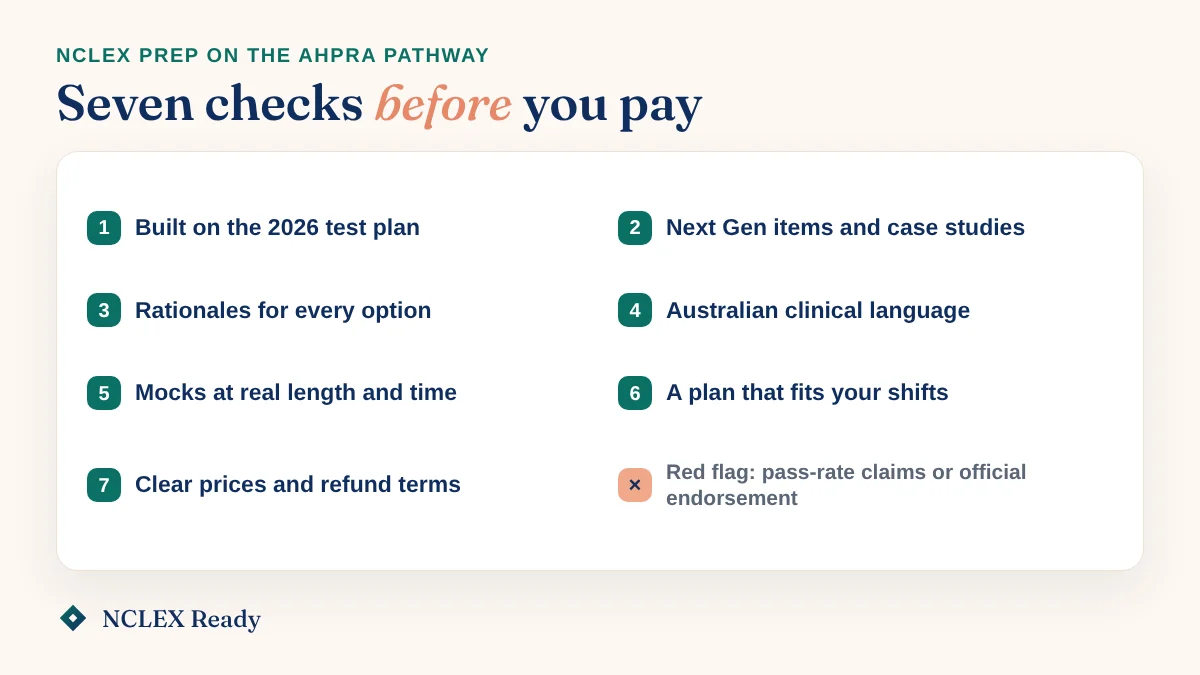
NCLEX prep in Australia: the seven checks
Use these as a scorecard. A course, a question bank or your own self-study plan should pass every one.
1. It is built on the 2026 test plan
The 2026 plan replaced the previous one on 1 April 2026, and it runs to 31 March 2029 (official NCLEX site). Its content is weighted across eight Client Needs areas. Management of Care is the largest at 15–21 per cent, followed by Pharmacological and Parenteral Therapies at 13–19 per cent (2026 RN Test Plan).
Ask the provider which test plan their questions are mapped to. A good answer names the 2026 plan and shows results by Client Needs area. That mirrors the Candidate Performance Report, which rates a failed candidate as below, near or above the passing standard by content area (official NCLEX site).
2. It includes Next Gen items and full case studies
The Next Generation NCLEX launched on 1 April 2023 to better measure clinical judgement (official NCLEX site). Under the 2026 plan, every exam includes three case studies of six items each. Each case study walks through the six steps of the Clinical Judgment Measurement Model. In our Australian spelling these are recognise cues, analyse cues, prioritise hypotheses, generate solutions, take action and evaluate outcomes (2026 RN Test Plan).
The test plan refers you to the official Candidate Tutorial for item formats. The official FAQ confirms multiple response (select all that apply) items, calculation items and items with exhibit tabs (official NCLEX site FAQ). Any item type may include charts, tables and graphics (2026 RN Test Plan). Work through the official tutorial first, then check that a course has items that look and behave like it.
Scoring matters too. The NCLEX gives partial credit on items with more than one key, using plus/minus, zero/one and rationale scoring (official NCLEX site FAQ). Prep that only marks you right or wrong hides where you picked up or lost points.
3. Every option has a rationale
A question bank teaches through its explanations. Look for a rationale on every option, including why each wrong answer is wrong, not just a line on the correct one. On a select-all-that-apply item, you learn most from the options you nearly chose.
Try a few sample questions before you pay. If the explanations are short, vague or copied across items, the bank will not show you why you are losing marks. You can see how we write ours on our sample questions page.
4. It uses Australian clinical language and shows both names
You work, think and chart in Australian terms. The TGA says adrenaline and noradrenaline "remain as the approved names in Australia" (TGA), with the international name added on labels as "adrenaline (epinephrine)" (TGA). Paracetamol is the Australian name, and the TGA itself notes it is known as acetaminophen in some countries (TGA).
Some old Australian names have gone. Medicines released for supply from 1 May 2026 must show the sole new name for most dual-labelled ingredients, so new labels say furosemide rather than frusemide and lidocaine rather than lignocaine, though older stock may still carry both names (TGA, TGA ingredient list). Good prep keeps up with that and shows both names where they still differ. Our guide to Australian drug names and terms covers the common pairs.
Terms vary within Australia too. Many wards say MET call. The national consensus statement talks about a rapid response system, delivered by medical emergency teams (METs) or nurse-led rapid response teams (ACSQHC) and NSW calls it a Rapid Response call (NSW Health). The national subcutaneous insulin chart records the blood glucose level as a BGL, which many nurses call a BSL (ACSQHC). The exam has its own vocabulary as well. The test plan says "client" and "primary health care provider", and uses unlicensed assistive personnel for any supportive role "regardless of title", which on your ward would cover AINs and PCAs (2026 RN Test Plan).
5. Mocks run at real length and real time
A mock should feel like the real day. That means up to 150 items in five hours with breaks inside the clock, and case studies mixed with stand-alone items (2026 RN Test Plan). It also means no skipping and no back button (official NCLEX site FAQ).
Pacing is a real risk. Under the run-out-of-time rule, if time expires before you have answered the minimum number of items, you fail automatically (official NCLEX site). Be wary of any mock that claims to predict your result exactly. A practice test can rehearse the conditions, but it is not the official adaptive exam.
6. It comes with a plan that fits your shifts
The official clocks shape your study window. Once your portfolio is established you have 180 days to complete the MCQ exam, says the NMBA, or your IQNM case is closed (NMBA). The AHPRA handbook words this as registering to sit the exam within 180 days of your dashboard moving to the MCQ stage (AHPRA RN MCQ handbook). The two pages differ, so check the official page and plan to sit well inside the window. AHPRA confirms your eligibility within four weeks of registering with Pearson VUE, and your Authorisation to Test is then valid for 90 days (NMBA, AHPRA RN MCQ handbook).
That is why it pays to start studying before the clock starts. A useful plan lets you:
- Take a baseline test and see your weakest Client Needs areas first.
- Set short sessions you can finish after a late shift, and longer ones on days off.
- Book full timed mocks for days off, never straight after a night shift.
- Track progress by area and by clinical judgement step, so you revise what is weak.
- Move your plan when the roster changes, without losing your history.
Our OBA pathway timeline shows how these clocks fit with the rest of the process.
7. Prices, inclusions and refund terms are clear
Know the official costs first. For Australian licensure, the official NCLEX site lists a US$200 registration fee and a US$150 international scheduling fee, and neither is refunded (official NCLEX site). From 1 February 2027 the registration fee becomes US$350. Each retake needs a new registration and fee (official NCLEX site, AHPRA RN MCQ handbook).
Before you pay for prep, ask:
- What is the total price, and does it renew automatically?
- How long does access last, and what happens if the exam date moves?
- What is the refund policy, in writing?
- Is there a free way to try real questions and mocks before paying?
If you are overseas: NCLEX centres operate in Australia, India and the Philippines, among other countries. The international scheduling fee applies at any centre outside the US and its territories, including centres in Australia (official NCLEX site).
If you are already in Australia: you still pay the international scheduling fee at an Australian centre. Budget for prep around your roster and pay cycle, not around a sales deadline.
Red flags worth walking away from
- Claims of official endorsement. The Board and AHPRA "do not endorse any external MCQ preparation programs" (NMBA).
- Pass-rate or guarantee claims you cannot check. A number with no method behind it tells you nothing.
- Recalled exam questions. The test plan says disclosing exam items is a violation of law and can lead to denial of licensure (2026 RN Test Plan).
- No mention of the 2026 test plan or case studies. The content may predate the current exam.
- Pressure tactics. Countdown timers and "last seats" messages are not reasons to pay.
Self-study, online course or face-to-face
There is no single right format. Self-study with the official tutorial and a good question bank costs the least, but it needs discipline. An online course adds structure and tracking, and fits around rotating shifts. Face-to-face classes give accountability, but fixed times can clash with a roster.
Whichever you choose, run it against the seven checks. Also plan for the result wait. AHPRA results take up to six weeks with no Quick Results, and a retake can be no sooner than 45 days after the exam (AHPRA RN MCQ handbook, official NCLEX site). If you are weighing up the order of exams, see NCLEX or OSCE first.
How NCLEX Ready can help
If you want a starting point, our free readiness test is about 30 questions and takes 30 to 45 minutes, with no account needed. It shows where you stand before you spend anything. NCLEX Ready has about 1,520 practice questions in Next Gen NCLEX formats, 62 case studies, flashcards and mock exams, with a 7-day free trial and no card required.
Frequently asked questions
Does AHPRA or the NMBA recommend an NCLEX prep course?
No. The NMBA multiple-choice exam page says the Board and AHPRA do not endorse any external MCQ preparation programs. Treat any provider that implies official endorsement as a red flag.
Is the NCLEX for AHPRA the same exam US nurses sit?
It is the same NCLEX-RN, built on the same test plan. The AHPRA candidate handbook says test plan questions about midwifery and practice specific to the United States do not appear in the question set for candidates authorised by AHPRA.
How long is the NCLEX-RN under the 2026 test plan?
You answer between 85 and 150 items within five hours, and the five hours include all breaks. The exam is adaptive, so in most cases it stops once it is 95 per cent certain your ability is clearly above or below the passing standard.
How much does the NCLEX cost for Australian registration?
The official NCLEX site lists a US$200 registration fee plus a US$150 international scheduling fee for candidates seeking Australian licensure, and neither is refunded. From 1 February 2027 the registration fee becomes US$350.
How long do NCLEX results take on the AHPRA pathway?
AHPRA sends official results within six weeks of your exam, and Quick Results is not available to AHPRA candidates. If you need a retake, the earliest is 45 days after the exam, with a new registration and fee.
Sources
- Multiple-choice question exam — Nursing and Midwifery Board of Australia — https://www.nursingmidwiferyboard.gov.au/Accreditation/IQNM/Examination/Multiple-choice-question-exam.aspx (accessed 18 October 2026)
- Registered nurses (IQNM examination) — Nursing and Midwifery Board of Australia — https://www.nursingmidwiferyboard.gov.au/Accreditation/IQNM/Examination/Registered-nurses.aspx (accessed 18 October 2026)
- RN MCQ candidate handbook, 7 July 2026 — AHPRA — https://www.ahpra.gov.au/documents/default.aspx?record=WD20%2f30348%5bv4%5d&dbid=AP&chksum=k4ADJY8TbYgF7ZCnhMWpRcC7DpNYtmns5SkLnOTea7o%3d (accessed 18 October 2026)
- Test plans — official NCLEX site — https://www.nclex.com/test-plans.page (accessed 18 October 2026)
- 2026 NCLEX-RN Test Plan (PDF) — official NCLEX site — https://www.nclex.com/files/2026_RN_Test%20Plan_English-F.pdf (accessed 18 October 2026)
- Computerized adaptive testing — official NCLEX site — https://www.nclex.com/computerized-adaptive-testing.page (accessed 18 October 2026)
- FAQs — official NCLEX site — https://www.nclex.com/faqs.page (accessed 18 October 2026)
- Next Generation NCLEX — official NCLEX site — https://www.nclex.com/next-generation-nclex.page (accessed 18 October 2026)
- Candidate Performance Report — official NCLEX site — https://www.nclex.com/candidate-performance-report.page (accessed 18 October 2026)
- Fees and payment — official NCLEX site — https://www.nclex.com/fees-payment.page (accessed 18 October 2026)
- Testing locations — official NCLEX site — https://www.nclex.com/testing-locations.page (accessed 18 October 2026)
- Results — official NCLEX site — https://www.nclex.com/results.page (accessed 18 October 2026)
- Changes to adrenaline and noradrenaline labels — Therapeutic Goods Administration — https://www.tga.gov.au/products/medicines/labelling-and-advertising/medicines-and-biologicals-labelling-and-packaging/changes-adrenaline-and-noradrenaline-labels (accessed 18 October 2026)
- Dual-labelled medicine ingredient names: transition to sole names — Therapeutic Goods Administration — https://www.tga.gov.au/products/medicines/labelling-and-advertising/medicines-and-biologicals-labelling-and-packaging/labelling-requirements-information-sponsors/dual-labelled-medicine-ingredient-names-transition-sole-names (accessed 18 October 2026)
- Section 19A approval (lapsed), Tylenol paracetamol 500 mg — Therapeutic Goods Administration — https://www.tga.gov.au/resources/section-19a-approvals/approval-lapsed-tylenol-paracetamol-500mg-tablet-100-tablets (accessed 18 October 2026)
- National Consensus Statement: recognising and responding to acute physiological deterioration, third edition — Australian Commission on Safety and Quality in Health Care — https://www.safetyandquality.gov.au/sites/default/files/2026-09/National-Consensus-Statement-Essential-elements-for-recognising-and-responding-to-acute-physiological-deterioration-third-edition.pdf (accessed 18 October 2026)
- Recognition and management of patients who are deteriorating (PD2025_014) — NSW Health — https://www1.health.nsw.gov.au/pds/ActivePDSDocuments/PD2025_014.pdf (accessed 18 October 2026)
- User guide to the National Subcutaneous Insulin Chart — Australian Commission on Safety and Quality in Health Care — https://www.safetyandquality.gov.au/sites/default/files/resources/attachments/User-guide-to-the-national-subcutaneous-insulin-chart-Acute-facilities-October-2017.pdf (accessed 18 October 2026)
- Updating medicine ingredient names: list of affected ingredients — Therapeutic Goods Administration — https://www.tga.gov.au/products/medicines/labelling-and-advertising/medicines-and-biologicals-labelling-and-packaging/labelling-requirements-international-harmonisation-ingredient-names-project/updating-medicine-ingredient-names-list-affected-ingredients (accessed 18 October 2026)
Last checked against the official sources above on 18 October 2026. Rules and fees change, so always confirm on the official page before you pay or book. If you spot something out of date, tell us at hello@nclexready.com.au.
How this guide was made
Researched and written by the NCLEX Ready team, drafted with AI assistance and checked line by line against the official pages listed above. This is general information, not registration, legal or migration advice.
NCLEX Ready is an independent educational platform operated by Aromika Pty Ltd. It is not affiliated with, endorsed by, or connected to AHPRA, NMBA, NCLEX, Pearson VUE, or NCSBN. NCLEX and NCLEX-RN are registered trademarks of NCSBN, used here for descriptive purposes only.