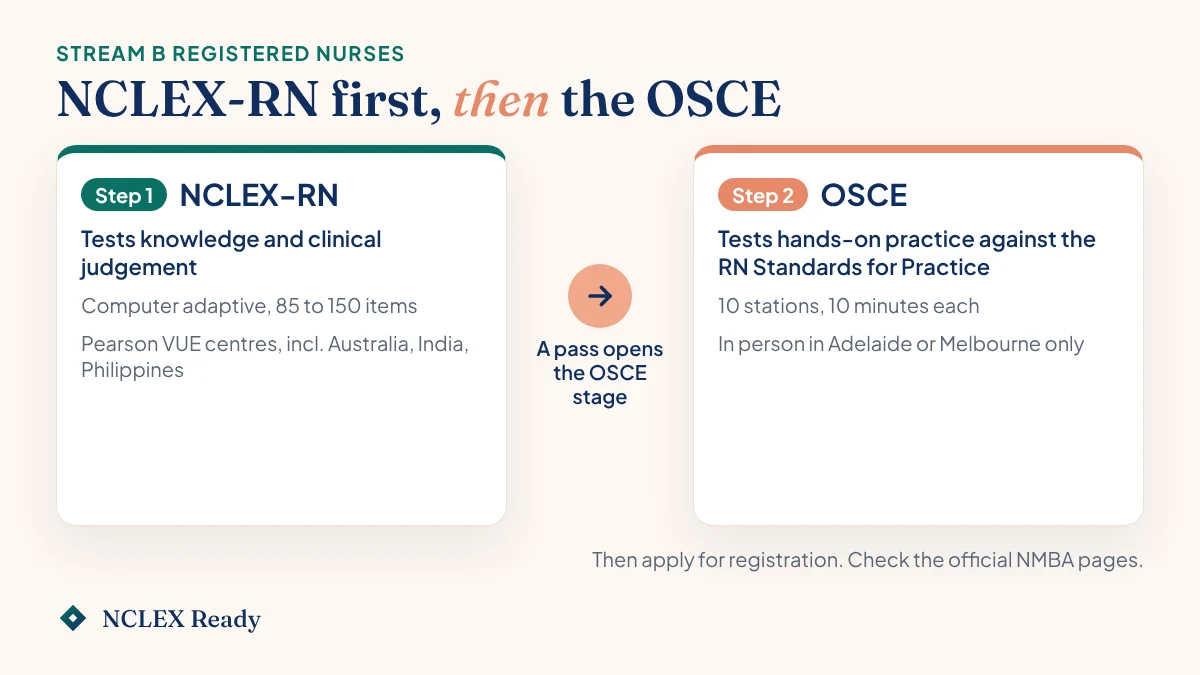
It is one of the most common questions internationally qualified nurses ask. NCLEX or OSCE first, and can I book the OSCE while I study for the NCLEX? The short answer is no. The useful answer is what that order means for your money, your visa planning and the 120-day payment window that opens once your case reaches the OSCE stage.
So, NCLEX or OSCE first? The NCLEX-RN comes first, every time, for registered nurses on the Stream B outcomes-based assessment. The NMBA states that "candidates must pass the MCQ exam before they can proceed to the Objective Structured Clinical Exam (OSCE)", and for RNs that MCQ is the NCLEX-RN (NMBA MCQ exam page).
At a glance
| Item | Current detail | Official source |
|---|---|---|
| Which exam comes first | NCLEX-RN (the MCQ exam for RNs), then the OSCE | NMBA MCQ exam page |
| Existing NCLEX-RN pass | Counts if passed within 10 years of establishing your portfolio | NMBA MCQ exam page |
| NCLEX-RN results | Emailed by AHPRA within six weeks. Quick Results is not available on this route | NMBA Registered nurses exam page |
| Window to pay for the OSCE | 120 days from when your case is set to the OSCE stage | NMBA OSCE page |
| OSCE fee | A$4,000 per sitting (schedule effective 9 October 2026) | NMBA fees |
| OSCE venues | Adelaide Health Simulation (Adelaide) and RANZCOG (Melbourne CBD), in person in Australia only | RN OSCE candidate handbook, 7 July 2026 |
| Re-sit wait after a fail | At least 45 calendar days from the result, for either exam | NMBA policy: Examination re-sits |
NCLEX or OSCE first: why the order is fixed
The outcomes-based assessment (OBA) is Stream B of the internationally qualified nurse and midwife (IQNM) process. The NMBA says Stream B stages must be completed "in the order shown": Orientation Part 1, then the Portfolio, then the OBA, which is an MCQ exam followed by an OSCE (Steps after Self-check).
The order is built into the system. The RN MCQ candidate handbook says that after a pass, "the next step is to pay the OSCE fee on the IQNM dashboard". The OSCE then has to be passed before you are eligible to apply for registration (NMBA OSCE page).
The NMBA describes the two exams differently. The MCQ exam "assesses the candidate's professional knowledge". The OSCE assesses whether you "demonstrate the knowledge, skills and competence of a graduate-level nurse" from an Australian NMBA-approved program (NMBA Examination page). Knowledge is checked first, then you show it in practice.
For the full sequence from Self-check to registration, see our guide to the AHPRA OBA pathway step by step.
The exception: an NCLEX-RN pass you already hold
If you passed the NCLEX-RN for another regulator, the NMBA accepts RN candidates "who have passed the NCLEX-RN exam within 10 years of establishing their portfolio" (NMBA MCQ exam page).
You upload your NCLEX-RN candidate report at the Portfolio stage, or email it to the IQNM Exams Team. If you cannot get the report, a copy of your test booking is accepted (NMBA Registered nurses exam page). This skips the MCQ step only. You still sit and pass the OSCE.
What each exam tests
The NCLEX-RN
For Australian registration, the MCQ for RNs is the National Council Licensure Examination for Registered Nurses (NCLEX-RN), delivered through Pearson VUE. AHPRA's handbook says the NCLEX test plans may include questions on midwifery and practice specific to the United States, and that these do not appear in the question set when AHPRA authorises you (RN MCQ candidate handbook).
Under the 2026 test plan, you answer between 85 and 150 items in a five-hour period that includes breaks. These include three clinical judgement case studies of six items each (2026 NCLEX-RN test plan). The July 2026 AHPRA handbook still quotes an older range of 75 to 265 items, so go by the current test plan. It is computer adaptive, so after every answer the computer re-estimates your ability and picks the next item to match (official NCLEX site, CAT).
You can sit it at Pearson VUE NCLEX centres in Australia, India, the Philippines and other countries (official NCLEX site, testing locations).
The OSCE
The RN OSCE is an in-person exam held in Australia only. It runs every calendar month at one of two venues, Adelaide Health Simulation in Adelaide or RANZCOG in Melbourne CBD (NMBA Registered nurses exam page).
It has 10 stations of 10 minutes each, made up of two minutes reading and eight minutes performing. Stations test you against the NMBA Registered Nurse Standards for Practice, in settings such as a ward, emergency department, GP clinic or aged care. You must perform the skills, "not just talk about what they would do". Communication is assessed in every station, and you should be familiar with the ISBAR approach (RN OSCE candidate handbook).
Side by side
| NCLEX-RN | OSCE | |
|---|---|---|
| What it checks | Professional knowledge and clinical judgement | Hands-on practice at graduate RN level, against the NMBA RN Standards for Practice |
| Format | Computer adaptive, 85 to 150 items, up to five hours | 10 stations, 10 minutes each |
| Where | Pearson VUE centres, including in Australia, India and the Philippines | Adelaide or Melbourne, in person only |
| Fees | US$200 registration plus US$150 international scheduling | A$4,000 per sitting |
| Results | Within six weeks, by email from AHPRA | Within eight weeks, with station-by-station marks |
For stations, dress code and exam day, see the NMBA OSCE and what to expect.
The deadlines on each side of the NCLEX
Before the NCLEX
Once your portfolio is established, you have 180 days to complete the MCQ exam, or your IQNM case is closed. You can ask the IQNM Exams Team to reopen it (NMBA MCQ exam page).
Your Authorisation to Test (ATT) is valid for 90 days from the date AHPRA authorises you. If you do not sit within that time, you re-register and pay the fees again. AHPRA's RN MCQ candidate handbook and the NMBA Registered nurses exam page allow an extension only for extenuating circumstances approved by AHPRA. The official NCLEX flyer for this route says "there are no extensions". Plan as if the 90 days are firm, and email the IQNM Exams Team straight away if something outside your control happens.
After the NCLEX: the OSCE clock
- Result. AHPRA emails your NCLEX result within six weeks. There is no Quick Results option on this route.
- Pay within 120 days. You have 120 days to pay the OSCE fee from when your case is set to the OSCE stage, or the case is closed (NMBA OSCE page).
- Visa, if you are overseas. After you pay, the IQNM Exams Team sends a letter you can include in a visa application, within four weeks. You must send a copy of your visa approval before you are invited to an exam date.
- Get in early. The handbook says your fee, and your visa if offshore, should be in at least three months before an exam cycle to receive an availability email.
- Book within about six months. The NMBA OSCE page gives 180 days after paying "to schedule" your exam. The July 2026 handbook says 180 days "to sit and complete" an OSCE. Plan to have sat it within six months of paying. If the window lapses, the case is closed and the fee refunded.
- Confirmation. Your confirmation letter arrives four to eight weeks before the exam. Do not book travel until it arrives.
- Result. OSCE results arrive within eight weeks, with each station's mark and standard. There is no recheck.
If you are overseas: you can sit the NCLEX near home, but the OSCE means travelling to Adelaide or Melbourne. Registration is not a visa, and AHPRA does not give visa advice. Take visa questions to the Department of Home Affairs or a registered migration agent.
If you are already in Australia: the visa letter and visa approval steps are for offshore candidates, but the 120-day payment and 180-day windows apply to you too. For whole-pathway timeframes, read how long the OBA pathway takes.
How long an OSCE pass lasts
The official sources differ, so here are both.
The NMBA OSCE page says "an OSCE passing result is valid for a period of five years". It adds that a pass meets the recency of practice standard for a maximum of two years.
The newer RN OSCE candidate handbook (7 July 2026) says you "have 90 days from receiving their result to submit their complete application for registration".
The safe plan is to have your registration documents ready before your OSCE result, then apply promptly. If you cannot apply within 90 days, check with the IQNM Exams Team before the deadline passes. If an OSCE pass does expire, the NMBA says you retake the OSCE but not the MCQ exam.
If you fail either exam
The NMBA examination re-sits policy, in effect from 1 July 2025, sets a wait of at least 45 calendar days from the date your result is communicated. A re-sit means the whole exam again. The policy does not state a maximum number of attempts, but it says re-sits are subject to any limit on the number allowed each calendar year, so check the current handbook before you plan a second attempt.
- NCLEX-RN fail: you register and pay with Pearson VUE again to start the process over. You receive a Candidate Performance Report.
- OSCE fail: you pay another OSCE fee, and the handbook says you must wait at least one exam cycle before rescheduling.
Planning tips for the gap
The wait between your NCLEX result and your OSCE date is useful time.
- Learn the Australian charts. The NMBA OSCE page links examples of charts and forms you may need to work with, including the adult and paediatric observation charts, neuro and neurovascular obs, a blood glucose record, falls and pressure care risk, a mental health risk chart and an IV fluid order chart.
- Practise ISBAR out loud. The handbook expects you to know the ISBAR approach, and lists the Australian Commission on Safety and Quality in Health Care ISBAR toolkit.
- Switch your vocabulary. Paracetamol, adrenaline, obs, MET call and BSL are what you will hear on an Australian ward. Our list of Australian drug names and terms helps.
- Budget for both exams. NCLEX fees are in US dollars. From 1 February 2027 the registration fee for Australian candidates rises to US$350. The notice does not mention a change to the US$150 international scheduling fee (official NCLEX site, fees).
- Think before transferring your score. Transferring an NCLEX-RN score out of AHPRA closes your IQNM case unless you have already paid the OSCE fee, and some regulators do not accept transfers from AHPRA (NMBA Registered nurses exam page).
- Hold off on big moves. The NMBA advises against irreversible decisions, such as resigning or moving to Australia, until your registration is approved (NMBA Before you apply).
How NCLEX Ready can help
NCLEX Ready has about 1,520 practice questions with rationales written in Australian clinical language, including Next Gen NCLEX formats and 62 case studies. To see where you stand before you book, the free readiness test takes about 30 questions and 30 to 45 minutes, with no account needed. The NMBA and AHPRA do not endorse any prep course, including ours.
Frequently asked questions
Can I book the OSCE before I pass the NCLEX?
No. For registered nurses on the Stream B outcomes-based assessment, the NMBA says you must pass the MCQ exam, which is the NCLEX-RN, before you can proceed to the OSCE. The OSCE fee can only be paid on your IQNM dashboard once the NCLEX pass shows there.
I passed the NCLEX for a US or Canadian regulator. Do I sit it again for AHPRA?
Not if the pass falls within 10 years of establishing your portfolio. Upload your NCLEX-RN candidate report at the Portfolio stage, or a test booking if the report is unavailable. You still need to pass the OSCE.
How long do I have to pay for the OSCE after passing the NCLEX?
The NMBA gives you 120 days to pay the OSCE fee from when your IQNM case is set to the OSCE stage. If you do not pay in that time the case is closed, though you can ask for it to be reopened.
How long is an OSCE pass valid?
The NMBA OSCE page says a pass is valid for five years but meets the recency of practice standard for only two. The July 2026 RN OSCE candidate handbook says to submit your registration application within 90 days of your result, so plan to apply promptly.
If my OSCE pass expires, do I have to sit the NCLEX again?
No. The NMBA says an expired OSCE pass means retaking the OSCE but not the MCQ exam, which for registered nurses is the NCLEX-RN.
How long must I wait to re-sit the NCLEX or the OSCE after a fail?
The NMBA re-sit policy sets at least 45 calendar days from the date your result is communicated, for both exams. The OSCE handbook adds that you must wait at least one exam cycle and pay the OSCE fee again.
Sources
- Multiple-choice question exam — Nursing and Midwifery Board of Australia — https://www.nursingmidwiferyboard.gov.au/Accreditation/IQNM/Examination/Multiple-choice-question-exam.aspx (accessed 18 October 2026)
- Objective structured clinical exam — Nursing and Midwifery Board of Australia — https://www.nursingmidwiferyboard.gov.au/Accreditation/IQNM/Examination/Objective-structured-clinical-exam.aspx (accessed 18 October 2026)
- Registered nurses (Examination) — Nursing and Midwifery Board of Australia — https://www.nursingmidwiferyboard.gov.au/Accreditation/IQNM/Examination/Registered-nurses.aspx (accessed 18 October 2026)
- Examination — Nursing and Midwifery Board of Australia — https://www.nursingmidwiferyboard.gov.au/Accreditation/IQNM/Examination.aspx (accessed 18 October 2026)
- Steps after Self-check — Nursing and Midwifery Board of Australia — https://www.nursingmidwiferyboard.gov.au/Accreditation/IQNM/Self-check-and-Portfolio/Steps-after-Self-check.aspx (accessed 18 October 2026)
- Before you apply — Nursing and Midwifery Board of Australia — https://www.nursingmidwiferyboard.gov.au/Accreditation/IQNM/Before-you-apply.aspx (accessed 18 October 2026)
- Fees — Nursing and Midwifery Board of Australia — https://www.nursingmidwiferyboard.gov.au/Registration-and-Endorsement/Fees.aspx (accessed 18 October 2026)
- Registered Nurse OSCE Candidate Handbook (7 July 2026) — AHPRA — https://www.ahpra.gov.au/documents/default.aspx?record=WD20%2f30349%5bv12%5d&dbid=AP&chksum=krcq6pDijKrhj6TZEQUMIsw0wcbCCWMzB4vo8GYPtPc%3d (accessed 18 October 2026)
- Registered Nurse MCQ Candidate Handbook (7 July 2026) — AHPRA — https://www.ahpra.gov.au/documents/default.aspx?record=WD20%2f30348%5bv4%5d&dbid=AP&chksum=k4ADJY8TbYgF7ZCnhMWpRcC7DpNYtmns5SkLnOTea7o%3d (accessed 18 October 2026)
- Policy: Examination re-sits — NMBA and AHPRA — https://www.ahpra.gov.au/documents/default.aspx?record=WD25%2f34888&dbid=AP&chksum=9u0zB%2bK%2b9%2fmX1RNpfBmopw%3d%3d (accessed 18 October 2026)
- 2026 NCLEX-RN Test Plan — official NCLEX site — https://www.nclex.com/files/2026_RN_Test%20Plan_English-F.pdf (accessed 18 October 2026)
- Computerized Adaptive Testing — official NCLEX site — https://www.nclex.com/computerized-adaptive-testing.page (accessed 18 October 2026)
- Testing locations — official NCLEX site — https://www.nclex.com/testing-locations.page (accessed 18 October 2026)
- Fees and payment — official NCLEX site — https://www.nclex.com/fees-payment.page (accessed 18 October 2026)
- NCLEX information flyer for AHPRA candidates — official NCLEX site — https://www.nclex.com/files/2026_nclex_info_flyer_aphra.pdf (accessed 18 October 2026)
- Department of Home Affairs — Australian Government — https://immi.homeaffairs.gov.au/ (accessed 18 October 2026)
Last checked against the official sources above on 18 October 2026. Rules and fees change, so always confirm on the official page before you pay or book. If you spot something out of date, tell us at hello@nclexready.com.au.
How this guide was made
Researched and written by the NCLEX Ready team, drafted with AI assistance and checked line by line against the official pages listed above. This is general information, not registration, legal or migration advice.
NCLEX Ready is an independent educational platform operated by Aromika Pty Ltd. It is not affiliated with, endorsed by, or connected to AHPRA, NMBA, NCLEX, Pearson VUE, or NCSBN. NCLEX and NCLEX-RN are registered trademarks of NCSBN, used here for descriptive purposes only.