Most nurses on the OBA pathway have years of clinical experience. You already recognise a deteriorating patient at two in the morning. What catches people out on the NCLEX is not the clinical knowledge itself but how the exam slices that thinking into separate, scored steps.
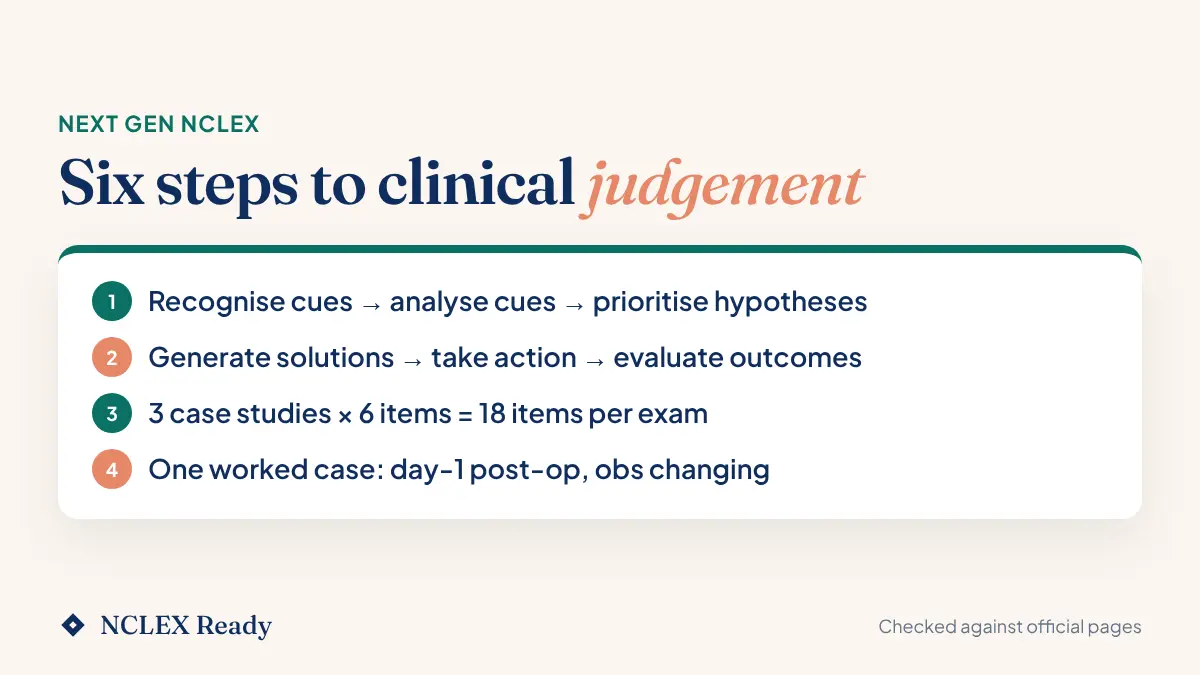
NCLEX clinical judgement is measured with a six-step model: recognise cues, analyse cues, prioritise hypotheses, generate solutions, take action and evaluate outcomes. Under the 2026 NCLEX-RN test plan, every exam has three case studies of six items, one item per step, plus stand-alone clinical judgement items (2026 NCLEX-RN test plan).
This guide explains each step, shows the kind of stem you will meet, names the common trap, then walks one Australian ward case through all six.
At a glance
| Item | Current detail | Official source |
|---|---|---|
| The model | Clinical Judgment Measurement Model (NCJMM), developed by the exam's owner, NCSBN | Official NCLEX site, NCJMM |
| The six steps | Recognise cues, analyse cues, prioritise hypotheses, generate solutions, take action, evaluate outcomes | 2026 NCLEX-RN test plan |
| Case studies per exam | Three, with six items each (18 items) | 2026 NCLEX-RN test plan |
| Stand-alone clinical judgement items | About 10 per cent, depending on exam length | 2026 NCLEX-RN test plan |
| Exam length | 85 to 150 items in five hours, breaks included | 2026 NCLEX-RN test plan |
| Scoring | Partial credit on items with more than one key: plus/minus, zero/one and rationale scoring | Official NCLEX FAQ |
| Going back | Not allowed. You cannot skip or change earlier answers | Official NCLEX FAQ |
What the clinical judgement model is
The Next Generation NCLEX launched on 1 April 2023 to better measure clinical judgement and decision making (official NCLEX site). The framework behind it is the NCSBN Clinical Judgment Measurement Model, usually shortened to NCJMM. We use the Australian spelling "judgement" in this guide, except in the model's proper name.
The official NCJMM page describes the model in layers, from layer 0, the context of the clinical situation, to layer 4, the most specific contextual detail. Layer 3 holds the cognitive skills that can be measured directly, and those are what exam items and case studies are built on (official NCLEX site, NCJMM). Those six skills are the six steps.
The same page says a nursing process underlies the model, and that the model was not built to replace any nursing process. So if you trained on ADPIE (assess, diagnose, plan, implement, evaluate) or a similar cycle, nothing is wasted. The NCJMM breaks the same thinking into finer steps so each one can be scored.
The 2026 test plan defines clinical judgement as an iterative, multistep process that uses nursing knowledge to observe and assess a situation, identify a prioritised client concern and generate the best evidence-based solutions for safe care (2026 NCLEX-RN test plan).
How clinical judgement shows up in the exam
Clinical judgement content arrives in two forms. A case study is six items about the same client, with information that unfolds as you move through it. A stand-alone item tests one piece of judgement on its own (2026 NCLEX-RN test plan).
The test plan sets out the minimum-length exam of 85 items like this:
| Part of the minimum-length exam | Items |
|---|---|
| Content-area items across the eight Client Needs areas | 52 |
| Clinical judgement case studies (three sets of six) | 18 |
| Unscored pretest items | 15 |
| Total | 85 |
Because clinical judgement crosses every content area, the case studies are counted separately from the content-area items. You might get a surgical case, a mental health case and a paediatric case in the same sitting.
Two practical points come from the official FAQ. You cannot go back to change an earlier answer, including inside a case study. And items with more than one correct answer earn partial credit under one of three scoring methods (official NCLEX FAQ):
- Plus/minus when you can choose any number of options. Correct picks earn points, wrong picks lose them, and the floor is zero.
- Zero/one when you are told how many to choose. Correct picks earn a point and wrong picks earn nothing.
- Rationale when two pieces of information are paired, such as a condition and the finding that supports it. Both halves must be right to score.
For the formats themselves, such as bow-tie, matrix and drop-down cloze, see our guide to Next Gen NCLEX question types.
The six steps of clinical judgement, one by one
The definitions below are from the 2026 test plan. The stem patterns and traps are ours, drawn from how these items are commonly written. They are a study aid, not official wording.
1. Recognise cues
What it asks: identify the relevant and important information from different sources, such as the medical history and obs.
Typical stem: "Which findings require immediate follow-up?" Often a highlight item on the nurses' notes or a matrix against the obs chart.
Common trap: selecting every abnormal value. A slightly low potassium in a stable patient is abnormal but may not be the cue that matters today. Ask what is new, what is changing and what is dangerous.
2. Analyse cues
What it asks: organise and connect the cues you recognised to the client's clinical presentation.
Typical stem: "The client's findings are most consistent with which condition?" or a drop-down sentence such as "The client is at risk for ___ as evidenced by ___."
Common trap: linking a cue to the wrong condition. Rationale scoring means a correct condition with the wrong supporting finding earns nothing for that pair.
3. Prioritise hypotheses
What it asks: evaluate and rank your hypotheses by urgency, likelihood, risk, difficulty and time constraints.
Typical stem: "Which condition is the client at highest risk for developing?" or "The nurse should first address ___."
Common trap: choosing the most likely problem rather than the most dangerous one. A low-grade temperature on day 1 is common, but low blood pressure with a rising heart rate is more urgent. Our guide to prioritisation and delegation questions goes deeper on ranking.
4. Generate solutions
What it asks: identify expected outcomes and use your hypotheses to define a set of interventions.
Typical stem: "Which interventions should the nurse anticipate for this client?" or a matrix of interventions marked as indicated, not indicated or contraindicated.
Common trap: planning for a hypothesis you already ranked lower. Your solutions should match the priority you set in step 3. Many of these items are select-all-that-apply, so read our guide to SATA questions.
5. Take action
What it asks: implement the solutions that address the highest priority.
Typical stem: "Which action should the nurse take first?" or "Which actions should the nurse implement?"
Common trap: picking an action outside the nurse's role, or one that delays urgent care. Leaving the deteriorating patient to look up a policy, or waiting for a result before escalating, are classic wrong answers.
6. Evaluate outcomes
What it asks: compare the observed outcomes with the expected outcomes.
Typical stem: "Which findings indicate the treatment has been effective?" or a matrix of findings marked as improved, no change or declined.
Common trap: treating any change as improvement. A heart rate that has dropped a little but is still high is not a full response. Compare each finding with the expected outcome you set in step 4.
A worked case on an Australian ward
This case is original and simplified for learning. It follows the same unfolding shape as an exam case study, with one question per step. Always follow your facility's escalation criteria and the treating team's orders in real practice.
The scenario
Mr Lim is 68 and on a surgical ward, day 1 after an open bowel resection. He has a patient-controlled analgesia (PCA) for pain and a wound drain. At handover he was settled, with a blood pressure of 132/78 and a heart rate of 84.
At 0600 you do his obs:
| Obs | Handover (2200) | Now (0600) |
|---|---|---|
| Heart rate | 84 | 116 |
| Blood pressure | 132/78 | 96/58 |
| Respiratory rate | 16 | 22 |
| SpO2 | 97% on 2 L nasal prongs | 95% on 2 L nasal prongs |
| Temperature | 37.2 °C | 37.4 °C |
| Urine output | 50 mL/h | 20 mL/h for the last two hours |
He is pale, clammy and says he feels "not right". The wound dressing has fresh blood-stained ooze and the drain has filled faster than overnight. Pain is 3 out of 10.
Step 1. Recognise cues
The cues that need follow-up are the heart rate of 116, the blood pressure of 96/58 (a big fall from 132/78), the respiratory rate of 22, the low urine output, the pale and clammy skin, the fresh ooze and the faster drain output. His temperature of 37.4 °C and pain of 3 out of 10 are not the urgent cues here.
Step 2. Analyse cues
Put the cues together. A rising heart rate, falling blood pressure, low urine output, pale and clammy skin and increased blood loss from the wound and drain fit hypovolaemia, most likely from post-operative bleeding. Other possibilities to keep in mind include sepsis, a pulmonary embolism and atelectasis.
Step 3. Prioritise hypotheses
Bleeding with early signs of shock is the most urgent and the most likely. Sepsis is less likely on day 1 when there are clear signs of blood loss, though it stays on the list because it can appear without a fever. Atelectasis is common after abdominal surgery, but it does not explain the fall in blood pressure. You address the bleeding first.
Step 4. Generate solutions
The expected outcomes are a heart rate and blood pressure moving back towards his baseline, urine output of at least 0.5 mL/kg/h and no further increase in blood loss. Interventions to plan for:
- Urgent medical review under your facility's escalation criteria, which may mean a MET call
- A clear ISBAR handover to the team
- Checking his IV access is patent and preparing for IV fluids as prescribed
- Bloods as ordered, which may include a full blood count and a group and hold or crossmatch
- Frequent obs, a check of the wound and drain, and an accurate fluid balance chart
- Keeping him nil by mouth until reviewed, in case he needs to return to theatre
Step 5. Take action
The first action is to stay with Mr Lim and escalate. Call for help under your local criteria, then give the medical officer an ISBAR handover. Lie him flat if he is light-headed, keep his oxygen on and repeat his obs. Give IV fluids and collect bloods as ordered. Do not leave him to chase a result or wait until the next scheduled obs round.
Step 6. Evaluate outcomes
Thirty minutes after a prescribed fluid bolus, his heart rate is 98, his blood pressure 110/68 and his urine output 35 mL in the last hour. The drain output has slowed. These findings show improvement towards the expected outcomes, but he is not back to baseline. He still needs close obs and the surgical team's plan. If his blood pressure had fallen again, the right answer would be to re-escalate, not to keep watching.
Why this matters on exam day
In a real case study, each step is a separate scored item, and the exam adds new data as you go. A wrong call in step 3 can pull steps 4 and 5 off course, so it pays to settle your priority before you plan.
How to practise NCLEX clinical judgement
- Learn the test plan's words. The test plan uses "client" for the person in your care and "primary health care provider" for the prescriber. It uses "unlicensed assistive personnel" for staff such as AINs (2026 NCLEX-RN test plan). Knowing these saves rereading time.
- Name the step before you answer. Ask yourself whether the item wants cues, a link, a priority, a plan, an action or an evaluation. The stem usually tells you.
- Practise full case studies, not only single items. The official prepare page offers a sample pack with three RN case studies (official NCLEX site, prepare). Work through them, and the official Candidate Tutorial, before exam day.
- Review every option, not just your score. With partial credit, the option you nearly chose teaches you most.
- Track your weak step. If you fail, the Candidate Performance Report can show whether you were near the passing standard in a clinical judgement category (official NCLEX FAQ). Do not wait for that. Note which step costs you marks in practice and revise it.
- Build it into a plan. Our 12-week NCLEX study plan shows where case study practice fits each week.
How NCLEX Ready can help
We wrote 118 case studies and 7,716 practice questions with rationales in Australian clinical language, so the obs, escalation and drug names read like your ward. You can try a few on our free sample questions page, with answers and rationales, or take the free readiness test in 30 to 45 minutes with no account needed. If it helps, Week 1 of any plan is free, with full access and no card required. The NMBA and AHPRA do not endorse any prep course, including ours.
Frequently asked questions
What are the six steps of clinical judgement on the NCLEX?
The 2026 NCLEX-RN test plan lists recognise cues, analyse cues, prioritise hypotheses, generate solutions, take action and evaluate outcomes. The official model spells them the American way, for example recognize cues.
How many clinical judgement case studies are on the NCLEX-RN?
Under the 2026 test plan, every exam includes three case studies of six items each, which is 18 items. Clinical judgement is also measured by stand-alone items, about 10 per cent of the exam depending on its length.
Does each case study test all six steps?
Yes. The test plan describes a case study as a set of six items about the same client presentation, with unfolding information, that measure each of the six steps of the Clinical Judgment Measurement Model.
Can I go back and change an earlier answer in a case study?
No. The official NCLEX FAQ says you must answer each question to move on, and you cannot skip items or go back to change previous answers.
Is the clinical judgement model the same as the nursing process?
Not exactly. The official NCLEX site says a nursing process underlies the model, but the model was not built to replace any nursing process. If you learned ADPIE or a similar cycle, that knowledge still carries over.
Sources
- 2026 NCLEX-RN Test Plan — official NCLEX site — https://www.nclex.com/files/2026_RN_Test%20Plan_English-F.pdf (accessed 20 October 2026)
- Clinical Judgment Measurement Model — official NCLEX site — https://www.nclex.com/clinical-judgment-measurement-model.page (accessed 20 October 2026)
- Next Generation NCLEX — official NCLEX site — https://www.nclex.com/next-generation-nclex.page (accessed 20 October 2026)
- Frequently asked questions — official NCLEX site — https://www.nclex.com/faqs.page (accessed 20 October 2026)
- Prepare for success — official NCLEX site — https://www.nclex.com/prepare.page (accessed 20 October 2026)
Last checked against the official sources above on 20 October 2026. Rules and fees change, so always confirm on the official page before you pay or book. If you spot something out of date, tell us at hello@nclexready.com.au.
How this guide was made
Researched and written by the NCLEX Ready team, drafted with AI assistance and checked line by line against the official pages listed above. This is general information, not registration, legal or migration advice.
NCLEX Ready is an independent educational platform operated by Aromika Pty Ltd. It is not affiliated with, endorsed by, or connected to AHPRA, NMBA, NCLEX, Pearson VUE, or NCSBN. NCLEX and NCLEX-RN are registered trademarks of NCSBN, used here for descriptive purposes only.