For nurses on the outcomes-based assessment (OBA) pathway, prioritisation and delegation items can feel the least like a knowledge test. You may know every fact in the question and still feel two answers are right. That is because these items test judgement on a busy shift, which is something you already do at work. This guide shows how the exam frames it, and how to reason through it in Australian ward terms.
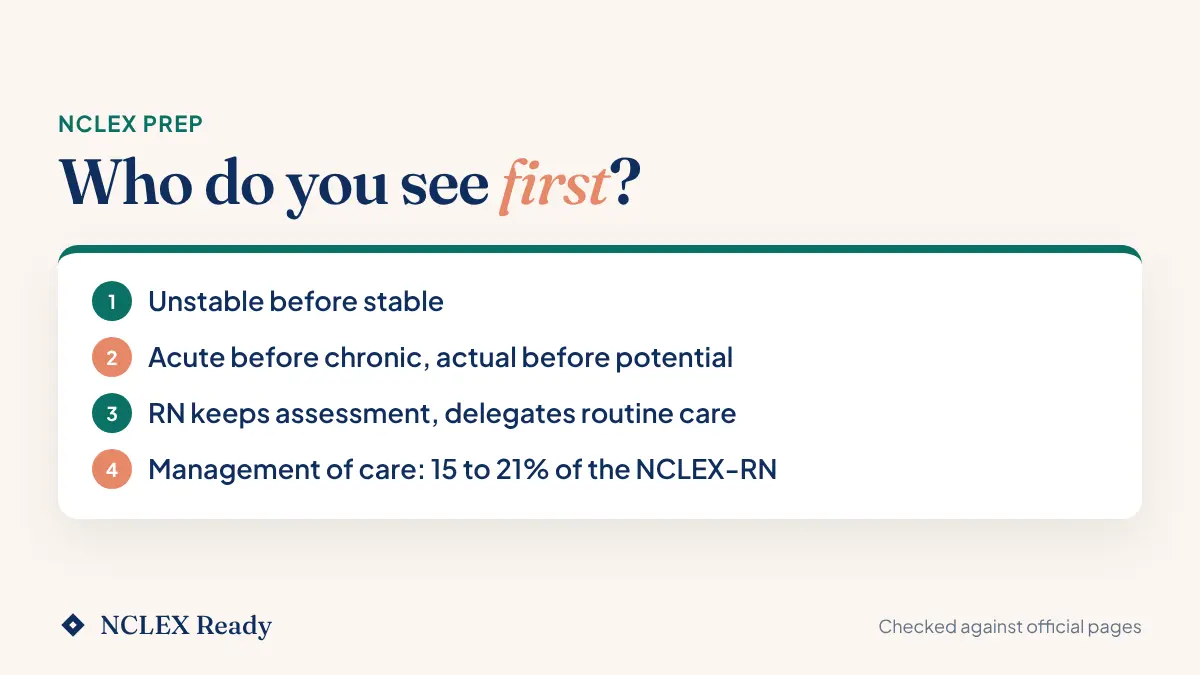
NCLEX prioritisation questions ask which patient you see first, what you do first, or which task you hand to someone else. They sit mostly in the Management of Care area, which is 15 to 21 per cent of the 2026 NCLEX-RN. Study tools such as airway, breathing, circulation and Maslow help you rank the options.
At a glance
| Item | Current detail | Official source |
|---|---|---|
| Where these items sit | Management of Care, part of Safe and Effective Care Environment | 2026 NCLEX-RN test plan |
| Share of the exam | 15 to 21 per cent, the largest client needs area | 2026 NCLEX-RN test plan |
| Topics named | Assignment, delegation and supervision, establishing priorities, and more | 2026 NCLEX-RN test plan |
| How "who first" is framed | Prioritise care based on acuity | 2026 NCLEX-RN test plan |
| Australian delegation guide | NMBA Decision-making framework for nursing and midwifery, in effect from 3 February 2020 | NMBA frameworks page |
| Who stays accountable | The registered nurse who delegates | NMBA Decision-making framework (PDF) |
What management of care covers on the NCLEX
The 2026 test plan, effective April 2026, sorts content into client needs areas. Management of Care sits under Safe and Effective Care Environment. The plan describes it as "providing and directing nursing care" to protect the client and health care staff (2026 NCLEX-RN test plan).
It is the biggest area on the exam at 15 to 21 per cent of items. The plan adds that each exam's content split can differ by up to 3 per cent in each area, because the exam is a variable length. For how all eight areas fit together, see our guide to the NCLEX-RN test plan and client needs categories.
Two of its listed topics are the focus of this guide.
- Assignment, delegation and supervision. This includes identifying tasks to delegate based on client needs, delegating to staff with the competency to do them, communicating the task, and evaluating that it was done correctly.
- Establishing priorities. This includes applying pathophysiology to set priorities across several clients, prioritising care "based on acuity", and revising the plan of care for multiple clients.
Management of Care also covers handover, advocacy, consent, confidentiality, advance care planning and working with the wider team. Those topics deserve their own study time, but this guide stays with the two that cause the most second-guessing.
Prioritisation is also part of clinical judgement
The test plan lists six clinical judgement steps that run through the case studies. The third is to "prioritize hypotheses", and the plan names what to weigh: urgency, likelihood, risk, difficulty and time constraints (2026 NCLEX-RN test plan). So prioritising is not only a stand-alone item type. It turns up inside case studies too. Our guide to clinical judgement on the NCLEX, step by step covers the other five steps.
How to answer NCLEX prioritisation questions
These items usually look like one of three stems.
- Which client should the nurse see first? Four patients, one shift, one of you.
- What is the nurse's first action? One patient, several sensible actions, one that has to come first.
- Which task can be delegated? A list of jobs and a list of staff.
Every option is often something a good nurse would do. The question is about order, not right or wrong. Read the stem for the words that carry the weight, such as "first", "priority", "most important" or "immediately".
Study frameworks that help you rank
The frameworks below are not rules published by the exam's owner, NCSBN. They are common teaching tools that nurse educators use to make acuity-based reasoning quicker. Use them as a checklist, not a formula.
| Framework | The question it asks | Typical winner |
|---|---|---|
| Airway, breathing, circulation | What threatens life soonest? | A compromised airway over a breathing problem, over a circulation problem |
| Maslow's hierarchy | Is this a physical need or a higher-level need? | Physiological needs and safety before comfort, education or self-esteem |
| Acute over chronic | Is this new, or is it the patient's baseline? | A new change over a long-standing, known finding |
| Unstable over stable | Is this patient getting worse? | A deteriorating patient over one whose obs are steady |
| Actual over potential | Is the problem happening now? | An actual problem over a risk that may develop |
| Safety | Who could be harmed in the next few minutes? | Falls risk, a confused patient pulling at lines, a medication error caught in time |
Two cautions help. First, the frameworks can conflict. A patient in severe pain may not be the priority if another patient's airway is at risk. Go back to the stem and ask which patient is most likely to come to harm if you are not there now. Second, a finding that is expected for a condition is usually not the priority. A long-standing finding at a patient's known baseline is less urgent than a new one in someone who was stable an hour ago.
The test plan's sample item for Safety and Infection Prevention and Control, the area next to Management of Care, makes the safety point well. It asks which client most needs safety precautions reviewed before an assistant helps them walk, and the keyed answer is the client with Ménière's disease, where vertigo raises the risk of a fall (2026 NCLEX-RN test plan).
NCLEX delegation questions and Australian practice
The test plan uses US role titles. Its delegation examples name "LPN/VN, assistive personnel, other RNs". It defines unlicensed assistive personnel (UAP) as any unlicensed person trained to work in a supportive role, "regardless of title", to whom a nursing responsibility may be delegated (2026 NCLEX-RN test plan).
On an Australian ward, the closest role to the LPN is the enrolled nurse (EN). UAP covers assistants in nursing (AINs), personal care assistants and similar roles. The plan also lists the rights of delegation: right task, right circumstances, right person, right direction or communication, and right supervision or evaluation.
What the NMBA framework says
In Australia, the NMBA's Decision-making framework for nursing and midwifery guides scope of practice and delegation decisions. It took effect on 3 February 2020. A few points from it are worth knowing for both the exam and your next shift (NMBA Decision-making framework (PDF)).
- The delegator stays accountable. The registered nurse who delegates remains accountable for the decision, for monitoring performance and for evaluating outcomes. The framework says plainly that accountability "cannot be delegated".
- Delegation is not the same as allocation. The framework treats delegation as different from allocating or assigning tasks, and says it does not give guidance on allocation. The NCLEX groups assignment and delegation together, so read each stem for what it is actually asking.
- Enrolled nurses work under RN supervision. ENs provide delegated care under the direct or indirect supervision of a registered nurse or midwife. Some ENs carry a notation on their registration saying they do not hold a Board-approved qualification in administration of medicines.
- Health workers get routine, predictable activities. Health workers, such as AINs, are not registered under the National Scheme. The framework says activities needing a narrow range of skill and knowledge may be delegated to them when the activity is "routine" and its outcome predictable.
- Competence and policy come first. Before delegating, the RN assesses the person's needs, checks the delegatee is competent and willing, and confirms local policy supports it. The delegatee cannot pass the task on to someone else without going back to the delegator.
The exam answer and the Australian framework point the same way. Keep assessment, judgement and care of unstable patients with the RN. Hand routine, predictable care of stable patients to the right person, then check it was done.
If you are working as an AIN while you wait for registration, you see delegation from the other side every shift. Our guide to working as an AIN while you wait for AHPRA registration covers that role.
Three worked examples
These are original practice items written for this guide, not recalled exam questions. They use Australian ward language and stay with textbook principles. Always follow your own facility's policy and escalation criteria at work.
Example 1: which patient do you see first?
You have just taken handover on a medical ward. Your four patients are:
- A. A 70-year-old with COPD. Oxygen saturation is at his documented target range and he is chatting with his wife.
- B. A 52-year-old, day 1 after a laparoscopic cholecystectomy, asking for pain relief before mobilising.
- C. A 76-year-old admitted yesterday with pneumonia. The AIN tells you she seems newly confused and her breathing looks faster than earlier.
- D. A 48-year-old with type 2 diabetes, waiting for discharge teaching on his new blood glucose meter.
Answer: C. New confusion and a rising respiratory rate in a patient with pneumonia are acute changes. They suggest she may be deteriorating, and breathing sits near the top of airway, breathing, circulation. You go to her, repeat a full set of obs and escalate under your local criteria, which may mean a MET call.
Patient A has a chronic condition and is at his known baseline. Patient B has an actual need, but it is expected after surgery and he is stable. Patient D's teaching matters, but it is a higher-level need that can wait a short while.
Example 2: which task goes to the AIN, and which to the EN?
You are the RN in charge of a team with one EN and one AIN. The tasks waiting are:
- A. The admission assessment for a patient just arrived from ED.
- B. Helping a stable patient, day 4 after a knee replacement, to shower. He has showered safely with help before.
- C. Recording 4-hourly obs on a stable patient, with clear parameters for when to report.
- D. First-time teaching for a patient newly started on an insulin pen.
- E. Giving the scheduled oral medicines for a stable patient on a regular round.
For the AIN: B and C. Both are routine for a stable patient, and the response and outcome are predictable. That matches what the NMBA framework describes for health workers. You tell the AIN exactly what to report, such as dizziness during the shower or any obs outside the set parameters, and you review the obs yourself.
For the EN: E. Giving medicines to a stable patient sits within EN practice under RN supervision. Check first that the EN does not have a medicines notation on their registration, and that local policy and their own competence support it. The EN reports back anything unexpected, such as a patient who refuses a dose.
Keep for yourself: A and D. Admission assessment and first-time teaching both need RN assessment and judgement. On the exam, assessing, teaching new content and evaluating a response are the classic tasks the RN keeps.
Example 3: what do you do first?
You are caring for a woman on day 1 after a total hip replacement. The AIN comes to find you. The patient says she suddenly feels short of breath and her chest hurts when she breathes in.
- A. Ask the AIN to recheck her obs in 15 minutes.
- B. Go to the patient now and assess her airway, breathing and circulation.
- C. Phone her daughter to ask about her usual health.
- D. Document the AIN's report in the notes.
Answer: B. Sudden shortness of breath with pleuritic chest pain after hip surgery may mean a pulmonary embolism. This is an acute change in a patient who was stable, so assessment by the RN comes before anything else. While you assess, you sit her up, stay with her and escalate under local criteria. Option A delegates the assessment of a possibly unstable patient, which is a common wrong answer. Options C and D are not wrong in themselves, but they can wait.
Delegation items can also come as select all that apply, where you choose every task you could safely hand over. Our guide to answering select-all-that-apply questions covers how those items are scored and how to judge each option on its own.
Common traps in prioritisation and delegation items
- Picking the most dramatic option. The patient with the scariest diagnosis is not always the most unstable right now. Look at the cues in the stem, not the label.
- Choosing to gather more data when action is needed. Assessment usually comes first. But if the stem already tells you the airway is blocked or the patient is unresponsive, the first action is to act and call for help.
- Delegating anything to do with an unstable patient. Assistants can help with care, but they should not be assessing or monitoring a deteriorating patient on their own.
- Forgetting to evaluate. The test plan lists evaluating delegated tasks as part of delegation. On the ward and on the exam, handing over a task is not the end of it.
- Reading US titles too literally. If a stem says LPN or UAP, translate to the EN or AIN role you know, then apply the principles.
How NCLEX Ready can help
NCLEX Ready has 7,716 practice questions with rationales written in Australian clinical language, including prioritisation and delegation items, Next Gen NCLEX formats and 118 case studies. Try our free sample questions with answers and rationales, or take the free readiness test, with no account needed. When you are ready, Week 1 of any plan is free, with full access and no card required. The NMBA and AHPRA do not endorse any prep course, including ours.
Frequently asked questions
How much of the NCLEX-RN is about management of care?
The 2026 NCLEX-RN test plan sets Management of Care at 15 to 21 per cent of items, the largest of the eight client needs areas. It includes assignment, delegation and supervision, and establishing priorities, among other topics.
Is ABC or Maslow an official NCLEX rule?
No. Airway, breathing and circulation, Maslow's hierarchy, acute over chronic and actual over potential are study frameworks used by nurse educators. The test plan asks you to prioritise care based on acuity and to weigh urgency, risk and time, and these frameworks are aids to that reasoning.
What can an assistant in nursing be delegated in Australia?
The NMBA Decision-making framework says routine activities needing a narrow range of skill and knowledge may be delegated to health workers, where the need, the person's response and the outcome are predictable. The registered nurse stays accountable for the decision to delegate and must check the worker is competent and that local policy supports it.
Who does the test plan mean by unlicensed assistive personnel?
The test plan defines unlicensed assistive personnel as any unlicensed person trained to work in a supportive role, regardless of title, to whom a nursing responsibility may be delegated. On an Australian ward that covers roles such as assistants in nursing and personal care assistants.
What tasks should the registered nurse keep in a delegation question?
As a general study rule, keep the initial or comprehensive assessment, care of an unstable or deteriorating patient, first-time teaching and evaluation of how a patient responded. Routine, predictable care for a stable patient is the usual delegation answer.
Sources
- 2026 NCLEX-RN Test Plan (PDF) — official NCLEX site — https://www.nclex.com/files/2026_RN_Test%20Plan_English-F.pdf (accessed 20 October 2026)
- Frameworks — Nursing and Midwifery Board of Australia — https://www.nursingmidwiferyboard.gov.au/Codes-Guidelines-Statements/Frameworks.aspx (accessed 20 October 2026)
- Decision-making framework for nursing and midwifery (PDF) — Nursing and Midwifery Board of Australia — https://www.nursingmidwiferyboard.gov.au/documents/default.aspx?record=WD19%2f29157&dbid=AP&chksum=9LilUkdFvM5AJeKIaJZd1A%3d%3d (accessed 20 October 2026)
Last checked against the official sources above on 20 October 2026. Rules and fees change, so always confirm on the official page before you pay or book. If you spot something out of date, tell us at hello@nclexready.com.au.
How this guide was made
Researched and written by the NCLEX Ready team, drafted with AI assistance and checked line by line against the official pages listed above. This is general information, not registration, legal or migration advice.
NCLEX Ready is an independent educational platform operated by Aromika Pty Ltd. It is not affiliated with, endorsed by, or connected to AHPRA, NMBA, NCLEX, Pearson VUE, or NCSBN. NCLEX and NCLEX-RN are registered trademarks of NCSBN, used here for descriptive purposes only.