Many nurses start NCLEX study with a question bank and a lot of hope. The NCLEX test plan is less exciting to open, but it is the closest thing you have to the exam's blueprint. It tells you what the exam covers, roughly how much of each area you will see and how clinical judgement is woven through it.
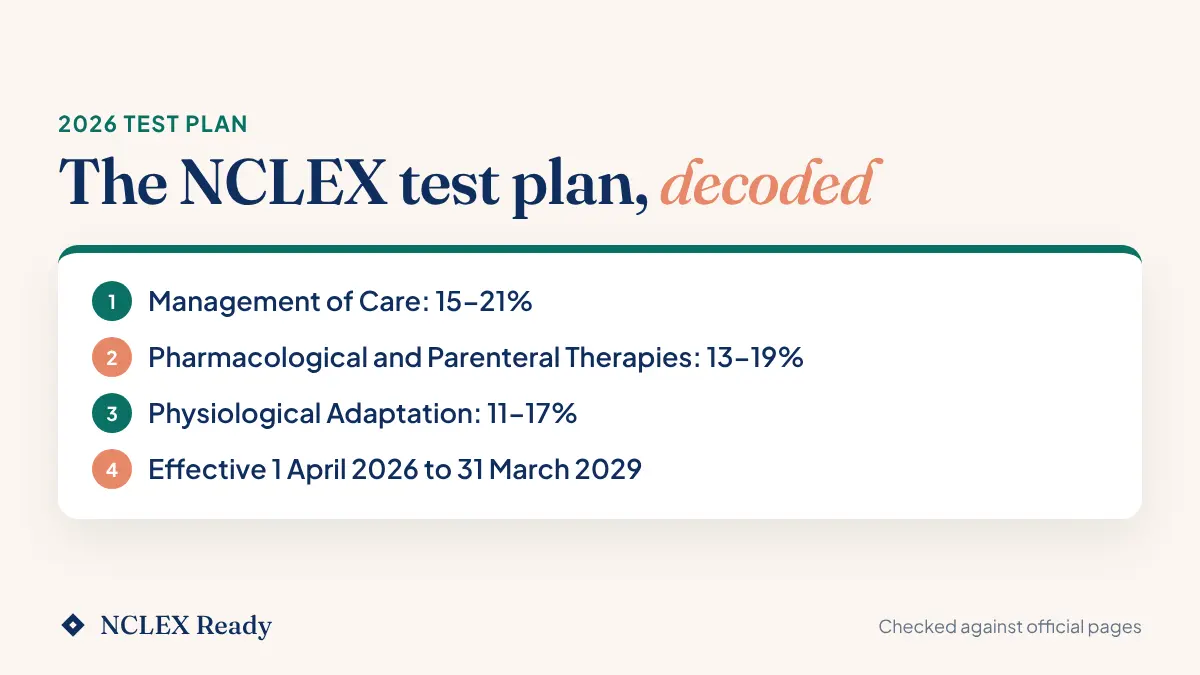
The NCLEX test plan for 2026 sorts every scored content item into four client needs categories, split into eight areas with set percentage ranges. Management of Care is the largest at 15–21 per cent. It also defines integrated processes, including clinical judgement, which run through every area (2026 NCLEX-RN Test Plan).
At a glance
| Item | Current detail | Official source |
|---|---|---|
| Current plan | 2026 NCLEX-RN Test Plan, effective 1 April 2026 through 31 March 2029 | Official NCLEX site: test plans |
| How often it changes | Updated every three years | Official NCLEX site: test plans |
| Structure | Four client needs categories, eight content areas | 2026 NCLEX-RN Test Plan |
| Largest area | Management of Care, 15–21% | 2026 NCLEX-RN Test Plan |
| Clinical judgement | Three case studies of six items each, plus about 10% stand-alone items | 2026 NCLEX-RN Test Plan |
| Exam length | 85 to 150 items within five hours, including breaks | 2026 NCLEX-RN Test Plan |
| Content AHPRA removes | Midwifery and US-specific practice questions do not appear for AHPRA-authorised candidates | AHPRA RN MCQ candidate handbook |
What the NCLEX test plan is, and which one applies to you
The test plan is a document published by the exam's owner, NCSBN, on the official NCLEX site. The site says it guides people preparing for the exam, directs how items are written and is used to classify every item (official NCLEX site: test plans).
The current version is the 2026 NCLEX-RN Test Plan. It is effective from 1 April 2026 through 31 March 2029. If you sit the NCLEX-RN for AHPRA in that window, this is your blueprint. Study material written before April 2026 may be mapped to the older plan, so check before you rely on its weightings.
The plan is built from a practice analysis of newly licensed RNs. The 2026 plan draws on a 2024 survey of nearly 24,000 of them about how often they perform each nursing activity, how important it is and how much it draws on clinical judgement (2026 NCLEX-RN Test Plan). That is why the activity lists in the plan read like a real shift.
One useful point for nurses on the OBA pathway. AHPRA's RN MCQ candidate handbook says the test plans may include questions on midwifery and practice specific to the United States, and that these do not appear in the question set for AHPRA-authorised candidates (AHPRA RN MCQ candidate handbook).
The four client needs categories and their percentages
The plan organises content into four client needs categories. Two of them are split into subcategories, which gives eight content areas. Here are the official ranges, copied from the 2026 plan.
| Client needs category | Content area | Percentage of items |
|---|---|---|
| Safe and Effective Care Environment | Management of Care | 15–21% |
| Safe and Effective Care Environment | Safety and Infection Prevention and Control | 10–16% |
| Health Promotion and Maintenance | (no subcategories) | 6–12% |
| Psychosocial Integrity | (no subcategories) | 6–12% |
| Physiological Integrity | Basic Care and Comfort | 6–12% |
| Physiological Integrity | Pharmacological and Parenteral Therapies | 13–19% |
| Physiological Integrity | Reduction of Risk Potential | 9–15% |
| Physiological Integrity | Physiological Adaptation | 11–17% |
The plan also shows a chart with a single figure for each area, at the middle of each range. Those are Management of Care 18%, Safety and Infection Prevention and Control 13%, Health Promotion and Maintenance 9%, Psychosocial Integrity 9%, Basic Care and Comfort 9%, Pharmacological and Parenteral Therapies 16%, Reduction of Risk Potential 12% and Physiological Adaptation 14%.
Why a range and not a fixed number? The exam is adaptive and varies in length. The plan says the content mix of an individual exam may differ by up to 3 per cent either way in each category (2026 NCLEX-RN Test Plan).
Add the four Physiological Integrity areas together and they make up roughly half the exam at the midpoints. Safe and Effective Care Environment makes up close to a third. Those two categories deserve most of your hours.
How the case studies fit in
The percentages above cover the content-area items only. Clinical judgement is also measured directly, by 18 case study items (three sets of six) and about 10 per cent stand-alone items.
On a minimum-length exam of 85 items, the plan breaks it down this way:
- 52 items from the eight content areas, in the stated percentages
- 18 items in three clinical judgement case studies
- 15 unscored pretest items, which look the same as scored items
The case studies "span any number of content areas", so they are counted separately (2026 NCLEX-RN Test Plan). For how the length changes past 85 items, read how many questions are on the NCLEX.
Safe and Effective Care Environment
This category is about providing and directing care in a way that protects both clients and staff. It is split into two areas.
Management of Care (15–21%)
What it tests. The coordination side of nursing. The activity list covers admission, transfer and discharge, giving and receiving handover, delegating and supervising care, prioritising by acuity, consent, advance directives, confidentiality, mandatory reporting, ethics and working within your scope of practice.
Study tip. This is where prioritisation and delegation questions live, and it is the biggest single area. Practise asking two things of every scenario: who do I see first, and who can safely do this task. The plan uses "unlicensed assistive personnel" for any unlicensed worker trained in a supportive role, whatever their title, which on an Australian ward would cover AINs and PCAs. Our guide to prioritisation and delegation questions works through the reasoning.
In Australia you will know handover through ISBAR, which the RN OSCE candidate handbook expects you to be familiar with. The skill being tested is the same: passing on the right information so the next nurse can act safely.
Safety and Infection Prevention and Control (10–16%)
What it tests. Protecting clients and staff from harm. That includes hand hygiene, aseptic and sterile technique, isolation and standard precautions, correct patient identification, falls and injury prevention, restraint requirements, allergies, reporting errors and near misses, emergency planning and escalating unsafe practice by staff.
Study tip. Learn the reasoning behind each precaution, not just the list. If you know why a client needs droplet rather than airborne precautions, you can answer a question about an infection you have not studied. Treat "report and escalate" items seriously. The safe answer often involves telling someone, not fixing it quietly.
Health Promotion and Maintenance (6–12%)
What it tests. Growth and development across the lifespan, prevention and early detection. The plan lists antenatal, labour and postnatal care, newborn and child care by age band, screening, health education, readiness to learn and assessing whether a client can manage at home.
Study tip. Build a one-page table of developmental milestones and age-appropriate teaching, from birth through older adulthood. The plan splits clients into age bands such as birth to 2 years and 65 years and over, so expect questions anchored to an age. Antenatal and postnatal care is listed in this area, even though AHPRA's handbook says midwifery questions are removed for AHPRA candidates. Cover the general nursing care of a pregnant or postnatal client rather than skipping it, and do not spend long on midwifery practice.
Psychosocial Integrity (6–12%)
What it tests. Emotional, mental and social wellbeing. The activity list includes therapeutic communication, abuse and neglect, substance misuse and withdrawal, depression, dementia, eating disorders, risk of violence, grief and loss, end-of-life care, coping and cultural and spiritual practices.
Study tip. Therapeutic communication items reward a pattern. Choose the option that acknowledges feelings and keeps the client talking, and avoid options that give false reassurance or ask "why". For safety items, remember that a risk to the client or others usually comes before rapport. Practise saying responses out loud. It helps you hear which ones sound dismissive.
Physiological Integrity
This is the largest category. The plan describes it as promoting physical health by providing care and comfort, reducing risk and managing health alterations. It has four areas.
Basic Care and Comfort (6–12%)
What it tests. Help with activities of daily living. The list covers mobility and assistive devices, skin and pressure care, elimination, nutrition and tube feeding, sleep, intake and output, pain assessment, non-drug comfort measures, postmortem care and complementary therapies.
Study tip. These items look simple but often hide a safety cue, such as a client at risk of aspiration during a tube feed. Study the "why" behind routine care. Link pressure care to the risk assessment charts you already know from Australian practice.
Pharmacological and Parenteral Therapies (13–19%)
What it tests. Giving medicines and IV therapy safely. The plan lists checking orders, the rights of medication administration, dose calculations, IV site care, controlled substances, reviewing lab results and allergies before giving a drug, titration, blood products, central lines, parenteral nutrition, pain medicines, medication reconciliation, high-risk medicines and safe disposal.
Study tip. Learn medicines by class, then the key nursing checks for each class. Practise calculations until they are routine. Drug names are a real trap for nurses trained on one naming system. The official NCLEX FAQ says items use generic medication names on most occasions, so learn both names for each medicine you study. You know paracetamol, adrenaline and glyceryl trinitrate. The exam may use the North American names instead, such as acetaminophen, epinephrine and nitroglycerin. Australian medicines released for supply from 1 May 2026 must show the sole name furosemide rather than frusemide. Our list of Australian drug names and the NCLEX equivalents covers the common pairs.
Reduction of Risk Potential (9–15%)
What it tests. Spotting and preventing complications from conditions, treatments and procedures. The list includes trends in obs, focused assessments, diagnostic test results, ECGs, point-of-care tests such as BSLs, pre-op and post-op care, moderate sedation, blood and other specimens, and inserting or removing nasogastric tubes, urinary catheters and peripheral IV lines.
Study tip. Know normal ranges for common blood results and what each abnormal value means for your next nursing action. A question rarely asks for the number alone. It asks what you do about it. Think in trends. A single set of obs in the danger zone still needs action, but the direction they are heading often tells you more, which is why Australian observation and response charts show obs over time.
Physiological Adaptation (11–17%)
What it tests. Care for acute, chronic and life-threatening conditions. The list covers emergency care, ventilated clients, chest drains and wound drains, wound care, ostomy care, telemetry and pacing devices, arterial lines, dialysis, fluid and electrolyte imbalances, haemodynamics and perfusion, and recognising complications.
Study tip. Study by body system, and for each condition learn the cues that tell you a client is getting worse. Then link each cue to the first action. In Australian practice that first action is often escalating to the rapid response system, which many wards call a MET call. On the exam, read what the options offer and choose the action that addresses the most urgent problem.
Integrated processes and clinical judgement
Integrated processes are not content areas. The plan describes them as fundamental to nursing and present throughout every category. There are six:
- Caring, built on mutual respect and trust
- Clinical judgement, the observed outcome of critical thinking and decision-making
- Communication and documentation, verbal, non-verbal and written
- Culture and spirituality, based on the client's own reported preferences
- Nursing process, which is assessment, analysis, planning, implementation and evaluation
- Teaching and learning, helping clients gain knowledge and skills
Clinical judgement gets the most detail. The plan describes it as a multistep process from the NCSBN Clinical Judgment Measurement Model. In Australian spelling the six steps are recognise cues, analyse cues, prioritise hypotheses, generate solutions, take action and evaluate outcomes (2026 NCLEX-RN Test Plan).
Each case study is six items on one unfolding client, with one item for each step. Because a case study can draw on any content area, a weak spot in pharmacology can cost you inside a case study too. Our step-by-step guide to Next Gen NCLEX question types shows how bow-tie, matrix and highlight items fit these steps.
The plan also notes that most items are written at the application level or higher. Memorising facts is necessary but not enough. You need to use them in a scenario.
How to turn the test plan into a study plan
The percentages are a starting point for dividing your hours. Here is one way to use them.
- Take a baseline. Sit a readiness test and record your results by content area. Our free readiness test gives you a starting point in about 30 questions.
- Weight your hours by the midpoints. If you have 10 study hours a week, the midpoints suggest roughly 1.8 hours for Management of Care and 1.6 hours for Pharmacological and Parenteral Therapies. The 9 per cent areas get about 0.9 hours each.
- Then shift time to your weak areas. A low score in a large area matters most. A weak result in Management of Care costs more than the same result in a 6–12 per cent area.
- Schedule case study practice every week. The case studies sit outside the percentages, but every exam has three.
- Track by area, not just overall score. If you fail, the official Candidate Performance Report rates your performance in each test plan content area and in clinical judgement as below, near or above the passing standard (official NCLEX site: Candidate Performance Report). Tracking the same areas in your own practice gives you the same picture before exam day.
- Re-test every few weeks. Move hours as your weak areas change.
Remember that the NCLEX is not graded by section. The official site says your overall performance decides the pass or fail result. Balance matters, but one weak area does not fail you on its own.
For a week-by-week version, see our 12-week NCLEX study plan for OBA nurses.
A few things the test plan does not tell you
- It does not list item formats in detail. The plan points you to the official Candidate Tutorial for that. Any item may include charts, tables and graphics.
- It does not give a pass mark as a percentage. The plan says there is no fixed percentage of candidates who pass or fail. You pass by performing at or above the passing standard.
- It does not share real items. The plan warns that disclosing exam items is a violation of law. Avoid any prep that offers "recalled" questions.
How NCLEX Ready can help
NCLEX Ready has 7,716 practice questions with rationales in Australian clinical language, plus 118 case studies and Next Gen formats. Start with the free readiness test, about 30 questions in 30 to 45 minutes with no account needed, and see which content areas need your time first. If you want to keep going, Week 1 of any plan is free, with full access and no card required. The NMBA and AHPRA do not endorse any prep course, including ours.
Frequently asked questions
When does the 2026 NCLEX-RN test plan apply?
The official NCLEX site says the 2026 RN test plan is effective from 1 April 2026 through 31 March 2029. Any NCLEX-RN you sit in that window is built on it.
What are the four NCLEX client needs categories?
Safe and Effective Care Environment, Health Promotion and Maintenance, Psychosocial Integrity and Physiological Integrity. The first and last are split into subcategories, which gives eight content areas in total.
Which client needs area has the most questions?
Management of Care, at 15 to 21 per cent of items. Pharmacological and Parenteral Therapies is next at 13 to 19 per cent, then Physiological Adaptation at 11 to 17 per cent.
Do the case studies count towards the client needs percentages?
No. The test plan says the three case studies span any number of content areas and are counted separately from the content-area items. On a minimum-length exam, 52 items come from the eight content areas, 18 from the case studies and 15 are unscored pretest items.
Is the NCLEX graded by section?
No. The official NCLEX site says the exam is not graded in sections and your overall performance decides the result. If you fail, the Candidate Performance Report rates you below, near or above the passing standard in each content area to guide your next attempt.
Sources
- 2026 NCLEX-RN Test Plan — official NCLEX site — https://www.nclex.com/files/2026_RN_Test%20Plan_English-F.pdf (accessed 20 October 2026)
- Test plans — official NCLEX site — https://www.nclex.com/test-plans.page (accessed 20 October 2026)
- Candidate Performance Report — official NCLEX site — https://www.nclex.com/candidate-performance-report.page (accessed 20 October 2026)
- Frequently asked questions — official NCLEX site — https://www.nclex.com/faqs.page (accessed 20 October 2026)
- Registered Nurse OSCE Candidate Handbook (7 July 2026) — AHPRA — https://www.ahpra.gov.au/documents/default.aspx?record=WD20%2f30349%5bv12%5d&dbid=AP&chksum=krcq6pDijKrhj6TZEQUMIsw0wcbCCWMzB4vo8GYPtPc%3d (accessed 20 October 2026)
- Registered Nurse MCQ Candidate Handbook (7 July 2026) — AHPRA — https://www.ahpra.gov.au/documents/default.aspx?record=WD20%2f30348%5bv4%5d&dbid=AP&chksum=k4ADJY8TbYgF7ZCnhMWpRcC7DpNYtmns5SkLnOTea7o%3d (accessed 20 October 2026)
- Dual-labelled medicine ingredient names: transition to sole names — Therapeutic Goods Administration — https://www.tga.gov.au/products/medicines/labelling-and-advertising/medicines-and-biologicals-labelling-and-packaging/labelling-requirements-information-sponsors/dual-labelled-medicine-ingredient-names-transition-sole-names (accessed 20 October 2026)
- National Consensus Statement: essential elements for recognising and responding to acute physiological deterioration, third edition — Australian Commission on Safety and Quality in Health Care — https://www.safetyandquality.gov.au/sites/default/files/2026-09/National-Consensus-Statement-Essential-elements-for-recognising-and-responding-to-acute-physiological-deterioration-third-edition.pdf (accessed 20 October 2026)
Last checked against the official sources above on 20 October 2026. Rules and fees change, so always confirm on the official page before you pay or book. If you spot something out of date, tell us at hello@nclexready.com.au.
How this guide was made
Researched and written by the NCLEX Ready team, drafted with AI assistance and checked line by line against the official pages listed above. This is general information, not registration, legal or migration advice.
NCLEX Ready is an independent educational platform operated by Aromika Pty Ltd. It is not affiliated with, endorsed by, or connected to AHPRA, NMBA, NCLEX, Pearson VUE, or NCSBN. NCLEX and NCLEX-RN are registered trademarks of NCSBN, used here for descriptive purposes only.