Almost every nurse preparing for the NCLEX-RN asks the same thing in the weeks before the exam. How many questions will I get, and what does it mean if the screen goes blank early? The number moves from person to person, and that is by design. Once you understand why, the exam feels a lot less mysterious.
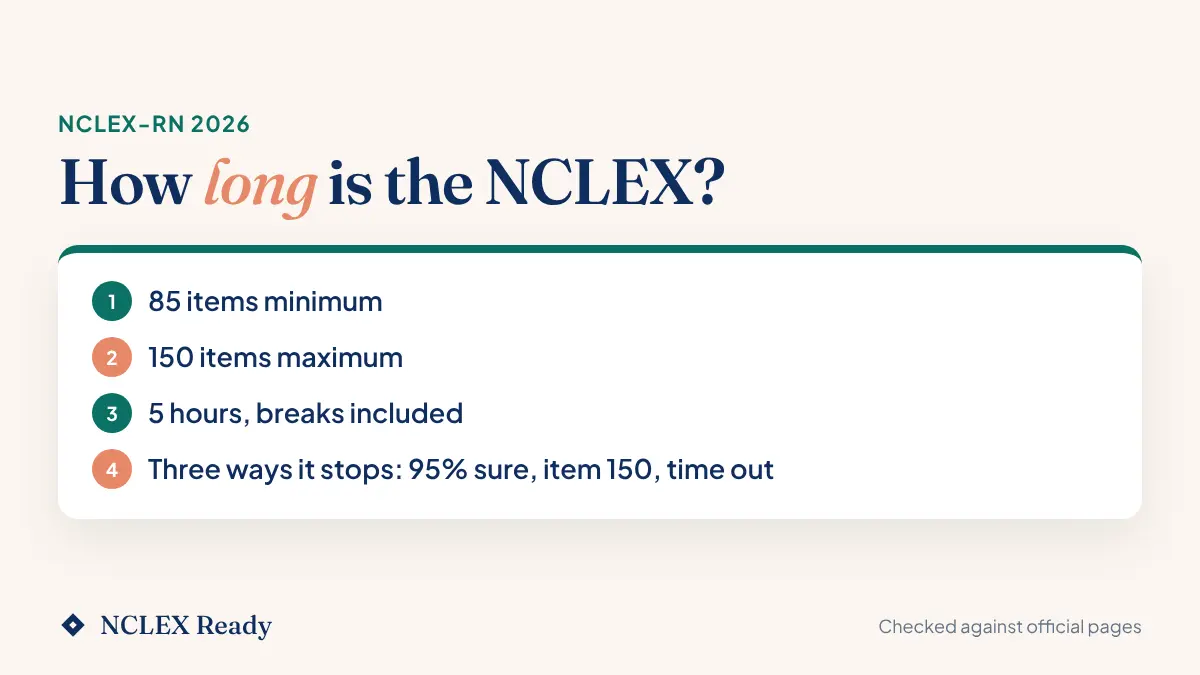
So, how many questions are on the NCLEX? Under the 2026 NCLEX-RN test plan you answer between 85 and 150 items within five hours, and the five hours include all breaks. Every exam has three clinical judgement case studies of six items each and 15 unscored pretest items (2026 NCLEX-RN test plan).
At a glance
| Item | Current detail | Official source |
|---|---|---|
| Minimum items | 85 | 2026 NCLEX-RN test plan |
| Maximum items | 150 | 2026 NCLEX-RN test plan |
| Case studies | Three, with six items each (18 items) | 2026 NCLEX-RN test plan |
| Unscored pretest items | 15 on every exam, and they look like scored items | 2026 NCLEX-RN test plan |
| Time limit | Five hours, including all breaks | 2026 NCLEX-RN test plan |
| Optional breaks | Offered at about two hours and about three and a half hours. The clock keeps running | NCLEX candidate rules, August 2026 |
| How it stops | One of three rules: 95% confidence, maximum length, or run out of time | Official NCLEX site, CAT |
| Results on the AHPRA route | Emailed by AHPRA within six weeks. No Quick Results | NMBA Registered nurses exam page |
How many questions are on the NCLEX, and what is in the minimum
The 2026 test plan, effective April 2026, sets a minimum of 85 items and a maximum of 150 for every RN candidate. It also explains what the first 85 are made of.
| Part of the minimum-length exam | Items | Scored? |
|---|---|---|
| Items from the eight Client Needs content areas | 52 | Yes |
| Three clinical judgement case studies (six items each) | 18 | Yes |
| Pretest items | 15 | No |
| Total | 85 | 70 scored, 15 unscored |
The case studies are counted separately from the content-area items. That is because a case study can span any number of content areas. Each one follows a single client, with information that unfolds as you go. Its six items line up with the six steps of the clinical judgement model: recognise cues, analyse cues, prioritise hypotheses, generate solutions, take action and evaluate outcomes. Our guide to clinical judgement on the NCLEX walks through each step.
On top of the case studies, the test plan says about 10% of items will be stand-alone clinical judgement items, selected depending on exam length. These sit on their own rather than inside a case.
If you keep going past 85, the extra items are scored items chosen to keep refining the computer's estimate of your ability. The number of pretest items stays at 15 whatever your length.
What about the 75 to 265 figure?
You may still see an older range of 75 to 265 items quoted online. The July 2026 AHPRA RN MCQ candidate handbook still quotes it too (AHPRA RN MCQ candidate handbook). Go by the current test plan, which says 85 to 150.
How CAT picks your questions
The NCLEX is a computerised adaptive test, or CAT. Every time you answer, the computer re-estimates your ability from all your previous answers and the difficulty of those items. It then picks the next item that will tell it the most about you (official NCLEX site, CAT).
The test plan says each item is chosen against three criteria.
- Content area. The item comes from whichever area keeps your exam closest to the test plan percentages. This is how CAT makes sure you get enough Management of Care, Pharmacological and Parenteral Therapies and so on.
- Difficulty. The item should be challenging for you, not too easy and not too hard.
- No repeats. A repeat candidate will not see the same item again from the current item pool.
The official FAQs add some useful detail. Everyone starts with an item of relatively low difficulty. From there, your path depends on your answers. Near the end of an exam you usually get items you have about a 50% chance of answering completely correctly (official NCLEX FAQs).
That last point is why the exam feels hard for almost everyone. If it feels hard, the system is doing its job. It is not a sign you are failing.
The FAQs also say there is no set percentage of each item format. Bow-tie, matrix, highlight and the other formats appear based on your ability and item difficulty, not a quota. For what each format looks like, see Next Gen NCLEX question types explained.
You cannot skip or go back
Items appear one at a time. You can change an answer until you confirm it and press Next. After that you cannot return to it. You also cannot skip an item, because the computer needs each answer to choose the next one (2026 NCLEX-RN test plan). If you are unsure, the test plan's advice is to consider every option and give your best answer.
The three NCLEX pass-fail rules
The official NCLEX site says the computer decides your result using one of three rules. Here they are in plain language.
1. The 95% confidence interval rule
This is the most common. Once you have reached the minimum number of items, the computer stops when it is 95% certain your ability is clearly above or clearly below the passing standard (official NCLEX site, CAT). That can happen at item 85 or anywhere after it.
2. The maximum-length rule
Some nurses sit very close to the passing standard. For them the computer keeps going until item 150. At that point it sets aside the 95% rule and looks only at your final ability estimate. At or above the passing standard is a pass. Below it is a fail.
3. The run-out-of-time rule
If time runs out before item 150 and the computer has not reached 95% certainty, an alternative rule applies.
- Fewer than 85 items answered: the result is a fail.
- 85 or more answered: the computer scores your final ability estimate from every item you completed. At or above the passing standard is a pass.
The practical message is simple. Make sure you reach 85. Under this rule, running out of time before then is an automatic fail, however well you were doing.
What the passing standard is
The passing standard is a cut point on an ability scale. It is not a percentage of correct answers. The test plan says it is reviewed every three years, and that there is no fixed percentage of candidates who pass or fail (2026 NCLEX-RN test plan).
NCLEX time limit and breaks
You have five hours in total. The test plan is clear that this includes all breaks.
The August 2026 candidate rules say you will be offered a scheduled break after about two hours of testing time, and again after about three and a half hours. All breaks count against your time. The clock does not stop for a scheduled or unscheduled break. If you need a break at another time, you raise your hand and wait to be escorted out. A palm vein scan is taken when you leave and again when you come back (NCLEX candidate rules, August 2026).
There is no time limit on any single item. A rough sum helps with pacing, though. Five hours is 300 minutes. If you went all the way to 150 items with no breaks, that would be two minutes per item. Case study items take longer to read, so some will take more and some less. The test plan's own advice is to keep a reasonable pace and read each item carefully.
A few exam-day points from the official site that affect your time:
- Arrive at least 30 minutes before your appointment. If you are more than 30 minutes late, you may forfeit the appointment and have to re-register and pay again (official NCLEX site, exam day).
- You get an on-screen calculator and an erasable note board and marker.
- The official tutorial is available before exam day, so you can see the item formats ahead of time (2026 NCLEX-RN test plan).
Myths about NCLEX length, checked against the official pages
| Myth | What the official pages say |
|---|---|
| If it shuts off at 85, you passed. | The FAQs say the number of items alone does not reveal your result. Failing at the minimum means it took only 85 items to be 95% certain your ability was below the standard. |
| Going to 150 means you failed. | The test plan says a candidate "may pass or fail regardless of the length of the examination". A long exam means your ability was close to the standard. |
| You can spot the unscored items. | The test plan says pretest items look the same as scored items, so you cannot tell them apart. |
| A similar question means you got the last one wrong. | The test plan says a similar item may be a pretest item or may test a different phase of care. It tells you not to read anything into it. |
| Breaks pause the clock. | The candidate rules say all breaks count against your time and the clock does not stop. |
| A re-sit starts where your last exam ended. | The FAQs say each attempt is independent and CAT starts again from the beginning. |
On the AHPRA route there is one more point. AHPRA's handbook says the NCLEX test plans may include midwifery content and practice specific to the United States, and that these do not appear in your question set when AHPRA authorises you (AHPRA RN MCQ candidate handbook).
After the exam on the AHPRA route
How long your exam ran tells you nothing official. Your result comes later, and on this route it comes from AHPRA.
- Result by email. The NMBA says exam results are sent by email within six weeks of your exam date (NMBA Registered nurses exam page). The official NCLEX flyer for AHPRA candidates says the same (NCLEX flyer for AHPRA candidates).
- No Quick Results. The official NCLEX site says Quick Results only applies to candidates seeking licensure in the United States. AHPRA's handbook confirms it is not available to candidates it authorises. The wait is real, so plan for it.
- If you pass. Your next step is the OSCE fee on your IQNM dashboard. Our guide to the NCLEX in Australia covers what comes next.
- If you do not pass. You receive a two-page Candidate Performance Report. It rates you as below, near or above the passing standard in each test plan content area and in clinical judgement (official NCLEX site, CPR). If you answered fewer than 85 items, you get a shorter version with no diagnostic detail. The NMBA re-sit policy requires at least 45 calendar days from your result before you sit again (NMBA policy: Examination re-sits).
If you have not booked yet, our step-by-step guide to booking the NCLEX for AHPRA covers registration, your Authorisation to Test and scheduling.
What this means for how you prepare
Knowing the rules changes a few habits.
- Build stamina for 150, not 85. You cannot know your length in advance. Practise some full-length sessions so the last hour does not catch you out.
- Protect your minimum. Under the run-out-of-time rule, fewer than 85 answered is a fail. Do not let one case study eat 20 minutes.
- Treat every item as scored. You cannot see which 15 are pretest items.
- Practise case studies as sets of six. At least 18 of your items come in that shape.
- Commit and move on. You cannot go back after pressing Next, so second-guessing an earlier item only costs time.
A structured plan helps you fit this in around shifts. Our 12-week NCLEX study plan is built for nurses on the OBA pathway.
How NCLEX Ready can help
We have 7,716 practice questions and 118 case studies, written in Australian clinical language with paracetamol, obs, MET calls and BSLs where you would expect them on an Australian ward. We also have mock exams, so you can practise sitting for a long stretch. The free readiness test is about 30 questions and takes 30 to 45 minutes, with no account needed. If you want more, Week 1 of any plan is free, with full access and no card required.
Frequently asked questions
How many questions are on the NCLEX-RN in 2026?
Under the 2026 NCLEX-RN test plan you answer at least 85 items and no more than 150. Every exam includes three clinical judgement case studies of six items each and 15 unscored pretest items.
Does the NCLEX shut off at 85 questions if you pass?
It can stop at 85 for a pass or for a fail. The official NCLEX site says the number of items alone does not reveal your result. Stopping at the minimum only means the computer was 95% certain your ability was clearly above or clearly below the passing standard.
How long is the NCLEX-RN?
You have five hours, and that limit includes all breaks. Optional breaks are offered after about two hours and again after about three and a half hours, and the exam clock keeps running while you are away.
What happens if I run out of time on the NCLEX?
If you have not answered the minimum 85 items, the result is a fail. If you have answered at least 85, the computer scores your final ability estimate from every item you completed, and you pass if it is at or above the passing standard.
Can I tell which NCLEX questions are unscored?
No. The 2026 test plan says there are 15 pretest items on every exam and they look the same as scored items, so you cannot pick them out. Treat every item as if it counts.
When do AHPRA candidates get their NCLEX result?
AHPRA emails NCLEX-RN results within six weeks of your exam date. Quick Results is not available to candidates authorised by AHPRA, so the early unofficial result some US candidates buy does not apply to you.
Sources
- 2026 NCLEX-RN Test Plan — official NCLEX site — https://www.nclex.com/files/2026_RN_Test%20Plan_English-F.pdf (accessed 20 October 2026)
- Computerized Adaptive Testing — official NCLEX site — https://www.nclex.com/computerized-adaptive-testing.page (accessed 20 October 2026)
- Frequently Asked Questions — official NCLEX site — https://www.nclex.com/faqs.page (accessed 20 October 2026)
- NCLEX Examination Candidate Rules (August 2026) — official NCLEX site — https://www.nclex.com/files/2026_NCSBN_Examination_Candidate_Rules_ENG_August2026.pdf (accessed 20 October 2026)
- Exam Day — official NCLEX site — https://www.nclex.com/exam-day.page (accessed 20 October 2026)
- Quick Results — official NCLEX site — https://www.nclex.com/quick-results.page (accessed 20 October 2026)
- Candidate Performance Report — official NCLEX site — https://www.nclex.com/candidate-performance-report.page (accessed 20 October 2026)
- NCLEX information flyer for AHPRA candidates — official NCLEX site — https://www.nclex.com/files/2026_nclex_info_flyer_aphra.pdf (accessed 20 October 2026)
- Registered nurses (Examination) — Nursing and Midwifery Board of Australia — https://www.nursingmidwiferyboard.gov.au/Accreditation/IQNM/Examination/Registered-nurses.aspx (accessed 20 October 2026)
- Registered Nurse MCQ Candidate Handbook (7 July 2026) — AHPRA — https://www.ahpra.gov.au/documents/default.aspx?record=WD20%2f30348%5bv4%5d&dbid=AP&chksum=k4ADJY8TbYgF7ZCnhMWpRcC7DpNYtmns5SkLnOTea7o%3d (accessed 20 October 2026)
- Policy: Examination re-sits — NMBA and AHPRA — https://www.ahpra.gov.au/documents/default.aspx?record=WD25%2f34888&dbid=AP&chksum=9u0zB%2bK%2b9%2fmX1RNpfBmopw%3d%3d (accessed 20 October 2026)
Last checked against the official sources above on 20 October 2026. Rules and fees change, so always confirm on the official page before you pay or book. If you spot something out of date, tell us at hello@nclexready.com.au.
How this guide was made
Researched and written by the NCLEX Ready team, drafted with AI assistance and checked line by line against the official pages listed above. This is general information, not registration, legal or migration advice.
NCLEX Ready is an independent educational platform operated by Aromika Pty Ltd. It is not affiliated with, endorsed by, or connected to AHPRA, NMBA, NCLEX, Pearson VUE, or NCSBN. NCLEX and NCLEX-RN are registered trademarks of NCSBN, used here for descriptive purposes only.