Select all that apply questions make careful nurses nervous. You know the content, then you see six options and no clue how many are right. Most nurses have stared at one on a practice test and second-guessed every tick. The scoring is published, and once you know it, the method follows.
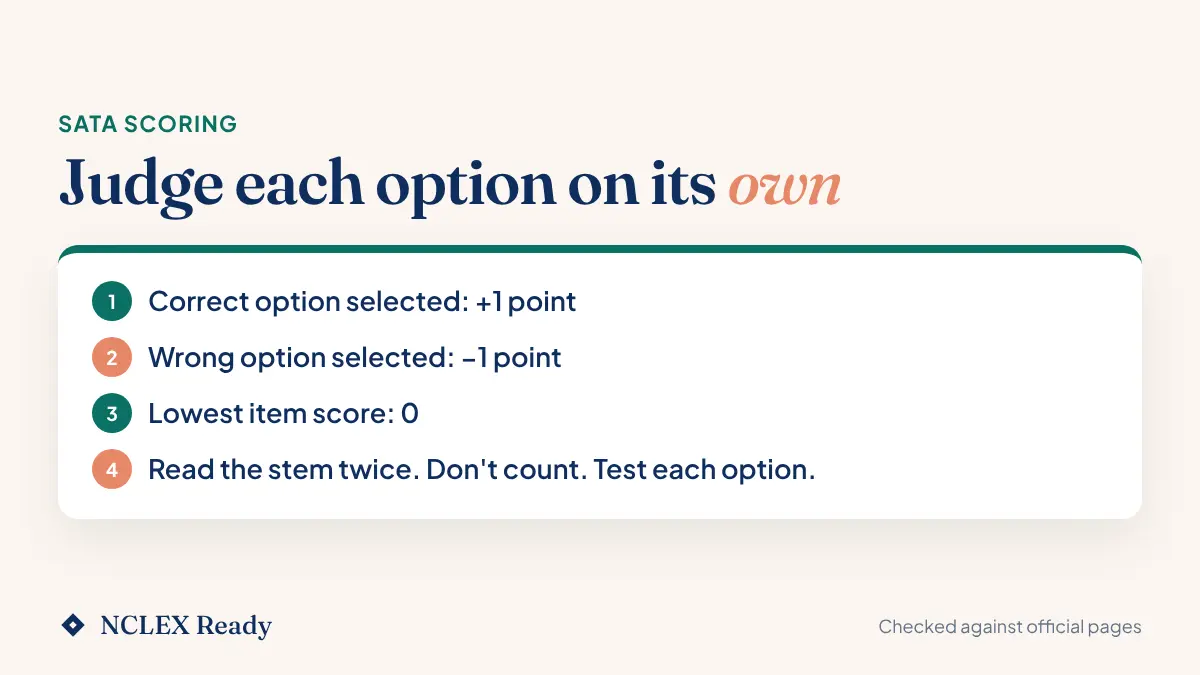
NCLEX SATA questions say "select all that apply" in bold and can have one or more correct options. The NCLEX FAQ scores items like these, where the number of correct options is left open, using plus/minus. You earn a point for each correct option you choose and lose one for each wrong one, with a floor of zero. So judge every option on its own.
At a glance
| Item | Current detail | Official source |
|---|---|---|
| How you know it is SATA | The words "select all that apply" appear in bold within the question | Official NCLEX FAQ |
| How many options are correct | One or more | Official NCLEX FAQ |
| Scoring model | Plus/minus, used when you may select an unspecified number of options | Official NCLEX FAQ |
| Lowest and highest score | Zero up to the number of correct options | Official NCLEX FAQ |
| "Choose a set number" items | Zero/one scoring, with no deduction for wrong choices | Official NCLEX FAQ |
| Going back | Not possible. You must answer to move on and cannot change earlier answers | Official NCLEX FAQ |
| Share of the exam | No set percentage of any item format | Official NCLEX FAQ |
What a select all that apply question looks like
A SATA item gives you a stem, a list of options and the qualifier "select all that apply" in bold. The official FAQ says that when the qualifier appears, "one or more of the options provided will be a correct answer" (official NCLEX FAQ).
That one sentence matters. It means a SATA can have a single correct option, or every option can be correct. There is no rule that at least two are right, and no rule that at least one is wrong.
The 2026 NCLEX-RN test plan shows a sample SATA. A client two days after a colostomy says five things, and you pick the statements that show ineffective coping. Two of the five are keyed (2026 NCLEX-RN test plan). It is a plain, single-screen item. In a Next Gen case study you may also meet the same idea with a longer option list, often called extended multiple response, sitting inside a client story with notes, obs and orders to read first.
For how SATA fits alongside bow-tie, matrix, highlight and drop-down items, see our guide to Next Gen NCLEX question types.
How NCLEX SATA questions are scored
The test plan says there is partial credit scoring for items with more than one key, using three methods: plus/minus, zero/one and rationale scoring. It refers you to the FAQ for the detail (2026 NCLEX-RN test plan).
The FAQ describes each one (official NCLEX FAQ).
| Method | When the FAQ says it is used | How points work |
|---|---|---|
| Plus/minus | You may select an unspecified number of options | A point for each correct option selected, a point deducted for each incorrect option selected. Maximum equals the number of correct options. Minimum is zero |
| Zero/one | You are told to choose a specific number of responses | A point for each correct response, nothing deducted for incorrect ones |
| Rationale | You evaluate closely linked information, such as a cause and its effect | Both parts of the pair must be correct to earn the point |
Select all that apply is the "unspecified number" case, so plus/minus is the rule that fits it. The FAQ adds that you "achieve higher scores by identifying a greater amount of correct information".
What plus/minus means in practice
Picture a SATA with six options and four keys. The item is worth up to four points.
| What you select | Points |
|---|---|
| All four keys, nothing else | 4 − 0 = 4 |
| Three keys and one wrong option | 3 − 1 = 2 |
| Two keys only | 2 − 0 = 2 |
| All six options | 4 − 2 = 2 |
| One key and three wrong options | 1 − 3, floored at 0 |
Three things stand out. Leaving out a key you were unsure of costs you that point but nothing more. Adding a wrong option costs you a point you had already earned. And ticking every box does not protect you, because each wrong option pulls the score back down.
The FAQ explains how each item is scored. It does not say how item points feed into the adaptive ability estimate, so we will not guess at that. What you can control is the score on each item, and that comes from judging options well.
A method that works under plus/minus
The scoring rewards one habit above all: decide on each option separately. Here is the routine we suggest.
- Read the stem twice and name the subject. Who is the question about, the client, a family member or a staff member? What exactly are you asked for: signs, actions, statements that need follow-up, or findings that show improvement?
- Find the timeframe and setting. "On admission", "two days after surgery", "before discharge" and "on the next visit" all change which options are true. A finding that is expected on day one can be a warning sign on day five.
- Turn each option into a true or false statement. Read the stem, then one option, as a full sentence. "A sign of fluid overload in this client is bilateral ankle oedema." True or false? Then cover it and move to the next.
- Do not count. The number of options you have selected tells you nothing. One correct option is allowed, and so is every option.
- Watch for absolute words. "Always", "never", "only" and "all" are rarely true in nursing. Check whether the option still holds in every case. If it does not, leave it out.
- Check for the opposite problem. Many SATAs mix signs of one problem with signs of its opposite, such as fluid excess against fluid deficit. If an option belongs to the opposite picture, it is false here.
- Stay inside the scope of the question. If the stem asks what the nurse should do first, or what an AIN can do, apply that limit to every option. Our guide to prioritisation and delegation questions covers those stems.
You cannot skip a SATA or come back to it later. The FAQ says you must answer to move on, and you cannot go back to change previous answers (official NCLEX FAQ). So make your decisions once, on the screen in front of you.
Worked example 1: signs of fluid overload
This is an original practice item written by NCLEX Ready. It is not from the NCLEX.
Stem. A client with heart failure is admitted to a medical ward with increasing breathlessness over three days. Which findings would the nurse recognise as signs of fluid volume excess? Select all that apply.
- Bilateral pitting oedema of the ankles
- Fine crackles heard at both lung bases
- Dry mucous membranes and reduced skin turgor
- Weight 2 kg higher than the weight recorded yesterday
- Needing three pillows to breathe comfortably at night
- A weak, thready pulse with flat neck veins when lying down
Keys: 1, 2, 4 and 5.
| Option | True or false | Why |
|---|---|---|
| 1. Bilateral ankle oedema | True | Excess fluid shifts into the tissues, and in heart failure it gathers in dependent areas such as the ankles and feet |
| 2. Crackles at the lung bases | True | Fluid backing up into the lungs causes crackles, often heard first at the bases |
| 3. Dry mucous membranes, poor turgor | False | These belong to fluid volume deficit, the opposite picture |
| 4. Weight up 2 kg in a day | True | A rapid rise in weight over a day or two reflects fluid retained, not tissue gained. This is why daily weights are part of heart failure care |
| 5. Needing three pillows at night | True | Breathlessness lying flat (orthopnoea) is a classic sign of fluid in the lungs |
| 6. Weak thready pulse, flat neck veins | False | These point to low circulating volume. Fluid excess is more likely to show a bounding pulse and distended neck veins |
Healthdirect's heart failure page lists swelling of the legs, ankles and feet, night-time cough, waking breathless and finding it uncomfortable to lie flat among the common signs (healthdirect).
Notice what the method did. Options 3 and 6 are true facts about fluid, just not about this client. Turning each option into a sentence about the stem makes that easy to see. Four keys out of six is also a reminder not to stop at two or three because it "feels like enough".
Worked example 2: suspected hypoglycaemia
This is an original practice item written by NCLEX Ready. It is not from the NCLEX.
Stem. A client with type 2 diabetes who uses insulin is on a surgical ward. At 1130 the client is pale, sweaty and shaky. The BSL is 3.1 mmol/L. The client is alert, talking and able to swallow. Which actions should the nurse take? Select all that apply.
- Give fast-acting carbohydrate by mouth, as set out in the ward's hypoglycaemia protocol
- Recheck the BSL 15 minutes after treatment
- Give the charted mealtime insulin as soon as the lunch tray arrives
- Once the BSL is above 4 mmol/L, give longer-acting carbohydrate such as a sandwich or the meal
- Give glucagon straight away, before trying anything by mouth
- Report the episode to the medical officer and document it, as local policy directs
- Leave the client to rest and come back after the medication round
Keys: 1, 2, 4 and 6.
| Option | True or false | Why |
|---|---|---|
| 1. Fast-acting carbohydrate by mouth | True | The client is conscious and can swallow, so oral fast-acting glucose is the first step. Follow the amounts in your local protocol |
| 2. Recheck BSL in 15 minutes | True | Diabetes Australia advises waiting 15 minutes, rechecking, and repeating the fast-acting glucose if still below 4 mmol/L |
| 3. Give mealtime insulin as charted | False | Giving insulin while the BSL is still low risks a further drop. Treat the hypo first and check with the medical officer before the mealtime dose is given |
| 4. Longer-acting carbohydrate once above 4 | True | Diabetes Australia advises a snack or meal with longer-acting carbohydrate once the level has risen above 4 mmol/L, to stop it falling again |
| 5. Glucagon first | False | Glucagon is for a client who cannot safely take glucose by mouth. This client is alert and can swallow |
| 6. Report and document | True | A hypo means the treatment plan may need review. Escalation and documentation follow your local policy |
| 7. Leave the client to rest | False | A client with a low BSL needs treatment and close observation now. Leaving them risks a further drop |
The treatment steps come from Diabetes Australia, which describes a hypo as a BGL that has dropped, usually below 4 mmol/L. It also warns that a person who is unconscious, drowsy or unable to swallow must not be given food or drink by mouth (Diabetes Australia). Australian charts often say BGL, and many of us still say BSL at handover. Both mean the same reading.
Look at how the stem did the work. "Alert, talking and able to swallow" is the cue that makes option 1 true and option 5 false. Change that one line to "drowsy and unable to swallow" and the answers change. That is why reading the stem twice, step 1 of the method, matters so much.
These two items sit in the recognise cues and take action steps of clinical judgement. Our guide to clinical judgement on the NCLEX walks through all six steps.
Common mistakes on SATA questions
- Counting options. Deciding "there must be three" and then hunting for a third. The FAQ allows one or more, so the count is never a clue.
- Selecting everything to be safe. Under plus/minus each wrong option takes away a point you earned. It is not a safety net.
- Choosing true facts that do not answer the stem. Dry mucous membranes are a real sign of something, just not fluid overload. Every option has to be true about this client, at this time.
- Ignoring the subject of the stem. "Statements by the client that show understanding" and "statements that need further teaching" ask for opposite sets.
- Skimming the timeframe. Expected findings straight after surgery can be red flags days later.
- Treating zero/one items like SATA. If the item tells you to choose a set number, choose exactly that number. The FAQ scores those items zero/one, with no deduction for wrong choices.
- Changing your mind by pattern. Unticking an option because "it seemed too easy" is not a reason. Go back to the true or false test.
- Learning from right or wrong only. If your practice platform marks the whole item wrong for one slip, you cannot see that you earned three of four points. Look for item-level feedback on each option.
How to practise SATA well
SATA is a skill you build with volume and review, not a trick you learn once.
- Do them in small sets. Ten to fifteen SATAs, then review every option, including the ones you got right.
- Say why each option is true or false. If you cannot give a reason in one line, that topic needs revision.
- Track your two error types. Missed keys and wrong options selected point to different habits. Missed keys often mean gaps in content. Wrong options selected often mean you are not reading the stem closely.
- Mix them into case studies. In the real exam a SATA can sit inside a case with notes and obs to read first. Practise finding the cues in a chart, not only in a one-line stem.
- Build them into your weekly plan. Our 12-week NCLEX study plan shows where question practice and review fit around shift work.
The official FAQ says there is no set percentage for any item format, because items are chosen by your ability and item difficulty (official NCLEX FAQ). So you cannot predict how many SATAs you will see. Be ready for them in any part of the exam.
How NCLEX Ready can help
Our SATA items are written in Australian clinical language, with BSLs, obs, MET calls and paracetamol where you would expect them on an Australian ward, and full rationales, with an explanation for each option on most items. You can try some in our free sample questions, which come with answers and rationales and need no account. If you want more, Week 1 of any plan is free, with full access to 7,716 practice questions and 118 case studies and no card required.
Frequently asked questions
How many answers are correct in an NCLEX select all that apply question?
The official NCLEX FAQ says that when the qualifier select all that apply appears, one or more of the options will be correct. It could be one option or all of them, so counting does not help.
Do you get partial credit on NCLEX SATA questions?
Yes. The official FAQ says items with more than one key get partial credit. Under plus/minus scoring you earn a point for each correct option you select and lose a point for each incorrect option you select, with the item score never going below zero.
Is it safer to select every option in a SATA question?
No. Under plus/minus scoring each wrong option you select takes a point away, so selecting everything cancels out the points you earned. Judge each option on its own against the stem.
What is the difference between select all that apply and select N questions?
Select all that apply leaves the number of correct options open and uses plus/minus scoring. When an item tells you to choose a specific number, the official FAQ says zero/one scoring applies, with no points taken away for wrong choices.
Can I go back and change a SATA answer later in the exam?
No. The NCLEX is computer adaptive, so each response is used to select the next item. The official FAQ says you cannot skip items or go back to change earlier answers.
Sources
- Frequently asked questions — official NCLEX site — https://www.nclex.com/faqs.page (accessed 20 October 2026)
- 2026 NCLEX-RN Test Plan — official NCLEX site — https://www.nclex.com/files/2026_RN_Test%20Plan_English-F.pdf (accessed 20 October 2026)
- Hypoglycaemia (hypo) and hyperglycaemia — Diabetes Australia — https://www.diabetesaustralia.com.au/managing-diabetes/hypo-hyperglycaemia/ (accessed 20 October 2026)
- Heart failure — healthdirect Australia — https://www.healthdirect.gov.au/heart-failure (accessed 20 October 2026)
Last checked against the official sources above on 20 October 2026. Rules and fees change, so always confirm on the official page before you pay or book. If you spot something out of date, tell us at hello@nclexready.com.au.
How this guide was made
Researched and written by the NCLEX Ready team, drafted with AI assistance and checked line by line against the official pages listed above. This is general information, not registration, legal or migration advice.
NCLEX Ready is an independent educational platform operated by Aromika Pty Ltd. It is not affiliated with, endorsed by, or connected to AHPRA, NMBA, NCLEX, Pearson VUE, or NCSBN. NCLEX and NCLEX-RN are registered trademarks of NCSBN, used here for descriptive purposes only.