You passed the NCLEX-RN. Now the question changes from "what do I know" to "can I show it with my hands, in eight minutes, with an examiner watching". OSCE preparation is harder to plan than NCLEX study, because there is no question bank and station content is confidential.
OSCE preparation for nurses in Australia starts with two official documents. The RN OSCE candidate handbook lists the skills that may be tested, and the NMBA Registered nurse standards for practice set what examiners mark against. Build your practice around both, using Australian national standards.
Venues, booking, what to wear and results are covered in our guide to the NMBA OSCE and what to expect. This guide is about how to get ready.
At a glance
| Item | Current detail | Official source |
|---|---|---|
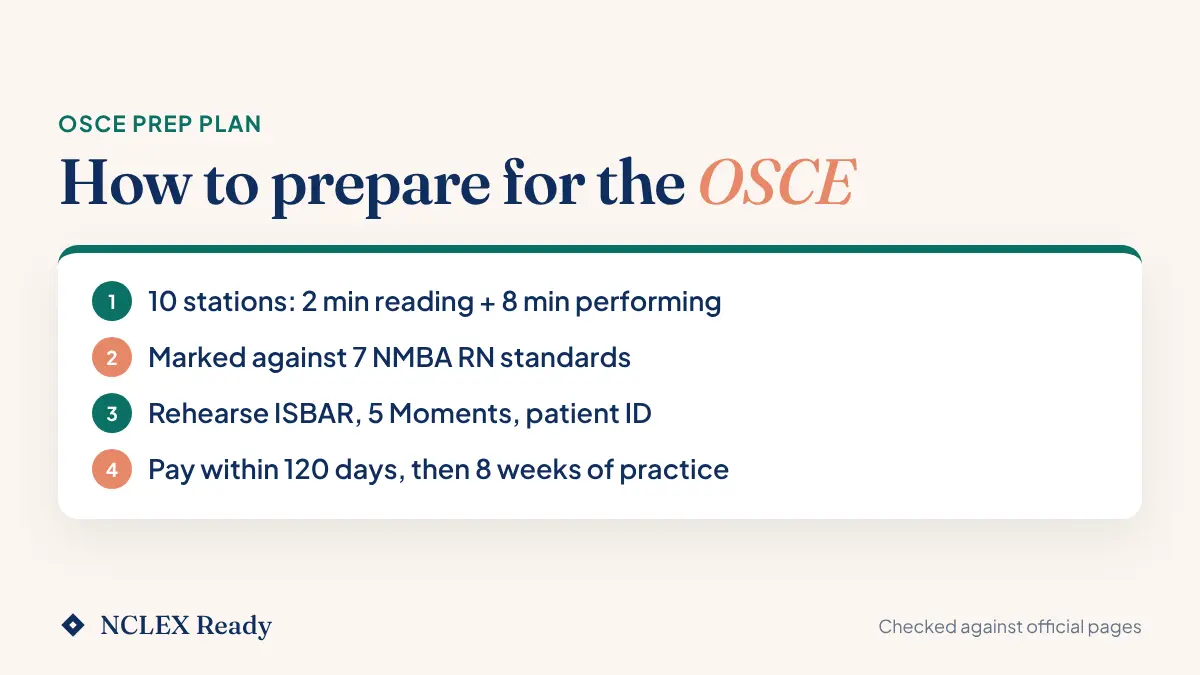
| Station format | 10 stations, each 2 minutes reading plus 8 minutes performance | RN OSCE handbook, 7 July 2026 |
| What marking is mapped to | The NMBA Registered nurse standards for practice (seven standards) | NMBA RN standards |
| Level expected | At least that of a graduate RN from an NMBA-approved Australian program | RN OSCE handbook |
| Communication | Assessed in every station. ISBAR named for handover | RN OSCE handbook |
| State policies | Not expected. Australian national standards are | RN OSCE handbook |
| Example charts | Published on the NMBA OSCE page | NMBA OSCE page |
| Time to pay the fee | 120 days from when your case is set to the OSCE stage | NMBA OSCE page |
| Prep courses | The NMBA and AHPRA do not endorse any | RN OSCE handbook |
What the RN OSCE handbook says is assessed
The handbook is the closest thing to a syllabus you will get. Read it in full once, then keep coming back to three sections.
The skills list
The handbook says you may be tested on skills that "may include, but are not limited to":
- physiological observations and vital signs
- calculating drug dosages and medication administration
- subcutaneous and intramuscular injection
- Aseptic Non-Touch Technique (ANTT) and wound care
- in-hospital resuscitation
- safe disposal of sharps, hand hygiene and infection control practices
- therapeutic patient communication and consent
- patient identification
- intravenous therapy administration and management
- risk management in the clinical environment
The three domains
Stations are grouped across three domains of care. The handbook lists what sits in each.
| Domain | Topics named in the handbook |
|---|---|
| Nursing assessment and care planning | Vital signs, focused nursing assessment, risk assessment |
| Care delivery | Medication administration, basic life support, aseptic and ANTT principles, pain assessment and management, starting and maintaining IV fluids, blood transfusion |
| Evaluation of care | Interdisciplinary communication |
Whole-patient care
Each station tests a skill and "the candidate's ability to manage the care of a patient in a holistic manner". The handbook gives examples of what to adjust for, such as a patient's ability to understand instructions, their physical capacity, the support they have and any vision or hearing impairment. You must "demonstrate/perform the skills, not just talk about what they would do".
Settings include a hospital ward or emergency department, a GP clinic, aged care and the community. All documentation and equipment in the rooms is "common to Australian healthcare facilities".
The seven NMBA standards, turned into practice habits
The handbook says each station's marking criteria are "mapped to the Registered Nurse Standards for Practice". The NMBA standards page lists seven. Here is one habit to build for each.
| Standard | A habit to rehearse |
|---|---|
| 1. Thinks critically and analyses nursing practice | In reading time, name the one problem the station is really about before you stand up |
| 2. Engages in therapeutic and professional relationships | Introduce yourself, check identity, explain, gain consent. Every time, manikin or not |
| 3. Maintains the capability for practice | Stay inside RN scope. Ask for the second check where Australian practice expects one |
| 4. Comprehensively conducts assessments | Do a focused assessment that fits the presenting problem, then a full set of obs on the official chart |
| 5. Develops a plan for nursing practice | Say your plan out loud to the patient or colleague, in plain words |
| 6. Provides safe, appropriate and responsive quality nursing practice | Perform hand hygiene, ANTT, injections and medication checks with your hands, not your voice |
| 7. Evaluates outcomes to inform nursing practice | Reassess after you act, document in the folder and hand over |
One check before you sit. The NMBA consulted on revised RN standards from 14 January to 13 March 2026. Its past consultations page says it anticipates the new standards will take effect later this year, with advance copies published first. Look at the standards page again in the month before your exam.
Australian practice to rehearse for the OSCE
The handbook says you are not expected to know state or territory policies. You are expected to understand "relevant Australian national standards". These are the ones that come up most often at an Australian bedside.
ISBAR handover
The handbook says you may need to convey clinical information to another health practitioner or the examiner, and should be familiar with ISBAR: Introduction, Situation, Background, Assessment and Recommendation. Its reading list links the Australian Commission on Safety and Quality in Health Care ISBAR toolkit.
Practise ISBAR out loud until it is a reflex, and time yourself, because every second of handover comes out of your eight minutes. Write a short card for yourself:
- Introduction. Your name, role and ward, who you are calling, and the patient you are calling about.
- Situation. Why you are calling, and the one thing you are worried about.
- Background. Only what matters to this problem.
- Assessment. Your obs and what you think is happening.
- Recommendation. What you want, and by when.
The NSQHS Standards
The handbook names the National Safety and Quality Health Service (NSQHS) Standards twice in its reading list. The Commission's NSQHS page says there are eight standards and that the second edition is current. Five of them map neatly onto OSCE-style tasks.
| NSQHS standard | What it looks like at the bedside |
|---|---|
| Communicating for Safety | Patient identification, structured handover, documentation |
| Medication Safety | Safe administration and monitoring, and explaining medicines to the patient |
| Comprehensive Care | Risk screening, including falls and pressure injuries |
| Recognising and Responding to Acute Deterioration | Spotting a change in obs and escalating promptly |
| Preventing and Controlling Infections | Hand hygiene, ANTT, sharps and waste |
Patient identification
Under the Communicating for Safety Standard, organisations require at least three approved patient identifiers when care, medicines or other services are given, and at handover, transfer and discharge. Which identifiers are approved is set locally, so in practice sessions check three identifiers against the wristband and the chart every time. Make it so automatic that you do it on a manikin without thinking.
Hand hygiene: the 5 Moments
Hand Hygiene Australia, which the handbook lists, uses the World Health Organization's "My 5 Moments for Hand Hygiene" approach. The HHA 5 Moments page names them as:
- Before touching a patient
- Before a procedure
- After a procedure or body fluid exposure risk
- After touching a patient
- After touching a patient's surroundings
In a station, perform hand hygiene at each moment. Saying "I would wash my hands now" is not the same as doing it.
Medication safety
Some stations may include a second RN in the room for checking medicines, according to the handbook. Treat that person as a real colleague. Ask for the check, read out what you are checking and wait for them to confirm.
Reference materials can be provided inside stations, including Australian Medicines Handbook printouts. You must not mark or write on them. Practise finding a drug quickly in the AMH format, and practise dose calculations on paper without a phone.
The Commission's National Inpatient Medication Chart (NIMC) is designed to standardise how medicines information is presented. The NMBA's published RN example charts do not include a medication chart, so do not assume a particular form. Learn the Australian generic names you will read on any chart, using our list of Australian drug names and terms.
Recognising deterioration and escalating
The Recognising and Responding to Acute Deterioration Standard aims to ensure deterioration "is recognised promptly and appropriate action is taken". The NMBA example charts include adult and paediatric observation charts, so plot obs on them and practise deciding what you would escalate.
The name of the call and its triggers vary by facility, whether it is a MET call or another rapid response name. In practice, follow the escalation instructions printed on the chart you are using, and state clearly who you are calling and why.
Communication, consent and documentation
The handbook lists what examiners look for in communication. It includes explaining care clearly, involving the patient in decisions, seeking and obtaining informed consent, active listening, dealing with an anxious person or relative, clear discharge instructions and clear documentation.
Documentation goes in the blue patient record folder inside the room. Notes on the notepaper you use during reading time are not marked. Write dates in the Australian day/month/year format, such as 1/10/2026.
An 8-week OSCE preparation plan for nurses in Australia
There is no official study length. These dates from official sources shape the plan:
- AHPRA emails your NCLEX result within six weeks.
- You then have 120 days to pay the OSCE fee from when your case is set to the OSCE stage, or the case is closed.
- The handbook says OSCE offers go out by the earliest date you paid (or, offshore, the earliest date you sent your visa).
- To be emailed about a cycle, your fee (and your visa, if offshore) must be in at least three months before it.
- Your confirmation letter arrives four to eight weeks before the exam.
So pay early within the 120 days, then use the wait. Budget for the A$4,000 fee plus travel and a night or two near the venue. Our breakdown of what the OBA pathway costs has the full list.
| Week | Focus |
|---|---|
| 1 | Read the handbook in full. Read the seven standards. Download the NMBA example charts and print them |
| 2 | Hand hygiene at every moment, patient identification, introductions and consent. Drill these until they are automatic |
| 3 | Full set of obs on the adult and paediatric charts. Neuro and neurovascular obs. Decide what you would escalate |
| 4 | Medication administration with a second check, dose calculations on paper, subcutaneous and intramuscular injections |
| 5 | ANTT, wound care, sharps disposal, IV fluid orders and the IV fluid order chart |
| 6 | Basic life support and in-hospital resuscitation using Australian Resuscitation Council guidance. Pain assessment |
| 7 | ISBAR handover and escalation. Falls, pressure care and mental health risk charts. Discharge teaching |
| 8 | Full mock circuits of 10 stations to time. Rest the day before |
If your confirmation letter gives you less than eight weeks, keep weeks 1, 2 and 8 and compress the middle.
How to practise with a study partner
A partner turns reading into performance. One of you plays the nurse, the other plays the patient and then the examiner.
- Write your own scenarios. Use the skills list and the three domains. A good scenario is a patient, a setting, one task and one complication.
- Run the clock. Two minutes seated reading the instructions, then eight minutes in the "room". The handbook says a bell sounds at the six-minute mark, so build that in. At eight minutes, stop, even mid-task.
- Stay seated for the full two minutes. The handbook requires it, even if you finish reading early. Use the time to plan your first three actions.
- Talk to the patient, not the examiner. Speak to a manikin as you would to a real person. Only address the examiner when the instructions ask you to present findings.
- Mark against the standards. After each run, your partner names one thing done well and one standard that was missed.
- Swap roles. Playing the patient teaches you how your explanations land.
A clear line here. The candidate rules say you must not access unauthorised copies of exam scenarios. They also say you must not reconstruct exam items from memory, and that re-enacting any part of the exam counts as disclosure. Do not use recalled stations from past candidates, online or in person. Write your own.
If you work as an assistant in nursing while you wait, ward shifts help you hear Australian handover and see local charts. Stay within your AIN role. Our guide to working as an AIN while you wait for registration covers what that role involves.
Getting ready for the day itself
The handbook asks that you be physically able, on exam day, to complete all tasks across the full range of RN practice. If you are injured or unwell after agreeing to the terms, notify AHPRA as soon as possible.
In the last week:
- Reread the handbook sections on conduct and timing.
- Practise in the clothes you will wear, bare below the elbows with short, unpolished nails.
- Do one full circuit at the time of day your session runs.
- Sleep. Ten stations in a row is tiring, and there are no scheduled breaks.
For the order of the pathway and the deadlines either side of the NCLEX, see NCLEX or OSCE first.
How NCLEX Ready can help
We do not run OSCE coaching, and the NMBA and AHPRA do not endorse any prep course, including ours. If you have not yet passed the NCLEX-RN, our free readiness test takes about 30 questions and 30 to 45 minutes, with no account needed. Our questions, case studies and flashcards use Australian clinical language, and Week 1 of any plan is free, with full access and no card required.
Frequently asked questions
What does the RN OSCE actually assess?
The candidate handbook says each of the 10 stations tests one clinical skill and how you manage the whole patient, against the NMBA Registered nurse standards for practice. Communication is assessed in every station, and written documentation is marked where a station asks for it.
Do I need to know my state's hospital policies for the OSCE?
No. The handbook says you are not expected to know specific state and territory policies and procedures. You are expected to show an understanding of relevant Australian national standards and international infection prevention and control standards.
Can I practise with real OSCE scenarios from past candidates?
No. The candidate rules say you must not access unauthorised copies of exam questions or scenarios, and that reconstructing or re-enacting exam content is misconduct. Build your own practice scenarios from the published skills list instead.
How long should I spend preparing for the OSCE?
There is no official figure. The NMBA gives you 120 days to pay the OSCE fee once your case reaches the OSCE stage, and places are offered by earliest payment date. This guide suggests paying early, then using about eight weeks of focused practice before your date.
Does the NMBA recommend any OSCE preparation course?
No. The handbook states that the Board and AHPRA do not endorse any OSCE preparation programs. Its own recommended reading list includes the NMBA standards and codes, the NSQHS Standards, the Australian Medicines Handbook, the Australian Resuscitation Council, Hand Hygiene Australia and the ISBAR toolkit.
Sources
- Registered Nurse OSCE Candidate Handbook (7 July 2026) — AHPRA and NMBA — https://www.ahpra.gov.au/documents/default.aspx?record=WD20%2f30349%5bv12%5d&dbid=AP&chksum=krcq6pDijKrhj6TZEQUMIsw0wcbCCWMzB4vo8GYPtPc%3d (accessed 20 October 2026)
- Registered nurse standards for practice — Nursing and Midwifery Board of Australia — https://www.nursingmidwiferyboard.gov.au/Codes-Guidelines-Statements/Professional-standards/registered-nurse-standards-for-practice.aspx (accessed 20 October 2026)
- Objective Structured Clinical Exam (OSCE) — Nursing and Midwifery Board of Australia — https://www.nursingmidwiferyboard.gov.au/Accreditation/IQNM/Examination/Objective-structured-clinical-exam.aspx (accessed 20 October 2026)
- Past consultations — Nursing and Midwifery Board of Australia — https://www.nursingmidwiferyboard.gov.au/News/Past-Consultations.aspx (accessed 20 October 2026)
- National Safety and Quality Health Service (NSQHS) Standards — Australian Commission on Safety and Quality in Health Care — https://www.safetyandquality.gov.au/standards/nsqhs-standards (accessed 20 October 2026)
- Communicating for Safety Standard — Australian Commission on Safety and Quality in Health Care — https://www.safetyandquality.gov.au/standards/nsqhs-standards/communicating-safety-standard (accessed 20 October 2026)
- Medication Safety Standard — Australian Commission on Safety and Quality in Health Care — https://www.safetyandquality.gov.au/standards/nsqhs-standards/medication-safety-standard (accessed 20 October 2026)
- Comprehensive Care Standard — Australian Commission on Safety and Quality in Health Care — https://www.safetyandquality.gov.au/standards/nsqhs-standards/comprehensive-care-standard (accessed 20 October 2026)
- Recognising and Responding to Acute Deterioration Standard — Australian Commission on Safety and Quality in Health Care — https://www.safetyandquality.gov.au/standards/nsqhs-standards/recognising-and-responding-acute-deterioration-standard (accessed 20 October 2026)
- National inpatient medication chart development and background — Australian Commission on Safety and Quality in Health Care — https://safetyandquality.gov.au/node/2604 (accessed 20 October 2026)
- 5 Moments for Hand Hygiene — Hand Hygiene Australia — https://hha.org.au/hand-hygiene/5-moments-for-hand-hygiene (accessed 20 October 2026)
- Hand Hygiene Australia — https://www.hha.org.au/ (accessed 20 October 2026)
- Registered nurses (IQNM examination) — Nursing and Midwifery Board of Australia — https://www.nursingmidwiferyboard.gov.au/Accreditation/IQNM/Examination/Registered-nurses.aspx (accessed 20 October 2026)
- Fees — Nursing and Midwifery Board of Australia — https://www.nursingmidwiferyboard.gov.au/Registration-and-Endorsement/Fees.aspx (accessed 20 October 2026)
Last checked against the official sources above on 20 October 2026. Rules and fees change, so always confirm on the official page before you pay or book. If you spot something out of date, tell us at hello@nclexready.com.au.
How this guide was made
Researched and written by the NCLEX Ready team, drafted with AI assistance and checked line by line against the official pages listed above. This is general information, not registration, legal or migration advice.
NCLEX Ready is an independent educational platform operated by Aromika Pty Ltd. It is not affiliated with, endorsed by, or connected to AHPRA, NMBA, NCLEX, Pearson VUE, or NCSBN. NCLEX and NCLEX-RN are registered trademarks of NCSBN, used here for descriptive purposes only.